


Pakistan broke the Indus treaty’s spirit long before India’s abeyance, says envoy Vinay Kwatra
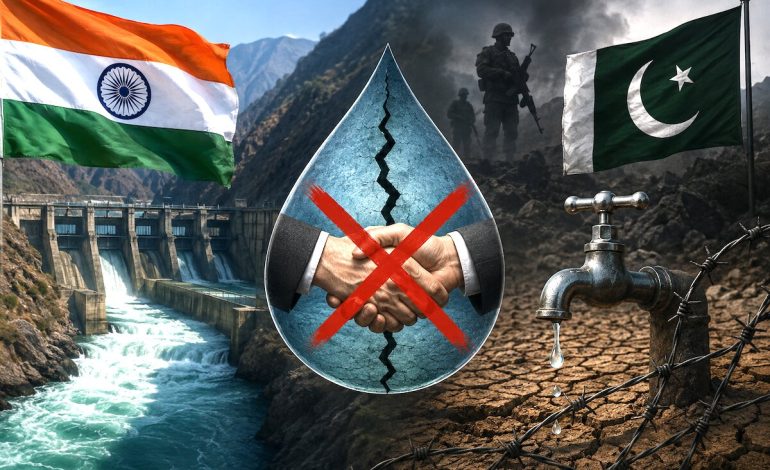
RNA Media illustration for representation.

New Delhi: India’s ambassador to the United States, Vinay Mohan Kwatra, has said the Indus Waters Treaty’s spirit of cooperation was destroyed by Pakistan’s own conduct decades before New Delhi placed the 1960 pact in abeyance. Writing in the US’s Newsweek on Saturday, Kwatra argued that the suspension announced after last year’s Pahalgam attack merely formalised a breakdown that Islamabad had been engineering since the treaty’s earliest years.
The intervention comes weeks after Pakistan convened an international conference in Islamabad to protest the abeyance, at which a former foreign minister of the country reportedly raised the prospect of war if New Delhi did not meet Islamabad’s demands on the Indus river system. Kwatra dismissed such rhetoric as a familiar diversion from Pakistan’s domestic troubles.
Treaty asymmetry and wars
The Indus Waters Treaty, brokered by the World Bank and signed in 1960, split the Indus basin’s six rivers between the two countries. India retained the three eastern rivers, carrying roughly 20 per cent of the basin’s water, while Pakistan received the three western rivers and about 80 per cent of the flow. Kwatra noted that this asymmetry held back development in Indian border regions for decades, yet India continued to honour the agreement regardless.
He set that restraint against a record of wars in 1965, 1971 and 1999, along with a string of terrorist attacks he attributed to Pakistan-based groups, including the 2001 Parliament attack, the 2008 Mumbai attacks, the 2016 Uri and Pathankot attacks, the 2019 Pulwama bombing and the Pahalgam killings of April 22, 2025. India suspended the treaty a day after that attack, in which 26 people – 25 Indians and one Nepali national – were killed by terrorists New Delhi has linked to the Pakistan-based Lashkar-e-Taiba.
It was, by most tallies, the deadliest single strike on civilians in India since the 2008 Mumbai carnage.
Kwatra also pointed to Pakistan’s alleged use of bureaucratic delay and dispute-resolution proceedings to stall Indian hydropower projects permitted under the treaty, and cited the 2012 attack on the Tulbul navigation project as an example of violence obstructing India’s treaty rights. He said Pakistan had likewise blocked Indian proposals to modernise the six-decade-old accord.
Islamabad’s conference
As RNA Media had reported, Pakistan has mounted a sustained diplomatic pushback since the abeyance took effect. At the Islamabad seminar on June 30, Pakistan’s deputy prime minister, Ishaq Dar, said India’s move violated international law and was sowing the “seeds of war” in the region. The Pakistan People’s Party chairman, Bilawal Bhutto-Zardari, went further, tying the water dispute directly to the country’s military preparedness. Pakistan’s army high command, under the country’s army chief, Field Marshal Asim Munir, backed that position after a Corps Commanders’ Conference in early July.
Islamabad has also taken the dispute to multilateral forums. Pakistan’s prime minister, Shehbaz Sharif, told a glacier-preservation conference in Dushanbe that his government would “never allow the red line to be crossed”, while Pakistan’s UN envoy, Asim Iftikhar Ahmad, cited a court of arbitration award from May that reportedly found limits on India’s water-control powers under the treaty. India has rejected the court’s jurisdiction outright and shows no sign of revisiting the abeyance.
New Delhi’s position has remained consistent through the yearlong standoff. The External Affairs Ministry spokesman, Randhir Jaiswal, reaffirmed in early July that the treaty would stay frozen until Pakistan takes credible action against cross-border terrorism, echoing the line the prime minister, Narendra Modi, set out last year: “Terror and talks cannot go together … water and blood cannot flow together.”
Kwatra used his article to challenge Pakistan’s “water aggressor” framing of India, arguing that Pakistan’s water stress owes more to its own management failures than to the treaty freeze. He put the country’s on-farm water efficiency at roughly 40 per cent, with more than 30 per cent lost in transit and the remainder running unused into the sea – figures Islamabad has not directly disputed in its own statements.
India, meanwhile, has pressed ahead with infrastructure on the western rivers previously reserved for Pakistan’s use, including the Chenab-Beas link tunnel and an expanded Ranbir canal, and has stopped sharing hydrological data with Pakistan’s Indus commissioner, moves Pakistani commentators say have sharpened the sense of urgency in Islamabad.