



L&T signs Middle East gas contract worth over ₹15,000 crore. Why deal is a strategic win for India
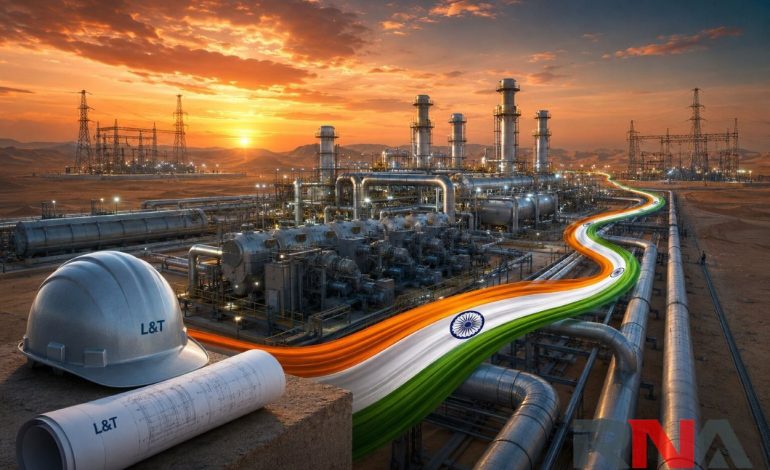
RNA Media illustration for representation.

New Delhi: Larsen & Toubro has signed a contract valued at more than ₹15,000 crore to build an extensive gas-compression complex for an undisclosed client in the Middle East, marking another major overseas success for India’s largest engineering and construction group. Beyond its financial size, the project demonstrates that an Indian company can compete for and execute technically demanding energy infrastructure contracts that were once dominated by western, Japanese and South Korean contractors.
The contract was signed by L&T Energy Hydrocarbon Onshore against a letter of award issued during the 2025–26 financial year, the company announced on Monday. L&T classifies contracts exceeding ₹15,000 crore as “ultra-mega”, although it has not disclosed the precise value, location, client or completion schedule.
The project will be implemented on an engineering, procurement and construction, or EPC, basis, placing responsibility for the integrated delivery of the facilities with L&T. Its scope includes gas-inlet facilities, compression systems, condensate and produced-water handling units, propane-refrigeration systems and associated utilities.
The new installations will process sour gas, which ordinarily contains hydrogen sulphide and may also have substantial concentrations of carbon dioxide. Such gas is corrosive and toxic, making its processing considerably more complex than conventional natural-gas handling and requiring specialized materials, safety systems and treatment technologies.
Gas-compression plants maintain the pressure required to process and transport gas as it moves from producing fields through treatment facilities and pipelines. Their importance rises as reservoir pressure declines or when gas must be moved across large processing networks without compromising throughput.
L&T’s power transmission and distribution business will separately build two 230-kilovolt extra-high-voltage substations to supply the complex. The arrangement gives the Indian conglomerate responsibility for both the hydrocarbon-processing facilities and a critical part of their supporting electricity infrastructure.
The senior vice-president and head of L&T Energy Hydrocarbon Onshore, ES Sathyanarayanan, said the project would add substantial gas-compression capacity and utility infrastructure. He said the award drew on the company’s experience in executing large hydrocarbon installations and underlined its ability to deliver integrated systems for difficult sour-gas applications.
L&T Energy Hydrocarbon Onshore provides lump-sum turnkey solutions across the upstream, midstream and downstream segments of the oil and gas industry. Its portfolio covers gas-processing plants, refineries, petrochemical complexes, liquefied natural gas terminals, fertilizer units and long-distance pipelines.
The latest contract is distinct from the ultra-mega offshore awards announced by L&T earlier in August, including an order from Adnoc Offshore on August 4 and another Middle East offshore-development contract disclosed on August 17. The new project concerns onshore gas compression and further broadens the company’s substantial hydrocarbon workload in West Asia.
The Monday disclosure also needs to be interpreted accurately: it records the signing of a contract against a letter of award received in FY26, rather than necessarily representing a completely new order secured during FY27. L&T has not stated when the value entered its order book, and the full amount should therefore not automatically be treated as fresh inflow for the current financial year.
Why the contract is strategically important for India
The importance of the project extends well beyond the immediate addition to L&T’s business pipeline because it validates India’s ability to export complex, high-value engineering services. Winning a contract of this scale in the competitive Middle Eastern energy market places Indian engineering alongside the world’s established EPC majors in a sector where technical performance, safety and delivery records heavily influence procurement decisions.
Sour-gas projects carry particularly high entry barriers because hydrogen sulphide demands advanced metallurgy, corrosion control, continuous monitoring and stringent worker-safety systems. Successful execution would strengthen L&T’s credentials for similar developments across Saudi Arabia, the United Arab Emirates, Qatar and other gas-producing markets.
The project also represents a high-value export of Indian project-management and engineering capability rather than a conventional merchandise export. Revenue earned overseas can support India’s services receipts and create opportunities for Indian engineers, designers, equipment suppliers and specialist contractors, although the domestic benefit will depend on the contract’s sourcing and local-content requirements.
Large Gulf energy companies increasingly require international contractors to procure locally, train domestic workers and build supply chains in the host country. Consequently, the entire ₹15,000-crore-plus value will not flow back to India, but design work, project supervision, specialist procurement and corporate earnings could still generate substantial domestic economic value.
For New Delhi, the contract adds a commercially important layer to India’s expanding engagement with West Asia. Indian companies are no longer participating in the region principally as manpower suppliers or subcontractors; they are increasingly assuming responsibility for complete power, transport, hydrocarbon and urban-infrastructure systems.
Gas projects are also gaining prominence as Middle Eastern economies attempt to meet rising electricity, industrial and desalination demand while reducing the direct burning of oil for power generation. The International Energy Agency forecast that combined gas demand in Africa and the Middle East would grow by 3.5 per cent in 2026, driven by greater consumption in industry and the power sector.
That investment cycle creates a long-term opening for Indian companies in gas processing, pipelines, electricity networks, petrochemicals and associated infrastructure. A successful project can lead to repeat orders because energy producers generally favour contractors with proven experience of their technical standards, procurement systems and safety requirements.
The deal does not, however, directly improve India’s energy security because L&T has not said that any gas from the project will be supplied to India. Its strategic benefit lies instead in strengthening an Indian industrial champion, deepening commercial ties with a region central to India’s energy interests and increasing the country’s presence in global infrastructure supply chains.
The order is especially consequential because overseas business has become central to L&T’s growth. Its order book stood at ₹7.40 lakh crore on March 31, 2026, with international contracts accounting for 52 per cent; about 78 per cent of that international backlog came from the Middle East.
That concentration is both a strength and a vulnerability. It gives L&T access to some of the world’s largest infrastructure budgets, but it also increases exposure to regional conflict, shipping disruption, delayed payments, labour constraints and fluctuations in construction and equipment costs.
Execution will therefore matter as much as the headline contract value, particularly if the agreement is based on fixed-price or lump-sum terms that leave the contractor carrying much of the cost and schedule risk. Nevertheless, the award is a significant endorsement of Indian engineering capability and evidence that India’s strategic economic footprint in West Asia is expanding through technology, capital projects and industrial expertise – not merely through energy imports.