


India won’t finalize the US trade pact until Washington matches rival tariffs, says Goyal
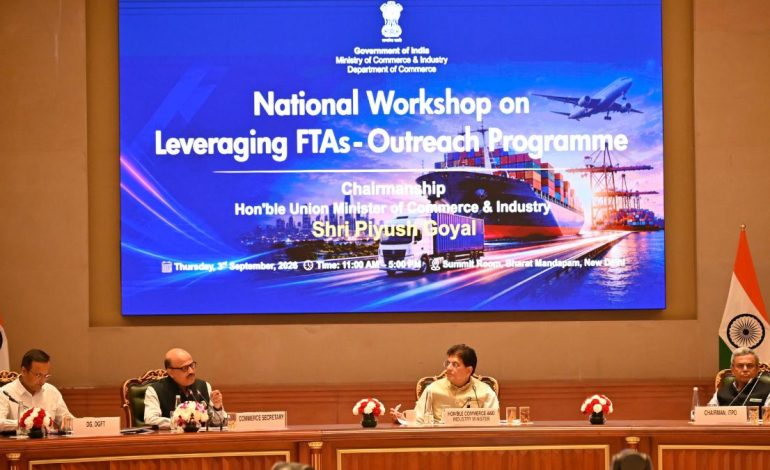
Piyush Goyal addresses the National Workshop on Leveraging FTAs, urging industry to turn India's expanding trade access into real export growth. Image credit: X/@PiyushGoyal

New Delhi: India will not announce the final details of its Bilateral Trade Agreement (BTA) with the US until Washington offers Indian exporters tariff terms that match or beat those given to rival economies. The commerce and industry minister, Piyush Goyal, said this on Thursday at a workshop on free trade agreements in New Delhi.
He added that the broader framework of the deal is largely settled and only this piece remains outstanding.
“As soon as the US is able to give us the preferential rate in comparison to our competition, we will finalize the BTA and announce the final details,” Goyal said. He named New Zealand and the European Union as the next trade pacts due to go live, ahead of the US deal.
Why the deal is still on hold
India and the US announced a framework for an interim trade agreement in February, under which Washington set a reciprocal tariff of 18% on a range of Indian goods, including textiles, leather and footwear, and dropped an earlier 25% tariff tied to India’s Russian oil purchases. India, in turn, agreed to cut or eliminate tariffs on several US industrial and agricultural products.
The US trade representative, Jamieson Greer, visited New Delhi in June to review the agreement’s remaining pieces, including market access, digital trade and non-tariff barriers, with both sides reporting substantial progress. Since then, the US has added a fresh 10% tariff on several countries, including India, from July 24, which pushed negotiations into another round.
India’s sticking point isn’t the tariff rate in isolation, it’s how that rate compares with what Washington offers competing exporters. According to reports, Goyal has said the deal will stay on hold unless the US gives India “some competitive advantage” over Vietnam, Thailand, the Philippines, Indonesia, Malaysia, China, Bangladesh and Sri Lanka.
Goyal used the textile sector to explain why this matters.
India has for years struggled to compete with Bangladesh and Vietnam in the US market, since both enjoy preferential access there through least-developed-country status or existing trade pacts, while Indian goods have faced higher duties.
He said India has now secured better rates than competing economies in most developed markets, shifting the pressure onto Indian exporters themselves. “The ball is now entirely in our court,” Goyal said.
Taking FTAs down to the district level
Beyond the US deal, Goyal used the workshop to push a wider message: India’s trade agreements only matter if businesses actually use them. He called for the outreach programme on FTAs to reach all 780 districts, covering MSMEs, traders, first-time exporters, startups and women entrepreneurs, not just large exporters already familiar with the system.
He asked the export-promotion councils and industry associations to take FTA information down to the grassroots, and called for more sector-specific and cluster-level workshops around the country. The commerce secretary, Rajesh Agrawal, said the workshop was meant to connect stakeholders directly with the specific opportunities each trade agreement opens up for their state or sector.
Goyal also flagged support measures for exporters in harder-to-reach regions, including freight assistance for businesses in the Northeast, Jammu & Kashmir, Uttarakhand and Himachal Pradesh. He said exporters would get priority access to the government’s planned “100 Bhavya” industrial parks, with better terms for those committing to higher export volumes.
Goyal said India’s nine free trade agreements now cover economies worth about $60 trillion in GDP, giving preferential access to nearly two-thirds of global trade.
Deals still in progress – with Canada, Mexico, Chile, Mercosur, the Southern African Customs Union, the Gulf Cooperation Council and Israel, plus reviews with Asean, South Korea and Japan – could push that closer to 75%.
India is targeting $1 trillion in exports this year, roughly 16% growth. Exports between April and July reached about $317 billion, up from $280 billion a year earlier, alongside 7.8% GDP growth in the first quarter.
Goyal said the longer-term goal remains $2 trillion in exports by 2030. He argued a lower target wouldn’t create enough jobs or foreign exchange earnings for India’s push to become a developed economy by 2047.