


Delhi’s H1N1 cases cross 1,700: What is behind the rise and how is swine flu different from Covid-19?
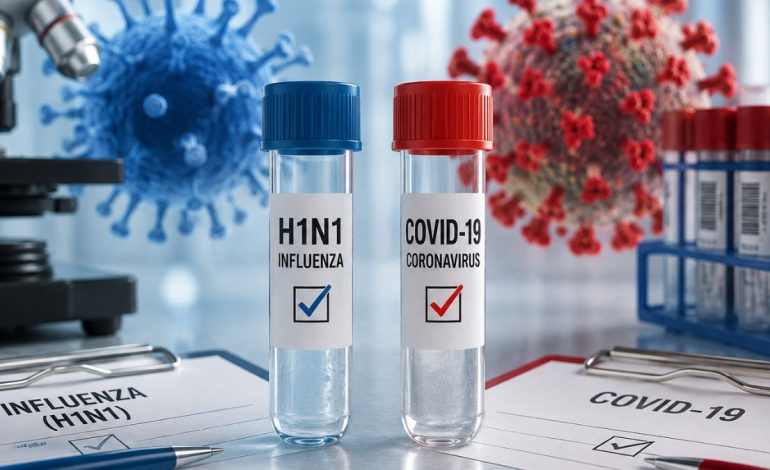
RNA illustration for representation.

New Delhi: Delhi has recorded 1,777 H1N1 infections up to August 20, compared with 229 cases last year. The sharp increase has prompted closer surveillance and preparedness, but the Indian Council of Medical Research (ICMR) has said it is not being driven by a new H1N1 strain.
The trend is not confined to Delhi. According to reports, Karnataka has reported 4,212 laboratory-confirmed influenza cases across 32 districts up to Saturday, with Bengaluru accounting for a substantial share. The state health department has described the increase as part of the usual seasonal pattern, particularly during the July-September period.
With H1N1 cases rising, another question is likely to come up for people experiencing flu-like symptoms: how do you know whether it is influenza or coronavirus disease (Covid-19)? The two infections are caused by different viruses but can begin with several of the same symptoms, making them difficult to distinguish without appropriate testing.
The numbers behind the rise
The Delhi figures show that H1N1 is accounting for a large part of the influenza burden this year. According to data cited by NDTV, Delhi had recorded 2,392 Influenza A cases by August 20, of which 1,777 were H1N1. The capital’s overall seasonal influenza tally, including Influenza A and B, stood at 2,602.
The comparison with last year is striking. Delhi had recorded 229 H1N1 cases during the corresponding period in 2025. The current figure is therefore nearly eight times higher.
According to a report citing Integrated Health Information Platform (IHIP) data, Karnataka had recorded 4,212 laboratory-confirmed influenza cases across 32 districts by August 22, compared with 4,583 cases in the whole of 2025 and 3,903 in 2024. Greater Bengaluru accounted for 2,070 cases, while Bengaluru Urban recorded 1,011.
The numbers are not directly comparable with Delhi’s H1N1 figure. However, Delhi’s 1,777 cased refers specifically to H1N1, whereas Karnataka’s 4,212 figure covers laboratory-confirmed influenza infections more broadly.
The increase has prompted a wider health-system response. On August 21, Union health minister, JP Nadda, reviewed the H1N1 situation and preparedness, including disease surveillance, testing and laboratory monitoring, as well as the readiness of healthcare facilities to manage seasonal influenza cases.
The sharp rise in cases has raised concerns about whether a new or more transmissible H1N1 strain could be circulating in India. TOI, quoting a senior scientist of Indian Council of Medical Research (ICMR), reported that no new H1N1 strain has been identified and that the increase is consistent with seasonal influenza activity.
The viruses currently circulating in India belong to the A/Missouri/11/2025 (H1N1) pdm 09-like virus group and have been in circulation since 2025, as per the ICMR scientists cited in the report. The report also identified the viruses as belonging to clade 6B.1A.5a2a and subclade D.3.1.1.
News On AIR reported, citing ICMR, that the currently circulating influenza viruses are well matched with the vaccine strains recommended for the Northern Hemisphere. ICMR has described seasonal influenza, including H1N1, as mostly self-limiting, while noting that young children, older people and those with underlying health conditions face a higher risk of complications.
The strain also features in the World Health Organization’s 2026-27 Northern Hemisphere vaccine recommendations, which include an A/Missouri/11/2025 (H1N1)pdm09-like virus as the H1N1 component.
Why are cases rising now?
In Karnataka, health authorities have pointed to the state’s normal seasonal influenza cycle. Influenza activity there generally has two peaks, one between January and March and another between July and September. The current increase therefore coincides with the state’s second seasonal peak.
That does not mean there is one proven explanation for the rise across the country. Influenza transmission can vary with seasonal patterns, the viruses circulating at a particular time, population exposure and levels of immunity.
For now, authorities are treating the increase as a seasonal influenza surge while keeping surveillance in place for anything unusual.
How serious can H1N1 be?
For many people, influenza passes without major complications. But the illness can become serious, particularly for young children, older adults, pregnant women and people with underlying conditions or weakened immunity.
Doctors in New Delhi have reported patients across age groups during the current rise. Most have responded well to treatment, although some cases have developed pneumonia and, in severe instances, acute respiratory distress syndrome (ARDS), according to doctors cited by the Indian Express.
That is why the current response is not based simply on counting infections. Health authorities are also watching severe respiratory infections and hospital capacity.
H1N1 and Covid-19: Why are they so easy to confuse?
H1N1 and Covid-19 are caused by different viruses. H1N1 is a strain of Influenza A, while Covid-19 is caused by the SARS-CoV-2 coronavirus. Yet, at least in the early stages, the two illnesses can look quite similar.
Both can bring fever, cough, sore throat, headache, fatigue and muscle aches. Influenza often develops more suddenly, with fever and pronounced body aches, while Covid-19 can present with a wider range of symptoms. Changes in taste or smell have also been associated with Covid-19, although they are not experienced by everyone.
That overlap makes it difficult to identify the infection based on symptoms alone. A person with fever and cough cannot reliably assume that they have H1N1 simply because influenza cases are currently rising in Delhi.
Though, testing can establish which virus is responsible when a diagnosis is needed.
Healthcare providers use tests that detect influenza viruses or SARS-CoV-2, depending on the patient’s symptoms and clinical situation. The World Health Organization says that the considerable overlap in symptoms can make the two infections difficult to distinguish clinically, making laboratory testing useful when confirmation is required.
So while symptoms can give doctors an indication of what might be causing an illness, they cannot by themselves confirm whether it is H1N1 or Covid-19.
Influenza and Covid-19 also require different treatments. Oseltamivir may be prescribed for people with influenza who are at higher risk or have severe illness, while Covid-19 has its own antiviral treatments for selected high-risk patients. Antibiotics do not treat either infection unless a bacterial infection is also present.
For mild illness, rest, fluids and symptomatic care may be enough. Difficulty breathing, chest pain, confusion, unusual drowsiness or worsening symptoms should prompt medical attention, particularly among older people, young children, pregnant women and those with underlying conditions.
The rise in H1N1 cases is significant, but there is no evidence of a new strain. With influenza and Covid-19 sharing several symptoms, people should avoid self-diagnosing and seek medical advice if symptoms are severe or do not improve.
Delhi steps up monitoring as cases rise
The rise in influenza cases has led Delhi to tighten its monitoring and preparedness measures. According to reports, the government is conducting daily surveillance of influenza-like illness (ILI), severe acute respiratory infections (SARI) and confirmed influenza cases under the Integrated Disease Surveillance Programme.
The surveillance is to track the spread of the infection as well as cases requiring greater medical attention. The Delhi health department has also issued public guidance on Influenza A (H1N1), updated on August 20, covering precautions, symptoms and when people should seek medical care.
At the hospital level, the government has asked health facilities and district health officials to maintain screening and reporting of suspected and confirmed cases. Delhi’s health minister, Pankaj Kumar Singh told TOI that hospitals had adequate beds, doctors, medicines and essential medical equipment to deal with the current situation.