


CISF, Drone Federation of India sign MoU to strengthen counter-drone security at critical infrastructure
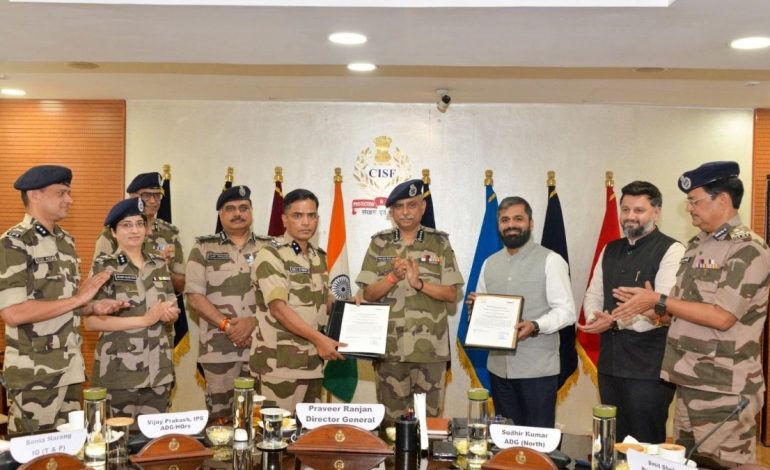
CISF, DFI Sign MoU To Boost Counter-Drone Security. Image: X/@CISFHQrs

New Delhi: The Central Industrial Security Force (CISF) and the Drone Federation of India (DFI) have signed a memorandum of understanding (MoU) to strengthen the force’s counter-drone capabilities for protecting critical infrastructure. The agreement, signed on Friday, covers training, technology, applied research, deployment and preparedness. It will also support the development of the CISF Recruit Training Centre (RTC) at Behror as a centre of excellence for drone and counter-drone systems.
The partnership comes as drones grow more common and more sophisticated, creating new aerial security challenges for vital installations. CISF currently guards more than 370 units across India, including installations linked to aviation, nuclear power, space and oil refineries.
The force has already incorporated drones into its operational activities. According to a statement issued by the force, more than 3,000 CISF personnel have been trained in drone and anti-drone protocols, while about 80 units use drones for continuous monitoring, threat detection, and training. CISF has also developed a team of domain experts working on adopting drone technology within its operational framework.
The MoU seeks to take these capabilities further by establishing a more structured system for counter-drone operations. DFI will facilitate engagement between CISF and Indian drone startups and technology companies, with the aim of supporting capacity building, applied research and operational preparedness.
The collaboration will include the development of standard operating procedures (SOPs), deployment frameworks and pilot projects for counter-drone systems at CISF-protected establishments. The two sides will also work on drone forensics by developing best practices and indigenous tools for the analysis, investigation and post-incident assessment of rogue drone activity.
Another component will involve controlled red-teaming exercises and joint drills. These will test the force’s ability to detect and track unauthorized drones, respond to an intrusion, manage escalation and remain prepared after an incident. The partnership will also cover dynamic training modules, student hackathons and challenge programmes dealing with operational practices, regulations and evolving threat scenarios.
CISF director general, Praveen Ranjan, said the agreement would help the force build RTC Behror into a specialized centre for drone and counter-drone capabilities. He said, “This MoU is particularly important for the CISF as we are working towards developing RTC Behror as a Centre of Excellence in the field of drones and counter-drone systems.”
He added that the partnership would allow CISF to test its preparedness against realistic and evolving drone threats and identify gaps in its existing systems, procedures and response mechanisms.
The MoU was signed by CD Naik, deputy inspector general, principal of MPRTC Behror, on behalf of CISF, and DFI president Smit Shah. CISF director general Praveer Ranjan, additional director general (ADG) north Sudhir Kumar and ADG Headquarters Vijay Prakash were among the senior officers present, while DFI representatives including director Shirin Joshi, associate director Shivangi Prakash and chief of staff Sama Sehgal attended the ceremony.
Shah said the partnership would help to connect operational requirements with India’s domestic drone industry. “The Indian drone industry is fully committed to supporting the CISF in safeguarding the nation’s critical infrastructure,” Shah said.
He said the collaboration would involve testing startup capabilities in realistic scenarios, developing forensic tools and creating specialized training platforms. He described these efforts as steps towards a technologically resilient and “Aatmanirbhar” security architecture.