US thwarts missiles fired at Kuwait, Bahrain; Iran says Israel must exit Lebanon for peace deal
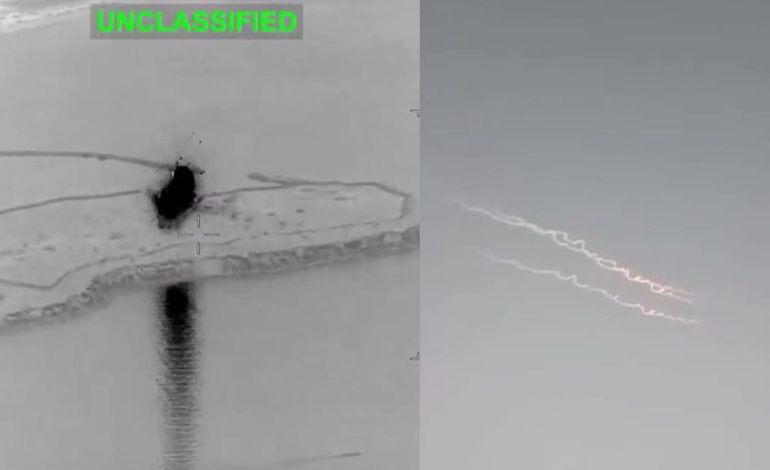
The United States says it intercepted Iranian missiles and attack drones aimed at the Gulf region, while tensions over Lebanon, the Strait of Hormuz and the future of US-Iran negotiations continue to complicate efforts to end the wider West Asia conflict. Image courtey: X.com/@BashaReport

New Delhi: Iran fired seven ballistic missiles toward Kuwait and Bahrain, which were intercepted on Friday, just hours after the US military said it had thwarted “one-way attack” drones earlier in the day. US Central Command (CENTCOM) posted on X that it intercepted six of the Iranian missiles, while one “did not reach its intended target.” The missiles were directed towards the two Gulf neighbours of Iran and the Strait of Hormuz.
“The attack drones posed an immediate threat to regional maritime traffic. US forces subsequently struck Iranian coastal surveillance radar sites in Goruk and on Qeshm Island to defend against future maritime attacks,” CENTCOM said in an X article on Saturday. “There are currently no reports of harm to US personnel, and Iranian claims of damaging US 5th fleet headquarters in Bahrain are false,” it said. “CENTCOM forces remain vigilant and postured to continue responding to unwarranted Iranian aggression in self-defense,” it added.
War will end when fighting stops in Lebanon: Iran
Meanwhile, Iran extended its support to Hezbollah, a Lebanon-based armed group seeking Israel’s annihilation, and demanded that Tel Aviv withdraw its forces from southern Lebanon. Tehran said the military conflict between Israel and Hezbollah was hampering a peace deal between Iran and the US.
Iran also noted that a ceasefire between Israel and Hezbollah was a must for it to enter a deal to end the war in West Asia and to reopen the Strait of Hormuz. “The war will end only when it ends in Lebanon as well,” Iran’s foreign minister Abbas Araghchi told Al Mayadeen, a Lebanese television station, on Thursday.
The war, which began on February 28, has entered its fourth month. Since the war began, Iran has imposed a blockade of the Strait of Hormuz, a narrow waterway through which energy cargo traffic passes from the Gulf region to the rest of the world.
“The end of the war in Lebanon must be accompanied by the withdrawal of Israeli forces from the territories they have occupied,” Araghchi said, soon after Hezbollah leader Naim Qassem rejected a US-brokered ceasefire agreement between Lebanon and Israel.
Hezbollah not part of Israel-Lebanon ceasefire
The ceasefire agreement between Israel and Lebanon had not provided for an Israeli withdrawal, and Hezbollah was not a party to the ceasefire talks. Israel has maintained that it would continue to hit Hezbollah in southern Lebanon if it threatened the security of the Israelis in northern Israel.
The latest fighting between Israel and Hezbollah began in early March, two days after the first US-Israel airstrike on Iran. Hezbollah entered the war in support of Iran, which is said to be funding the outfit in its military operations against Israel.
Lebanese president Joseph Aoun, meanwhile, accused Iran of using his nation as leverage in its peace negotiations with the US. “The people of Lebanon are paying the price…for the sake” of Iran, and were “fed up” with the war between Israel and Hezbollah, Aoun said in a CNN interview on Friday. “They (Iranians) are using Lebanon as a bargaining chip in their negotiations with the United States,” he said, adding that “it’s unacceptable.”
In another development, Iranian supreme leader’s adviser Mohsen Rezaei said on Friday that a potential deal with the US depended on US president Donald Trump agreeing to unfreeze $24-billion Iranian assets.
Trump says he could seize Iranian uranium, but didn’t
Meanwhile, Donald Trump told reporters on Thursday that the US forces could have seized Iran’s enriched Uranium if he had wanted, but there wasn’t a need to do so, as these stockpiles were under rubble after the storage sites were destroyed in US-Israel airstrikes in March. He said that he considered sending the military to get hold of the buried stockpile soon after the war began on February 28, but declined to do so due to risks and potential complications.
“I didn’t feel like being like Jimmy Carter,” he said, referring to the former president’s failure to rescue 52 American embassy staff held hostage in Iran in the early 1990s. “We could get it right now. I don’t think they could stop us if we wanted, but there’s no reason to. It’s entombed,” Trump said in Washington.
This was the first time Trump mentioned that he had the option of seizing Iranian enriched uranium by sending the military into the West Asian nation, and his inclination not to choose the military means for the purpose. “It’s not like Venezuela…like you go in, you’re there for a matter of minutes, and you’re out. And everybody’s waving goodbye as you take off,” he said. “This is different. You have to be there for two weeks. You’d need massive equipment. You’d have to airlift the equipment,” he elaborated.
Trump’s task to seize the Iranian uranium was dangerous, as Iran would have found out about the operation to recover the enriched uranium. Trump’s choices were to remove or destroy about 440 kg of Iran’s stockpile of 60% enriched uranium, just a few steps away from becoming weapons-grade.