




US Navy destroyer uses Helios laser to bring down four drones in counter UAS test
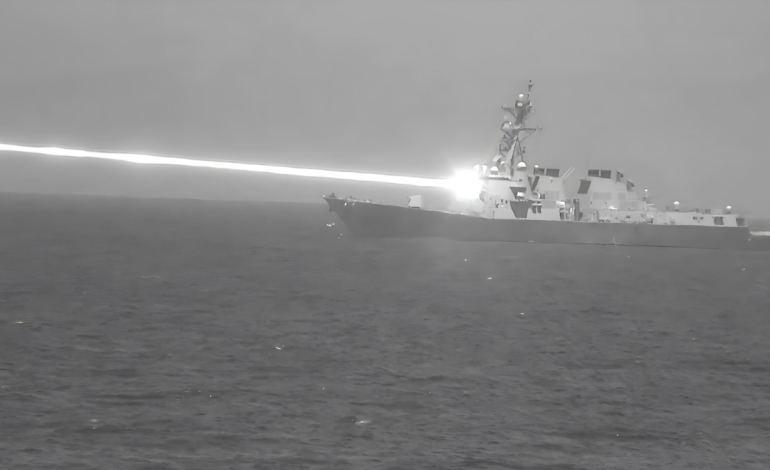
US Navy destroyer’s Helios laser downs four drones. (Image courtesy: X/@UKDefJournal)

New Delhi: A US Navy destroyer has demonstrated a new way of tackling drone threats at sea by using a high-energy laser to destroy multiple uncrewed aircraft during a counter UAS exercise. The test highlights the growing role of directed-energy weapons in defending warships while reducing dependence on costly interceptor missiles.
The demonstration involved USS Preble, an Arleigh Burke-class destroyer fitted with Lockheed Martin’s high-energy laser with integrated optical-dazzler and surveillance (Helios) system. During a navy run demonstration at sea, the laser weapon successfully neutralized four drone targets, according to Lockheed Martin.
The company disclosed the results in its latest financial update, with chief executive Jim Taiclet describing the demonstration as an example of how laser weapons could be used against incoming unmanned threats.
Unlike conventional air-defence missiles, laser weapons do not require a physical interceptor for every engagement. They use concentrated energy to damage or disable a target, potentially giving warships a more sustainable option against drones that can be deployed in large numbers.
Helios is a roughly 60-kilowatt-class laser system integrated with the destroyer’s Aegis Combat System. This allows the weapon to operate alongside the ship’s existing radar, sensors and other combat systems.
The system can perform both soft-kill and hard-kill missions. In a soft-kill role, Helios can interfere with or dazzle the optical sensors of an approaching target, while its hard-kill capability uses the laser’s energy to heat and physically damage the drone.
The successful engagement of four drones is particularly significant as navies are increasingly facing the challenge of defending ships against low-cost unmanned aircraft. Blasting every little drone with a high-end missile isn’t cheap, especially over the long haul and against multiple targets.
The use of laser weapons would provide additional means of protection for the ships as an intermediate between ordinary guns and costly surface-to-air missiles. At the same time, the efficiency of the laser weapon will be influenced by such variables as the amount of power, weather conditions, distance and capability to maintain the beam on the moving target.
For the US Navy, the demonstration of the Helios is another milestone in incorporating the weapon system into warships. The technology might complement the currently used air-defence systems making the use of costly missiles possible only against more complicated targets. or higher-value threats.
The demonstration also comes as the US military expands its focus on countering drone swarms and other low-cost unmanned systems. The ability to defeat several such targets using a ship-mounted laser could therefore become increasingly important for naval forces operating in contested environments.