




US federal court orders Marco Rubio to revive 2027 green card lottery, sets November 1 deadline
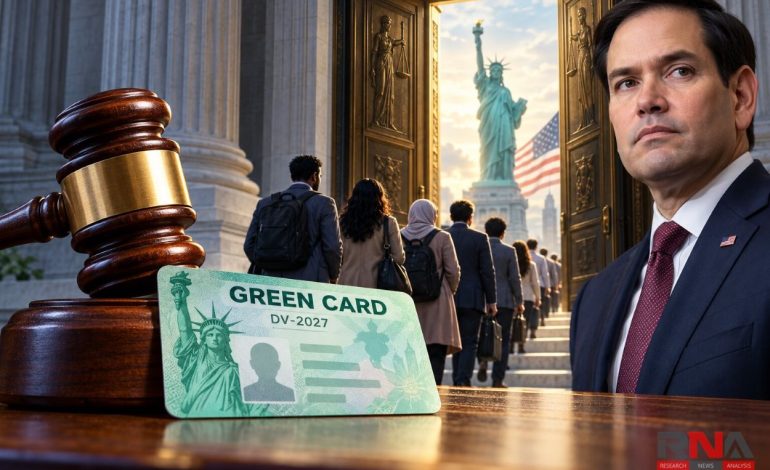
RNA Media illustration for representation.

New Delhi: A US federal judge has ordered the administration of the president, Donald Trump, to open registration for the delayed 2027 diversity visa lottery, restoring the application process for a programme that offers up to 55,000 immigrant visas annually. The ruling requires the secretary of state, Marco Rubio, and the US state department to proceed on a court-imposed timetable after their failure to launch registration threatened to effectively cancel that year’s lottery.
The district judge, Jinsook Ohta, of the Southern District of California, granted a preliminary injunction on Wednesday in a lawsuit brought by the immigration firm Red Eagle Law. Under the revised schedule, the department must announce registration details by October 29, open a 30-day entry window by November 1 and notify selected applicants by December 3.
The court’s original injunction set earlier deadlines, which were subsequently extended at the request of both parties. The announcement must specify the opening and closing dates, the electronic entry website and participation requirements, allowing prospective applicants to distinguish the court’s direction from an operational launch notice.
The dispute concerns a registration process that would ordinarily have taken place in autumn 2025, rather than a routine opening for next year. Diversity visa programmes are named for the fiscal year in which visas become available, and the DV-2027 issuance period runs from October 1 to September 30, 2027.
In a November 5, 2025, notice, the US state department said it was changing the entry process and would announce registration and selection-result dates as soon as practicable. It nevertheless retained the existing visa issuance period, meaning the prolonged registration delay has reduced the time available for successful entrants to complete subsequent formalities.
Red Eagle Law, which assists diversity visa applicants, challenged the department’s inaction in August, arguing that failing to open registration amounted to cancelling the programme in practice. Government lawyers maintained that the relevant statutory timetable had already passed and that it was too late to conduct the 2027 lottery.
Ohta’s intervention requires the process to move forward while the litigation continues; the preliminary injunction is not a final judgment resolving the entire case. It also does not guarantee permanent residence to anyone who enters or is selected, with visa applications remaining subject to eligibility requirements and processing.
The diversity visa programme is intended for people from countries with historically low immigration to the United States, with selection conducted through a computer draw. Selection provides an opportunity to pursue an immigrant visa rather than an automatic green card, and applicants must satisfy education or qualifying work-experience requirements alongside other immigration conditions.
For Indian readers, the country-of-birth rules are particularly significant: India was among the countries excluded from the published DV-2026 eligibility list because of its comparatively high immigration numbers. The reopening order does not itself change country eligibility, and applicants must consult the forthcoming DV-2027 instructions rather than assume that Indian citizenship, residence abroad or possession of an H-1B visa qualifies them to enter.
The existing instructions provide limited exceptions through an eligible spouse’s country of birth or, in specified circumstances, a parent’s country of birth. Those provisions carry detailed conditions, making the distinction between nationality and country of birth important when assessing eligibility.
Applicants will also encounter changes from the previous registration system, including a $1 electronic entry fee introduced through a September 2025 regulation. That charge is separate from the $330 diversity visa application fee payable by selected applicants who proceed to the visa stage.
A separate March 2026 regulation requires entrants, subject to limited exceptions, to supply valid, unexpired passport information and upload a scan of the passport’s biographical and signature page. The State Department has presented the requirement as a means of strengthening identity checks and countering fraudulent registrations.
The ruling comes against wider uncertainty over US immigration arrangements affecting Indian professionals and their families. As RNA Media reported on Thusrday, Washington has finalized the withdrawal of automatic employment authorization extensions of up to 540 days for several categories, including eligible H-4 spouses awaiting work-permit renewals.
That measure generally affects renewal applications filed on or after October 30, 2025, exposing affected workers to employment gaps if their existing authorization expires before renewal is approved. It removes a protection against processing delays rather than abolishing their underlying eligibility to apply for employment authorization, and the diversity visa injunction does not reverse it.
Another recent RNA Media report examined India’s objections to US restrictions on the employment-based permanent labour certification process involving several technology companies. That process, commonly known as PERM, supports many employer-sponsored green card applications and is distinct from both temporary H-1B status and the diversity lottery, so the latest ruling does not resolve those separate restrictions.
For prospective lottery entrants, the next practical milestone is the State Department’s formal registration announcement and the opening of its designated electronic diversity visa portal. Even after selection, applicants face a compressed processing period: the court-directed programme remains subject to visa availability and the September 30, 2027, fiscal-year deadline.



