



US finalizes end to 540-day work permit extensions, raising job risks for H-4 spouses
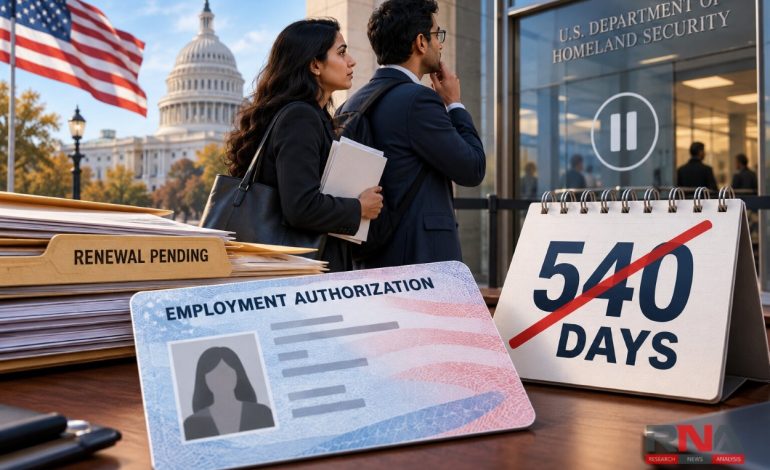
RNA Media illustration for representation.

New Delhi: The United States has finalized a rule ending automatic work permit extensions of up to 540 days for many foreign nationals awaiting renewal, leaving affected workers exposed to employment interruptions if their applications are delayed. The measure covers several categories of employment authorization document holders, including eligible H-4 spouses of H-1B workers, certain asylum applicants and people awaiting green cards.
The final rule, published in the Federal Register, took effect on Wednesday, confirming restrictions introduced through an interim rule last year. Crucially, it retains October 30, 2025, as the cutoff: renewal applications filed on or after that date generally do not attract an automatic extension simply because they remain pending.
For affected workers whose employment authorization depends on an EAD, submitting a renewal application no longer provides the previous protection against a gap after the existing authorization expires. Unless another valid basis for employment applies, they must stop working when that authorization ends and await renewed permission, even if they submitted their paperwork on time.
The withdrawn provision was an automatic extension for qualifying renewal applicants, rather than a general “grace period” available to everyone with an expired work permit. Under the earlier framework, eligible applicants could continue working for up to 540 days beyond their document’s expiry while US Citizenship and Immigration Services (USCIS) processed their renewal requests, subject to the applicable conditions.
The distinction matters for Indian professionals and their families because eligible H-4 spouses depend on EADs to work, while other affected applicants use them during the process of obtaining permanent residence. Ending the extension does not itself abolish these groups’ eligibility to seek employment authorization; it removes the protection that previously helped bridge processing delays.
The US homeland security department (DHS) has defended the change as necessary to complete updated screening and establish continuing eligibility before extending employment authorization. In its announcement of the original policy, the department argued that more frequent background reviews would help detect fraud and potential security threats.
However, the decision comes against a substantial processing backlog, making the timing of renewal decisions critical for workers and employers. According to Bloomberg Law, more than 432,000 EAD renewal applications had been pending for at least six months as of June 30, including more than 91,000 awaiting decisions for over 18 months.
The longer extension had been introduced to prevent administrative delays from forcing otherwise eligible people out of work. DHS temporarily expanded the previous 180-day allowance in 2022 and 2024, before a December 2024 regulation made the 540-day period permanent under the previous administration.
One important clarification in the latest rule concerns how early applicants can submit renewal requests. Although USCIS generally recommends filing within 180 days before an EAD expires, DHS explicitly states that an otherwise eligible Form I-765 renewal will not be rejected or denied solely because it was filed earlier – qualifying reports that describe six months as an absolute filing limit.
Existing protections are not being withdrawn across the board: qualifying automatic extensions linked to applications filed before October 30, 2025, remain subject to the earlier rules. Limited exceptions also survive where extensions are provided by law or through Federal Register notices, including certain employment documents associated with temporary protected status.
Employers must also account for the change when checking employees’ continuing right to work through the Form I-9 verification process. As the Murthy Law Firm explains, a renewal receipt for an affected application filed on or after the cutoff cannot serve as evidence of the automatic extension previously available, requiring employers to verify continuing authorization through acceptable documentation.
The policy has already faced a legal challenge from H-4 spouses, with a federal court in California granting relief to seven plaintiffs in September. In a September 11 order, the judge, David O Carter, found that DHS had not justified bypassing the normal notice-and-comment procedure when issuing the interim rule. That ruling applied to the seven plaintiffs rather than restoring automatic extensions nationwide. For other affected workers, the finalized policy leaves continuity of employment dependent on obtaining renewed authorization before their existing permission expires or qualifying for a separate basis to continue working.