
Trump-Xi summit extends trade reprieve as lavish welcome masks deep US-China divisions
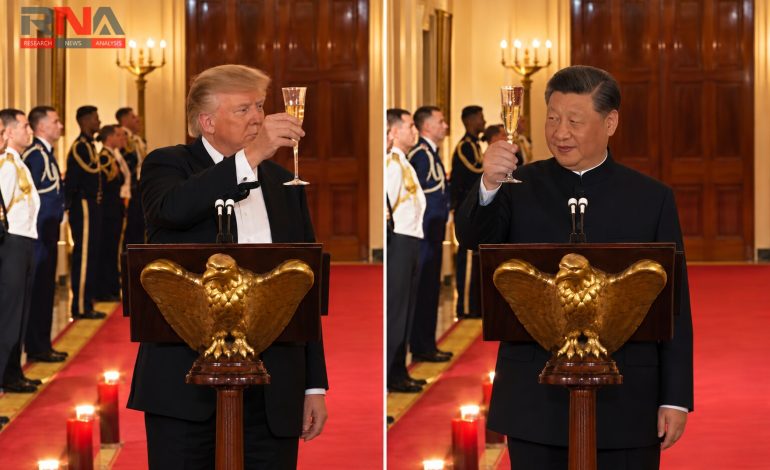
This combo image created from screenshots taken from a White House video shows Donald Trump (L) and Xi Jinping raising toasts during the state dinner hosted by The US president for the Chinese president.

New Delhi: The US president, Donald Trump, hosted the president of China, Xi Jinping, for talks on Thursday, seeking to stabilize relations strained by trade disputes, technological competition and the Iran war. An elaborate welcome and state dinner projected personal warmth, but the public account of their discussions offered limited evidence of progress towards resolving those differences.
The clearest economic development came before the summit, when the two sides agreed to extend their trade truce by two months. The US treasury secretary, Scott Bessent, said the extension would give negotiators more time to pursue an agreement, postponing another potential confrontation over tariffs.
The arrangement, reached after the leaders’ meeting in Busan in October 2025, had been due to expire on November 10 and will now continue until January 10, 2027. It preserves a negotiating window without settling the broader disputes over market access, Chinese purchases of American goods and restrictions on strategically important supplies.
The unfinished business extends to commitments announced after Trump visited Beijing in May, including proposed trade and investment boards and reciprocal tariff reductions on selected goods. Associated Press reported before the Washington meeting that implementation had been uneven, with agricultural purchases, aircraft orders and investment arrangements still requiring further work.
Xi used the Washington visit to argue that economic competition needed limits and that both countries would suffer from confrontation. He called for regular military dialogue and stronger arrangements for crisis communication, presenting the prevention of conflict as a shared responsibility.
That appeal addressed a recurring weakness in the relationship: communication channels intended to contain military incidents have themselves been disrupted by political disputes. Beijing suspended important contacts after the then speaker of the US House of Representatives, Nancy Pelosi, visited Taiwan in August 2022, while Xi’s November 2023 meeting with the then US president, Joe Biden, produced an agreement to restore several exchanges.
Taiwan remained a central point of disagreement, with China’s official account saying Xi wanted Washington to handle the issue cautiously and oppose Taiwanese independence. Reuters reported no indication that Washington had accepted that formulation, which goes beyond its established position of not supporting independence.
Artificial intelligence was another major subject, with Xi saying its development should remain under human control. Earlier discussions between the two governments had included an American proposal for a mechanism to notify each other about AI incidents, although the summit reporting did not establish that a completed arrangement had been adopted.
The concern reaches beyond commercial competition between technology companies to the possibility of automated systems triggering security crises. Ahead of the summit, American and Chinese researchers proposed safeguards around nuclear command systems, human oversight of consequential cyber operations and a hotline for incidents involving autonomous AI; these remained expert recommendations rather than government commitments.
On Iran, Chinese state broadcaster CCTV reported that Xi supported a return to the interim agreement reached during the summer as a route towards ending the conflict. Washington has wanted Beijing to use its influence with Tehran, but China has opposed the US and Israeli military campaign, leaving the two powers divided over how to secure a settlement.
The ceremonial programme nevertheless emphasized the importance both governments attached to maintaining contact, with Trump and his wife, Melania, personally welcoming Xi and his wife, Peng Liyuan, at Joint Base Andrews on September 23. The following day’s White House programme included military performances and a flyover, while Melania and Peng visited the Smithsonian National Museum of Asian Art.
After approximately 90 minutes of discussions, Trump showed Xi the presidential helicopter, Marine One, and the White House’s new helipad. He described their encounter as a “great meeting”, without immediately providing a detailed public explanation of its substantive results.
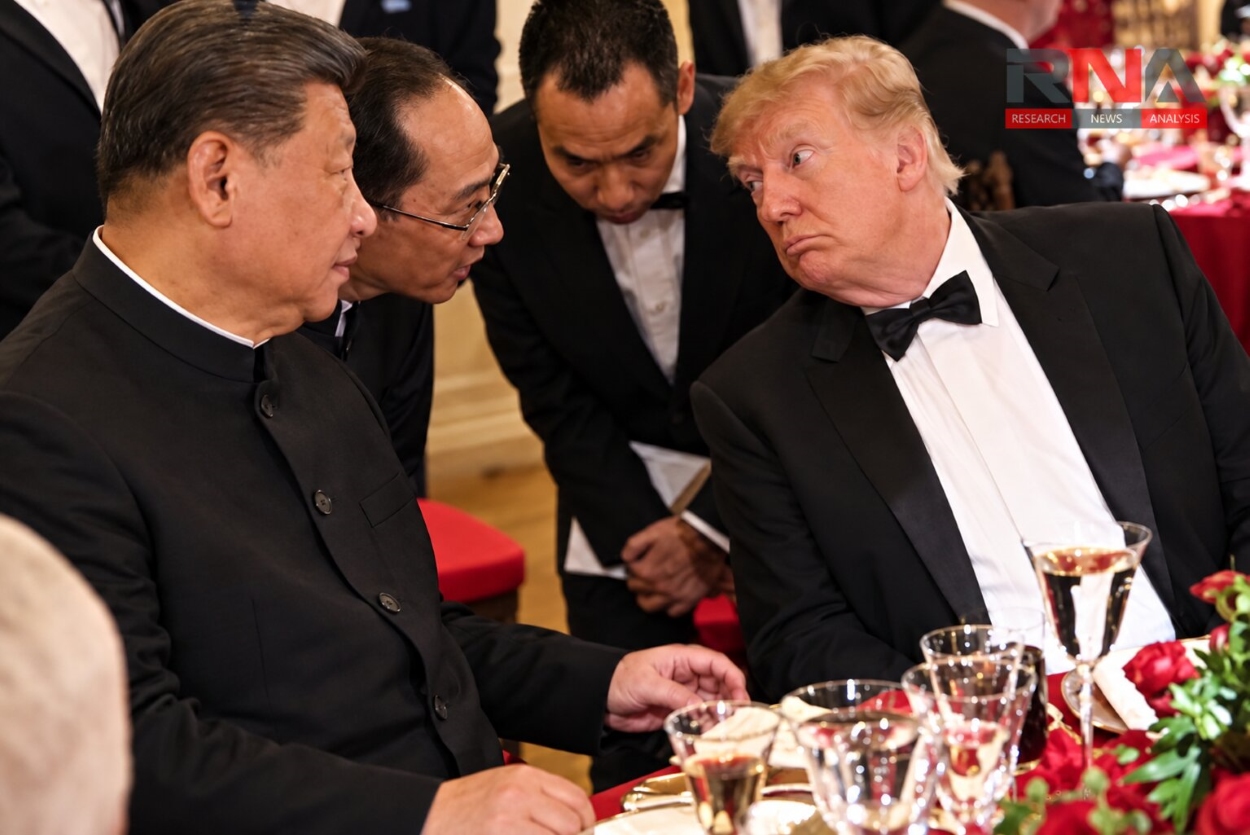
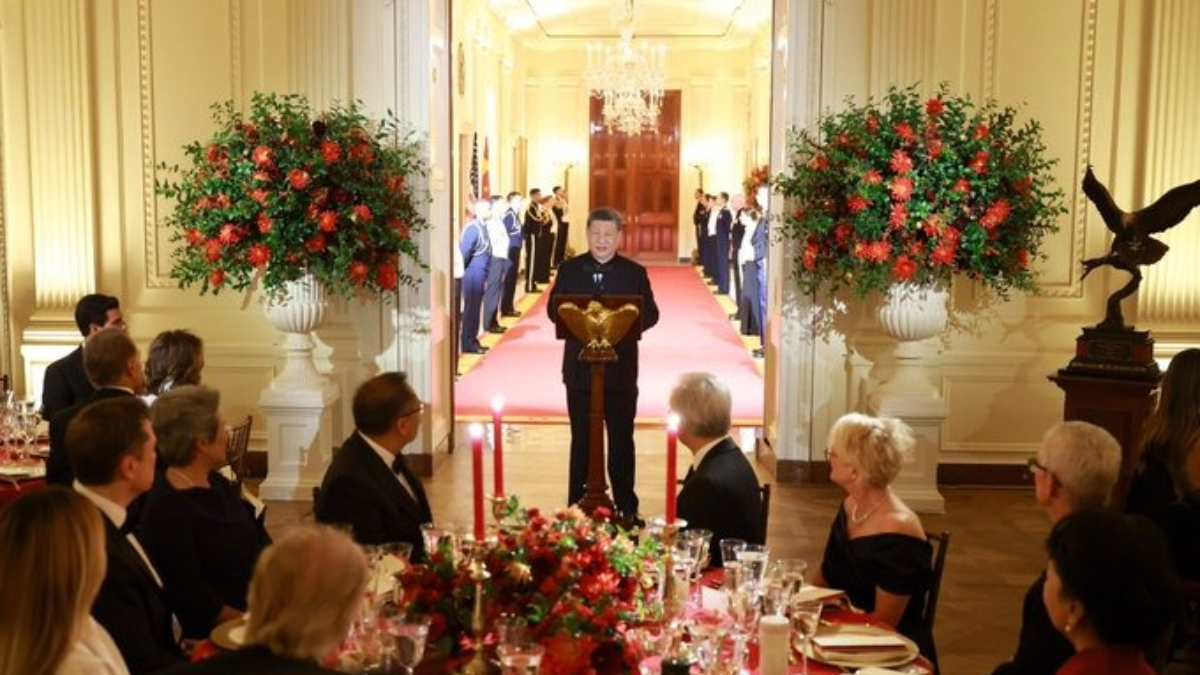
The evening’s state dinner brought the commercial dimension of the relationship into view, with guests including Jeff Bezos, Elon Musk, Sundar Pichai and Jensen Huang. In his toast, Xi suggested that America’s and China’s national ambitions could reinforce one another, while Trump presented him with an eagle statue.
The menu paired American ingredients with Chinese influences, moving from yellow squash soup with mushrooms and pancetta to sesame-crusted sea bass with bok choy and aubergine. Dessert included vanilla cremeux, sour cherry confit, walnut frangipane and ice cream made with White House honey, according to details released by the White House.
The historical references were deliberate: the sparkling-wine toast recalled Richard Nixon’s 1972 visit to China, while red table settings and flowers acknowledged Chinese cultural traditions. The couples were scheduled to conclude the visit on September 25 with tea and a tour of the National Archives, extending the diplomatic emphasis on history and personal contact beyond the negotiating table.