




Trump announces ‘massive’ Greenland resource exploration, but key details remain unclear
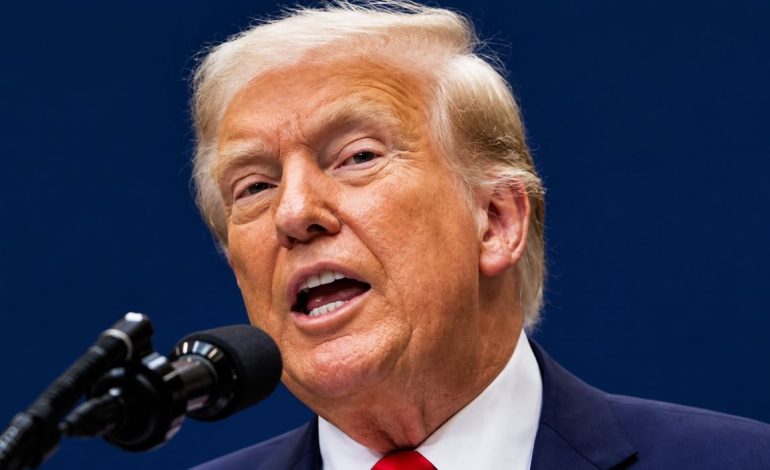
Donald Trump.

New Delhi: The US president, Donald Trump, said on late on Tuesday night (on Wednesday morning India time) that preparations were underway for extensive oil, gas and mineral exploration in Greenland, linking its resource potential to Washington’s expanding Arctic defence ambitions. He provided no operational details, while the island remains a self-governing territory within the Kingdom of Denmark and retains restrictions on new oil and gas exploration licences.
In a Truth Social announcement, Trump described the proposed activity as “massive” and referred to the island as “our new and beautiful Greenland”. He also claimed that unnamed experts considered its readily accessible oil resources exceptionally large, without identifying their assessments or providing evidence for the comparison.
The announcement left unanswered where exploration would take place, which companies would participate and when work might begin. As RNA Media had reported, the recent security agreement involving Washington, Copenhagen and Greenland did not itself grant the United States resource exploration rights.
Trump’s remarks followed the signing of a three-party defence agreement on September 22, 2026, after months of tension over his demands for American control of Greenland. The agreement expressly reaffirms Danish sovereignty and territorial integrity, alongside Greenlanders’ right to self-determination, giving no basis for treating the territory as an American possession.
The pact permits the modernization and expansion of US activities at Pituffik Space Base and provides for additional defence areas at Narsarsuaq and Mestersvig, with implementation details to be agreed between the parties. It also envisages a role for Greenland in Trump’s proposed Golden Dome missile defence system, although its entry into force depends on the completion of the necessary parliamentary procedures in Denmark and Greenland.
The security agreement was still undergoing political scrutiny shortly before Trump’s exploration announcement. Reuters reported on October 12 that a majority of Greenlandic lawmakers had indicated support during a parliamentary debate, while opposition figures questioned the financial benefits and the lack of implementation details.
A central uncertainty surrounding the proposed energy programme is Greenland’s existing licensing policy. Its government decided on June 24, 2021, to stop issuing new hydrocarbon licences, a decision subsequently recorded in an official notice from its mineral resources authority.
That restriction must be distinguished from the status of previously issued licences, which were not automatically extinguished by the decision. Anadolu’s report on Trump’s announcement noted that earlier licences remain valid, leaving open whether his remarks concerned existing exploration rights or a proposed change in policy.
Greenland’s petroleum potential has been studied for decades, but geological estimates require careful interpretation. A US Geological Survey assessment published in 2025 estimated mean undiscovered, technically recoverable resources of 7.8 billion barrels of oil and 91.9 trillion cubic feet of gas in the West Greenland–East Canada geological province.
Those figures cover a region extending beyond Greenland and describe estimated resources that have yet to be discovered, rather than established commercial reserves. Technical recoverability also does not establish that extraction would be profitable – an essential distinction when assessing Trump’s assertion that large quantities of oil are easily available.
Mineral development presents a separate set of opportunities and obstacles, particularly around rare earth deposits such as Tanbreez and Kvanefjeld in southern Greenland. A study by the Center for Strategic and International Studies identifies transport limitations, constrained electricity supplies, processing requirements and local environmental concerns as substantial barriers to developing the sector.
The two deposits also illustrate why Greenland’s mineral wealth cannot be treated as a single, immediately accessible resource. Kvanefjeld’s development has been obstructed by its uranium content and Greenland’s uranium restrictions, while Tanbreez has attracted interest for its heavy rare earths but still requires investment to turn its geological potential into a functioning supply chain.
Trump also portrayed Greenland as indispensable to American and European security, claiming that future attacks on the United States would cross the island and could be intercepted there. Its established military role is more specific: the US Space Force’s 12th Space Warning Squadron operates an upgraded early-warning radar at Pituffik, supporting missile warning and surveillance of objects in orbit.
Resource development and military security are nevertheless increasingly connected in the new agreement. A British parliamentary briefing explains that certain sensitive investments involving states or investors outside the EU or Nato would require agreement from all three parties, adding a strategic screening requirement to Greenland’s future investment decisions.
For prospective investors, including those from India, that provision could become relevant where resource projects involve sensitive infrastructure, significant influence or access to information carrying security risks. Trump’s announcement therefore raises questions extending beyond the size of Greenland’s deposits, including who can develop them, under which permissions and on what commercial terms.



