Taiwan plans 16% jump in 2027 defence budget, set to cross NT$1 trillion for the first time
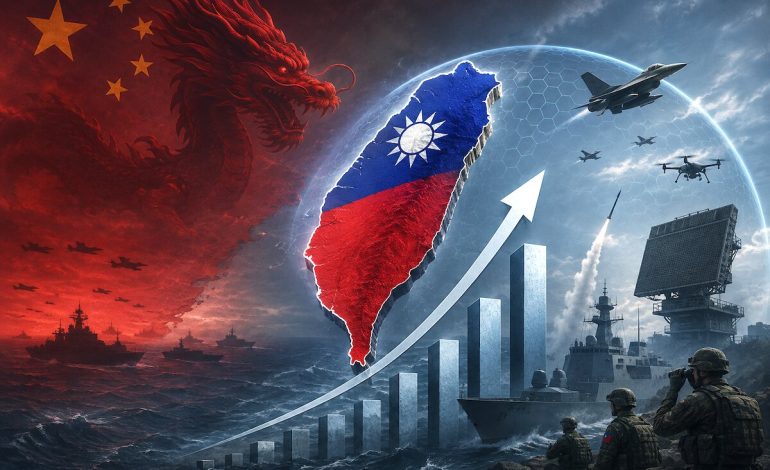
RNA Media illustration for representation.

New Delhi: Taiwan’s cabinet is set to propose a 16% rise in defence spending for 2027, taking the annual budget past NT$1 trillion (roughly $31 billion) for the first time in the island’s history, its official Central News Agency reported on August 9, 2026. The increase, to be formally unveiled on August 20, arrives as Taipei accelerates military modernization in the face of sustained Chinese pressure and repeated calls from Washington for allies to fund their own defence.
The proposed outlay, expected to top NT$1.1 trillion, covers not just the armed forces but also the coast guard, veterans’ welfare and a set of special projects, the Central News Agency said. Like this year’s budget, it will exceed 3% of gross domestic product, a threshold Taiwan had not touched since 2009 before the current administration began pushing it back up.
The president of Taiwan, Lai Ching-te, has made military build-up a central plank of his administration since taking office, repeatedly pledging bigger budgets as Beijing keeps up near-daily naval and air activity around the island. Taiwan’s premier, Cho Jung-tai, said earlier this year that the 2026 defence budget alone would touch 3.32% of GDP, with spending on military investment – largely payments for weapons bought from the United States – rising by more than 16% to NT$161.6 billion.
Four years ago, that figure sat closer to 2.5%.
Washington’s pressure, Beijing’s rejection
The United States has for years urged Taiwan to lift defence spending closer to the levels Washington now expects of its European allies within Nato, and Lai has embraced that pressure publicly. China, which claims democratically governed Taiwan as its own territory and has vowed to bring it under its control, by force if necessary, rejects any suggestion that the island’s government has a right to arm itself against Beijing.
China refuses formal contact with Lai, dismissing him as a “separatist”, a label he rejects, insisting only Taiwan’s roughly 23 million people can decide the island’s future. Beijing’s People’s Liberation Army continues to operate almost daily around Taiwan and holds periodic large-scale exercises, the most recent of which took place in late December 2025.
Beijing is hardly standing still on military spending of its own. In March 2026, China announced a 7% rise in its defence budget, to 1.91 trillion yuan (about US$283 billion) – over nine times the size of Taiwan’s proposed 2027 outlay – as it continues fielding new aircraft carriers, stealth fighters and long-range missiles.
War games, drones, delayed submarine
The spending announcement lands in the middle of Taiwan’s annual Han Kuang exercises, a 10-day drill that began on August 5 and mobilizes tens of thousands of reservists alongside active-duty troops. This year’s edition, the island’s longest yet, has for the first time put American-supplied M1A2T Abrams tanks through live-fire drills and rehearsed a mock “decapitation strike” scenario, code-named Wan Chun, in which Lai was evacuated by armoured vehicle to a fortified command centre.
Watching a coastal strike drill in Kaohsiung on August 8, Lai said each exercise added to the confidence of Taiwan’s forces. The sense of urgency traces partly to a warning, first sounded in 2021 by a former US Indo-Pacific commander and repeated in 2024 by a former CIA director, that China’s leader, Xi Jinping, has directed the People’s Liberation Army to be capable of taking Taiwan by 2027 – a timeline Lai himself has publicly acknowledged.
Whether or not Beijing intends to act on it, Taipei is budgeting as though the clock is real.
Alongside the drills, Taiwan is pressing ahead with its “T-Dome” air-defence concept and a plan to field around 100,000 drones by 2027, and continues to await delivery of its first indigenously built submarine, the Hai Kun, whose sea trials have run well past their original 2024 schedule. A separate US$14 billion American arms package and a domestic special defence budget – originally pitched at US$40 billion but pared down to roughly US$24.8 billion by an opposition-controlled parliament – remain works in progress, a reminder that domestic politics can slow even a well-backed military build-up.
Why Taiwan’s build-up matters to New Delhi
For India, a sustained rise in Taiwan’s defence spending is less about the island itself than about the wider Indo-Pacific balance it sits at the centre of. Any serious disruption to the Taiwan Strait – through which a significant share of global container traffic passes – would ripple through Indian trade, energy shipments and regional supply chains well before it touched New Delhi’s own security calculus.
New Delhi has no formal defence relationship with Taipei and is unlikely to seek one, given its own carefully managed ties with Beijing. But as Quad partners the United States, Japan and Australia recalibrate their postures around a more assertive China, Taiwan’s budget decisions offer a useful gauge of how seriously the region’s democracies now rate the risk of conflict – and how quickly that risk could reshape the Indo-Pacific security order India inhabits.