
Saudia pilot among three killed in Riyadh airport attacks as Indian airlines suspend flights
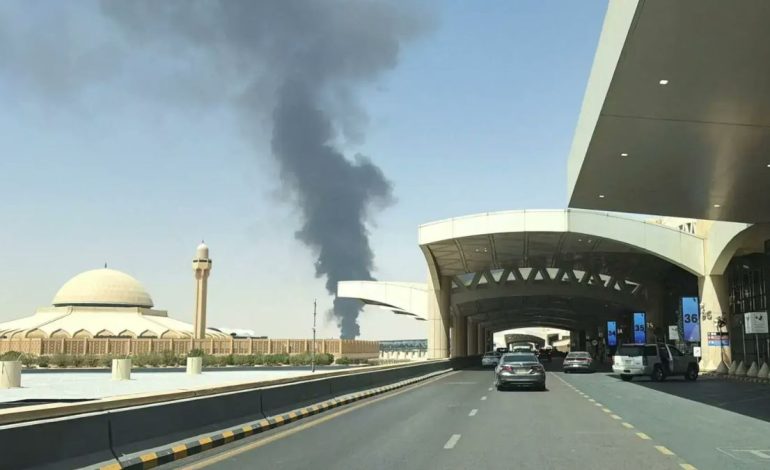
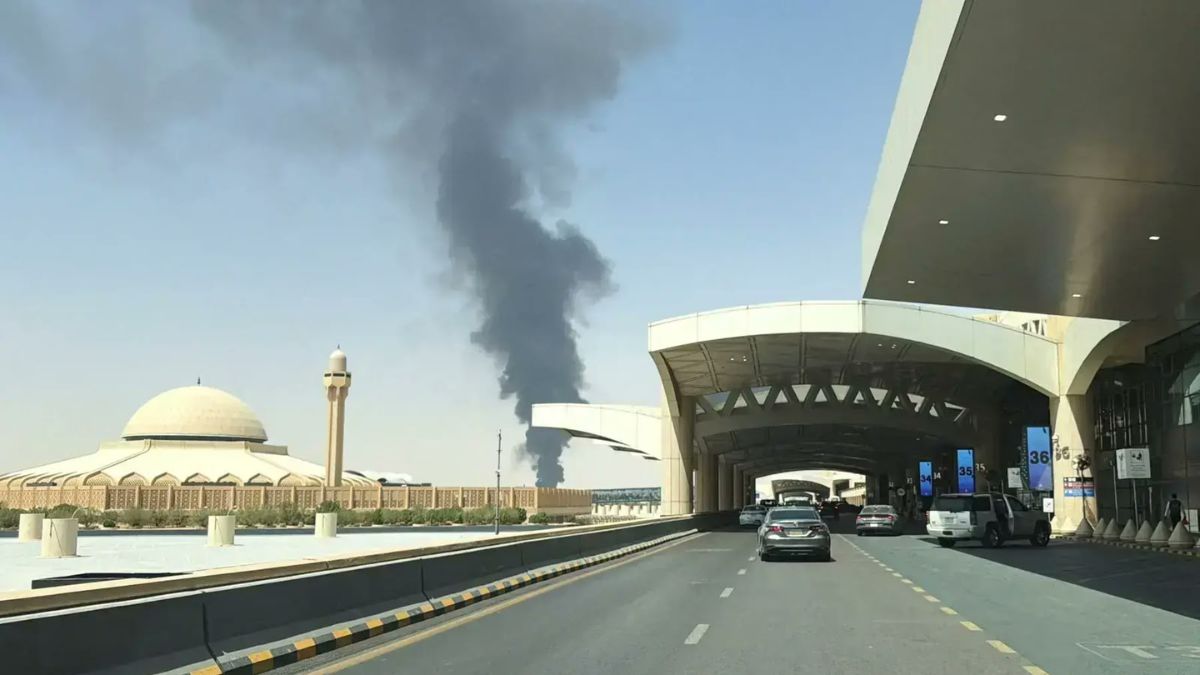
Smoke rises near Riyadh’s King Khalid International Airport after reported Houthi attacks on Saudi civilian infrastructure.(Image courtesy: X/@nathtapas)

New Delhi: Three Saudi nationals, including a Saudia pilot, were killed in two attacks on Riyadh’s King Khalid International Airport on Thursday, Saudi authorities confirmed on Friday. The strikes damaged airport facilities and an aircraft belonging to the national carrier, adding to the disruption of international flights as fighting between Saudi-backed forces and Yemen’s Houthis escalates.
Saudi Arabia’s civil aviation authority said the first attack targeted airport facilities, while the second struck a Saudia aircraft. Several Saudi citizens and foreign residents were injured, with wounds ranging from minor to severe, and were taken to hospital for treatment.
The airline identified the pilot who died as Captain Hamoud Ali Al-Kalthami and expressed condolences to his family and colleagues. It confirmed that the damaged aircraft was on the ground with no passengers aboard, but did not explain the precise circumstances of Al-Kalthami’s death.
Yemen’s Iran-aligned Houthis said they had attacked the Riyadh airport with two cruise missiles, according to Reuters’ latest report. The group also claimed strikes on Najran airport and an airbase in Khamis Mushait, although Saudi authorities had not confirmed the Najran claim.
The Saudi aviation authority’s statement did not identify who carried out the attacks, leaving the Houthi account separate from the kingdom’s confirmed findings. Saudia said airport operations had returned to normal by 6pm on October 8, several hours after the strikes.
Earlier, three people briefed on the incident told Reuters that a parked Saudia aircraft had caught fire after being hit by shrapnel from an interception or another projectile. A verified video showed flames and a thick column of black smoke rising from the airport, but the exact mechanism of the damage remained unclear.
The restoration of airport operations did not immediately reverse airline suspensions. Air India and Akasa Air cancelled Riyadh services until Saturday, while IndiGo announced cancellations until Friday and Lufthansa Group suspended its airlines’ flights through October 16.
Air India also said a Delhi-Riyadh flight returned to the Indian capital on October 8, illustrating the immediate consequences for passengers travelling between the two countries. The cancellations followed renewed Houthi threats against airlines operating in Saudi airspace.
As RNA Media had reported, India’s embassy in Riyadh issued a fresh advisory on Thursday as the security situation deteriorated. Indian nationals were advised to remain vigilant, follow local authorities’ instructions and stay indoors if required, according to reporting on the embassy’s guidance.
The latest deaths followed separate attacks on Riyadh and Abha airports reported on October 7. Saudi officials said those strikes killed a Sudanese national in Riyadh and Moroccan and Algerian residents in Abha, while injuring 36 people across the two airports.
The Houthis say their attacks are a response to Saudi support for Yemen’s internationally recognized government, whose forces are seeking to recover territory from the group. Renewed fighting has broken the relative calm that followed the 2022 truce and brought Saudi civilian infrastructure back into the conflict.
The military campaign also concerns territory along Yemen’s Red Sea coast and the Bab al-Mandab Strait, a critical maritime passage. Houthi positions there threaten shipping at a time when disruption around the Strait of Hormuz has already increased pressure on regional transport routes.
Saudi aviation authorities said emergency teams responded to both airport attacks and that damage assessments were continuing in coordination with security agencies. Their immediate priorities were passenger and worker safety, alongside maintaining the security of the kingdom’s civil aviation network.