
Russia warns Japan over US Typhon missiles ahead of Orient Shield military drills
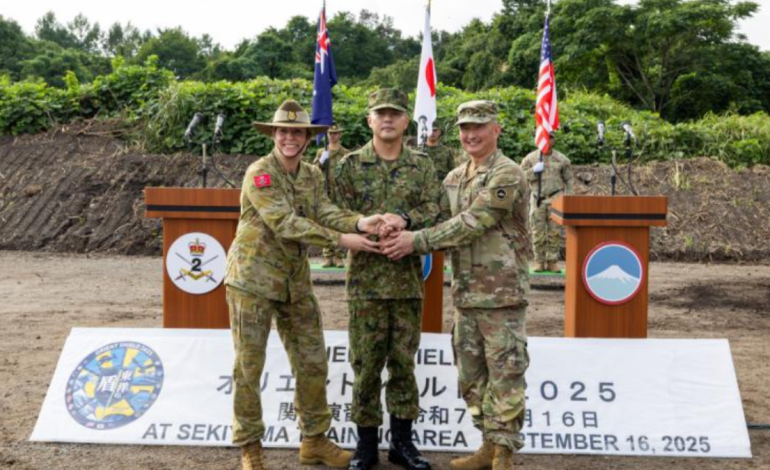
Australian Army soldier at the opening ceremony of Exercise Orient Shield 2025. (Image courtesy: Australian department of defence)

New Delhi: Russia has protested Japan’s upcoming Orient Shield military exercise with the United States and Australia, saying the deployment of US Typhon missile systems on Japanese territory poses a threat to its national security. Moscow has warned that it could take “compensatory countermeasures” in response to the drills, which are scheduled to take place from September 8 to 24.
The Russian foreign ministry spokeswoman, Maria Zakharova, said Moscow had lodged a formal complaint with the Japanese embassy. She said Russia considers military activity near its Far Eastern borders unacceptable, particularly the planned deployment of American ground-based Typhon systems during the exercise.
The exercise is expected to involve around 3,700 Japanese, US and Australian personnel, making it the largest edition of the drills so far. For the first time, the exercise will also involve the US Typhon system, which can launch Tomahawk cruise missiles and SM-6 missiles, Reuters reported.
The Typhon is a mobile, ground-based missile system designed to provide US forces with a land-based capability to launch weapons normally associated with naval platforms. Its ability to fire Tomahawk cruise missiles gives the system a long-range strike capability, while the SM-6 provides an additional missile option.
The US had already brought the Typhon system to Japan in June for joint training with the Japanese defence forces. The system is expected to take part in the September drills before being moved to a US military base in Japan around mid-October.
The Russian warning comes as Tokyo, Washington and Canberra deepen defence cooperation in the Indo-Pacific. Japan and the US have said their joint exercises are intended to improve operational coordination and interoperability, while Moscow has increasingly criticized Japan’s expanding military cooperation with the US and other partners.
Japan is also rapidly strengthening its defence capabilities, particularly around its southwestern islands. Tokyo is increasing investment in drones, long-range missiles and other standoff weapons as it responds to what it describes as growing Chinese military activity around Japanese waters and airspace.
The previous edition of Orient Shield military exercise, held from September 16 to 24, 2025, marked Australia’s first participation in Orient Shield. About 200 Australian soldiers joined Japanese and US forces in infantry assaults, live-fire training, logistics and medical evacuation exercises.
The 2025 exercise focused on improving interoperability between the three forces and testing combined operations. The 2026 edition is set to take that cooperation further by bringing the Typhon missile system into the exercise, a move that has become the main source of concern for Moscow.
Russia’s objection also comes against the backdrop of strained ties with Japan. The two countries have exchanged protests in recent weeks over military and territorial issues, adding another layer of tension to Moscow’s opposition to expanded US-Japan military activity in Japan’s Far East.