


Pentagon rebukes Canada over defence spending and F-35 review, Ottawa asserts sovereignty
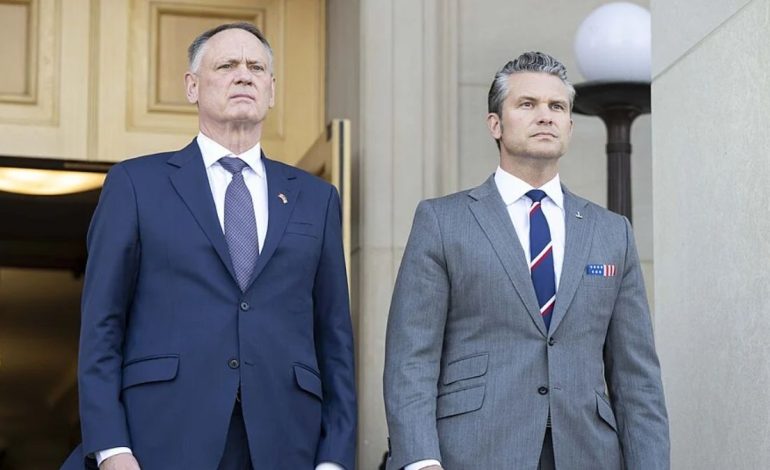
The Canadian defence minister, David McGuinty (L) and US defence secretary, Pete Hegseth (R). (Image courtesy: Wikimedia Commons)

New Delhi: The Pentagon has sharply criticized Canada over military spending, operational readiness and its review of the planned purchase of American-made F-35 fighter jets, questioning Ottawa’s credibility as a partner in defending North America. The Canadian defence minister, David McGuinty, responded on Tuesday by declaring that Canada was a sovereign nation that did not report to Washington, while reaffirming Ottawa’s commitment to Nato’s defence spending targets.
The confrontation followed an unusually blunt Pentagon fact sheet issued on Monday, accusing Canada of failing to modernize its armed forces and establish a credible, fully funded plan to meet Nato commitments. “Canada’s defense shortfalls speak for themselves. Canada must get serious and focused,” the Pentagon stated, as reported by the Associated Press.
McGuinty rejected Washington’s criticism while speaking to reporters in Ottawa the following day. “Canada is a sovereign nation. I’ll be very direct. We don’t report to the United States,” he said, maintaining that defence cooperation between the two countries remained unchanged.
Nato spending targets deepen disagreement
The Pentagon questioned Canada’s ability to meet Nato’s commitment to invest 5 per cent of gross domestic product (GDP) annually in defence and related security requirements by 2035. It accused Ottawa of postponing its largest spending increases until after the 2029 federal election and said the US defence secretary, Pete Hegseth, was “laser focused” on Canadian military modernization.
Under Nato’s agreement reached at The Hague in June 2025, members committed to allocating at least 3.5 per cent of GDP to core defence requirements and up to 1.5 per cent to broader security-related investments. The agreement provides for a review in 2029 to assess spending trajectories and evolving military requirements.
McGuinty maintained that Canada remained committed to Nato’s 2035 target, saying combined defence and security spending was expected to reach 4 per cent of GDP by 2030, compared with approximately 1.25 per cent 14 months earlier. Separately, Canada’s latest budget projects spending of 4.1 per cent by 2027-28, including 2.6 per cent for core defence, although the parliamentary budget watchdog has questioned how Ottawa will achieve the full 5 per cent target.
Ottawa has committed C$81.8 billion over five years to rebuilding its armed forces and says it reached Nato’s previous 2 per cent defence spending benchmark five years ahead of schedule. Canadian officials maintain that procurement reforms and increased investment are intended to address longstanding capability gaps.
Washington has also raised concerns about operational readiness, citing Pentagon figures showing that only 41.9 per cent of Canada’s air force fleet and 53.9 per cent of its naval fleet were serviceable during 2025-26. The department assessed army readiness at 48 per cent, highlighting equipment shortages and personnel constraints affecting military effectiveness.
The prime minister, Mark Carney, has acknowledged similar problems, including that only one of Canada’s four ageing submarines was seaworthy. His government plans to acquire up to 12 replacement submarines as part of a broader military modernization programme.
F-35 review tests bilateral defence cooperation
The Pentagon also criticized Ottawa’s reconsideration of its planned acquisition of 88 American-made F-35 fighter jets, warning that operating a mixed fleet could aggravate personnel shortages and complicate coordination within the North American Aerospace Defense Command (Norad). It accused Canadian leaders of prioritizing domestic economic considerations over military effectiveness.
Carney ordered the procurement review amid escalating trade tensions with Washington and the president, Donald Trump’s, repeated suggestions that Canada could become America’s 51st state. Ottawa has examined Swedish-made Gripen fighters as a possible alternative or supplementary option, potentially creating domestic manufacturing opportunities, although the F-35 purchase has not been cancelled.
The confrontation follows restrictions imposed by Hegseth on American military participation in certain Canadian think tank events and social engagements. Pentagon policy chief, Elbridge Colby, also suspended the US-Canada permanent joint board on defense, established in 1940, earlier this year.
The Republican senator, Mike Rounds, said the latest restrictions were not expected to disrupt joint military operations or intelligence sharing. McGuinty likewise maintained that cooperation through Norad and Nato remained unchanged despite the political disagreement.
The dispute comes as both countries confront overlapping continental defence requirements while pursuing increasingly different approaches to military investment and procurement. Its longer-term significance will depend on whether Ottawa’s spending commitments and fighter aircraft decisions can accommodate Canada’s sovereign priorities without weakening established bilateral defence arrangements.