
Ebola death toll surges in DR Congo as 12,000 cases and rebel clashes strain containment
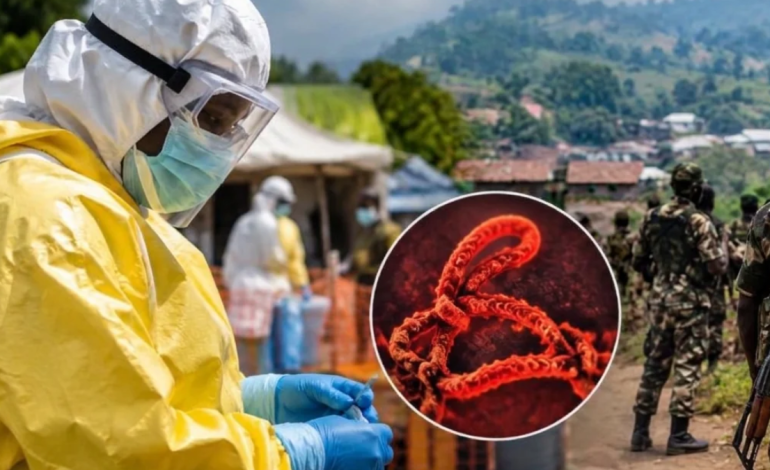
RNA Media illustration for representation.

New Delhi: Renewed fighting in eastern Democratic Republic of the Congo (DR Congo) is creating fresh obstacles for health workers battling a rapidly spreading Ebola outbreak, with medical teams struggling to reach affected communities and maintain disease surveillance. The outbreak has now recorded 12,021 confirmed infections, with nearly half of those infected dying, according to figures from the Congolese health ministry on Thursday.
The latest violence erupted on Thursday in Iga-Barrière, a mining town around 25-kilometres north of Bunia in Ituri province. Clashes between the Congolese army and the Convention pour la révolution populaire (CRP) rebels triggered fresh displacement towards Bunia, the provincial capital and an important centre for Ebola response operations.
The fighting has compounded difficulties faced by medical teams in the region. Earlier clashes had prevented response workers from accessing some communities, disrupted the monitoring of people exposed to the virus and reduced staffing at certain treatment centres, Dr Catherine Smallwood, the World Health Organization’s Ebola incident manager, told AP.
The security situation has also forced medical personnel to leave affected areas. Around 12 people, including two WHO personnel and Congolese health officials, were evacuated to Bunia on Tuesday after remaining trapped for three days inside a hospital in Akwe amid intense crossfire.
The outbreak, declared in May, is caused by the Bundibugyo strain of Ebola, for which no approved vaccine or treatment is currently available. With 12,021 confirmed infections, it has become the deadliest of DR Congo’s 17 recorded Ebola outbreaks. Its death toll is approaching the 11,000 fatalities reported during the West African Ebola epidemic between 2014 and 2016.
Besides armed violence, there are additional hurdles posed by poor road connectivity and resistance from local communities. Misinformation and mistrust have hampered health workers in carrying out essential public health operations.
Ebola is transmitted by direct contact with the blood or other body fluids of infected individuals or from the body of a person who has died of the disease. Controlling transmission requires identifying and isolating patients, monitoring people who may have been exposed and ensuring safe burial practices.
The CRP is among more than 100 armed groups operating in eastern DR Congo, a region already facing a prolonged humanitarian crisis. Founded last year by former warlord Thomas Lubanga, the group is led by a figure convicted by the international criminal court in 2012 for recruiting and using children under 15 in armed conflict.
Continued insecurity is placing additional pressure on an already difficult containment operation, as health workers face restricted access to communities at a time when the outbreak continues to expand.