
Pentagon presses arms makers to speed up weapons output as Iran war drains US stockpiles
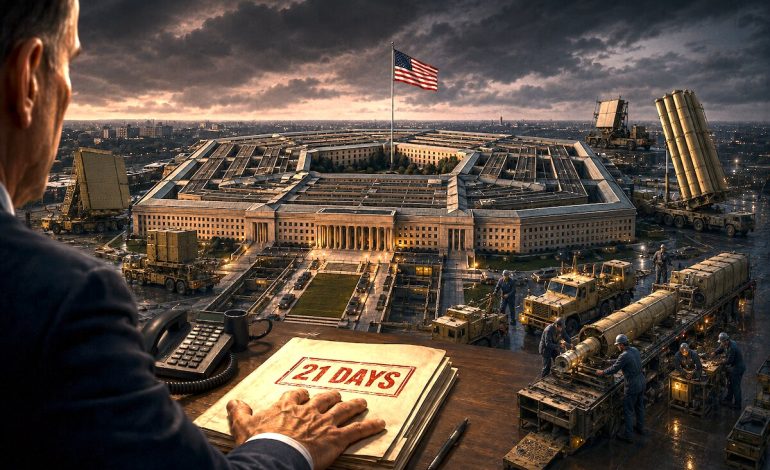

New Delhi: The US war department has ordered its top arms manufacturers to sharply accelerate weapons production, as five months of conflict with Iran have left American munitions stocks severely depleted. A memo from the country’s deputy war secretary, Steve Feinberg, obtained by the Washington Post, gave industry leaders no more than 21 days to submit plans for faster delivery schedules and higher output of critical capabilities.
The instruction, dated Wednesday, August 5, 2026, was confirmed publicly three days later. The Pentagon spokesman, Sean Parnell, said in a statement on Saturday that the department was focused on speeding up munitions acquisition to provide “the weapons our warfighters need at the pace the threat demands.” He insisted the push was part of a broader modernization drive that predated the conflict, though he did not dispute that the war had sharpened its urgency.
The scale of the depletion is stark. As RNA Media reported earlier, the Center for Strategic and International Studies, a Washington thinktank, Patriot interceptor stocks fell from 2,330 before the war to 1,030 by the time an April ceasefire took hold. Following renewed fighting since then, the stockpile has dropped further, to an estimated 759 to 827 – a fall of at least 65 per cent from pre-war levels.
Thaad interceptors have followed a similar trajectory. Numbers fell from 452 before the war to between 232 and 262 at the start of the April truce, before partial replenishment lifted the total to between 234 and 278. Even so, CSIS noted, the stockpile remains at least 38 per cent smaller than it was before the conflict began.
The thinktank warned that such shrunken inventories could force the US and its Middle Eastern partners into riskier operational choices. American forces may, for instance, launch fewer interceptors against incoming Iranian drones and missiles to conserve stock, a calculation that raises the probability of a strike getting through.
Congress, Trump at odds over numbers
The push for faster production comes as a defence spending bill remains stalled on Capitol Hill. Lawmakers, angered by the administration’s military action against Iran, have resisted a White House request to raise the Pentagon’s budget substantially, to $1.5 trillion from roughly $900 billion the previous year.
The US president, Donald Trump, has meanwhile bristled at reports of a munitions shortfall. Writing on Truth Social, on Thursday, he said the country had “massive amounts” of weaponry, adding that “large amounts are being manufactured and shipped to the US as needed.” Parnell, asked to reconcile that claim with Feinberg’s memo, affirmed on Saturday that the directive was genuine and would feed into the fiscal year 2028 budget submission to Congress.
This is not the first such intervention this year. In March, the Pentagon announced framework agreements with BAE Systems, Lockheed Martin and Honeywell to expand production of munitions and defence systems as part of what officials called putting the US military on a “wartime footing”. Those deals followed a White House meeting with executives from seven major contractors, called after Trump publicly criticised defence primes for prioritising shareholder returns – buybacks and dividends – over production performance.
The US undersecretary of war for acquisition and sustainment, Michael Duffey, told the country’s house armed services committee in early March that he was confident in the assessment of the chairman of the joint chiefs of staff, Dan Caine, that overall US munitions levels remained adequate. Five months on, with two rounds of fighting behind it and interceptor stocks still deeply reduced, that confidence appears to be facing its sternest test yet.
Recently, as RNA Media reported citing a CNN story, General Dan Caine, the chairman of the US joint chiefs of staff, has privately urged senior officials to find a way out of the war with Iran amid concerns that further bombing will not force Tehran to accept Trump’s terms.
The report said Gen Caine discussed his concerns with the CIA director, John Ratcliffe; the secretary of state, Marco Rubio; and the vice-president, JD Vance. His main worry is that continued bombing may not be enough to force Iran to accept Trump’s terms.
Lessons
For countries such as India that rely on a mix of imported and indigenous air-defence systems, the episode is a reminder of how quickly high-intensity conflict can outpace even the world’s largest defence-industrial base. Operation Sindoor demonstrated the value of layered, partly indigenous air defence.
Washington’s current scramble to refill Patriot and Thaad stocks underlines why New Delhi’s continuing push on indigenous missile and interceptor production, alongside diversified sourcing such as the S-400 units from Russia, remains strategically prudent rather than merely aspirational.