



Pakistan says 74 militants killed in major raids as insurgency grips Afghan border regions
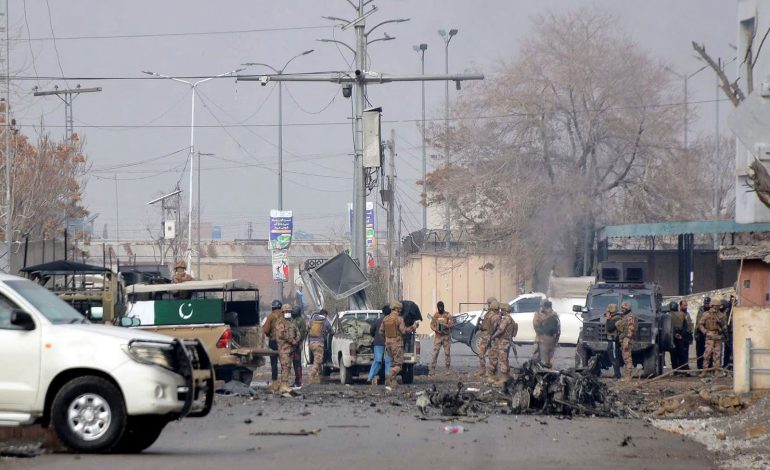
This photo purportedly shows the Shah Almas Pir Pahari checkpoint in Hangu, Khyber Pakhtunkhwa after a militant attack that killed a soldier on November 10, 2026. (Photo: X/@TareenAneesa)

New Delhi: Pakistan’s military, on Friday, said its security forces had killed 74 suspected militants in a series of counterterrorism operations across the restive provinces of Khyber Pakhtunkhwa and Balochistan, as the country struggles to contain armed groups operating near its border with Afghanistan. The operations, conducted over the preceding 10 days, come against a backdrop of persistent militant violence, deteriorating relations with Kabul and renewed accusations by Islamabad that India is supporting insurgent organizations inside Pakistan.
According to the military’s media wing, Inter-Services Public Relations (ISPR), 43 militants were killed in intelligence-led raids in Khyber Pakhtunkhwa over the previous 48 hours, with another 31 reported dead in a separate operation in Balochistan that began on November 3. The military described the raids as part of a wider campaign to dismantle militant networks and prevent further attacks on security installations, law-enforcement personnel and civilian targets.
Raids target militant strongholds in two provinces
The latest operations in Khyber Pakhtunkhwa concentrated on Mir Ali in North Waziristan district and the neighbouring Orakzai district, both of which have experienced prolonged militant activity. Pakistani forces reported killing 35 suspected fighters in Mir Ali and eight in Orakzai following exchanges of gunfire, according to Dawn.
Troops also recovered firearms, ammunition, homemade explosives and improvised explosive devices from suspected militant positions, which the military said could have been used in future attacks. Search-and-clearance operations remained under way in the affected areas, although independent confirmation of the reported militant casualties and the identities of those killed was not immediately available.
In Balochistan, security forces reported killing 31 suspected militants during an extended operation in the Kurram area of Quetta district, where troops had been targeting suspected hideouts since November 3. The military said several engagements had taken place and weapons and explosives had been recovered but did not provide independently verifiable evidence establishing the affiliations of all those killed.
Islamabad renews allegations against India and Afghanistan
Pakistan’s military identified the suspected militants using the official designations Fitna al-Khawarij and Fitna al-Hindustan, terms Islamabad employs for militant organizations it alleges have external support. It specifically accused India of sponsoring the fighters targeted during the operations, although New Delhi has consistently rejected allegations that it finances or directs terrorism inside Pakistan.
The accusations also extend to Afghanistan, whose Taliban administration Pakistan accuses of providing sanctuary to the Tehreek-e-Taliban Pakistan (TTP), commonly known as the Pakistani Taliban. Kabul denies allowing Afghan territory to be used for attacks on Pakistan, and neither Islamabad’s allegations against India nor those against Afghanistan have been independently substantiated in connection with the latest raids.
The TTP is organizationally distinct from Afghanistan’s ruling Taliban but maintains ideological and historical links with the movement that regained power in Kabul in August 2021. Its campaign has primarily targeted Pakistan’s security forces and state institutions, particularly in the country’s northwest, complicating Islamabad’s attempts to stabilize its border regions.
Deadly police ambush underscores persistent threat
The announcement followed a deadly attack on police in Kohat, Khyber Pakhtunkhwa, on November 11, when militants ambushed officers returning from an operation against illegal gold mining. Pakistani authorities initially reported that 10 policemen and 18 suspected militants were killed in the ensuing fighting, with 12 officers injured, although subsequent local accounts placed the police death toll at 11.
The TTP claimed responsibility for the ambush, which highlighted the growing intersection between militant activity and criminal enterprises in parts of Pakistan’s northwest. Police alleged that armed groups had developed links with illegal mining networks, raising concerns about criminal activities providing resources and operational opportunities for insurgents.
Militant violence remains a major security challenge
Despite the latest military operations, Pakistan continues to face an entrenched insurgency spanning its northwestern tribal districts and the mineral-rich province of Balochistan. The latter also faces a separate ethnic separatist rebellion, led principally by the Baloch Liberation Army (BLA), whose objectives and political motivations differ from those of the TTP.
According to the Pakistan Institute for Conflict and Security Studies, the country recorded 143 militant attacks in October, representing a 37 per cent decline from September’s 226 incidents. Nevertheless, the institute documented 1,376 militant attacks during the first 10 months of this year, an increase of 53 per cent compared with the corresponding period of 2025, indicating that the overall security challenge remains substantial.
Pakistan’s president, Asif Ali Zardari, and the prime minister, Shehbaz Sharif, welcomed the latest operations and pledged continued action against militant organizations. The military said its counterterrorism campaign, conducted under the government’s Azm-e-Istehkam initiative, would continue, although the latest casualty figures alone offer little indication of whether the operations have significantly weakened the militants’ capacity to recruit, reorganize and launch further attacks.


