

Pakistan ramps up Islamabad security as over 22,000 personnel readied ahead of protest marches
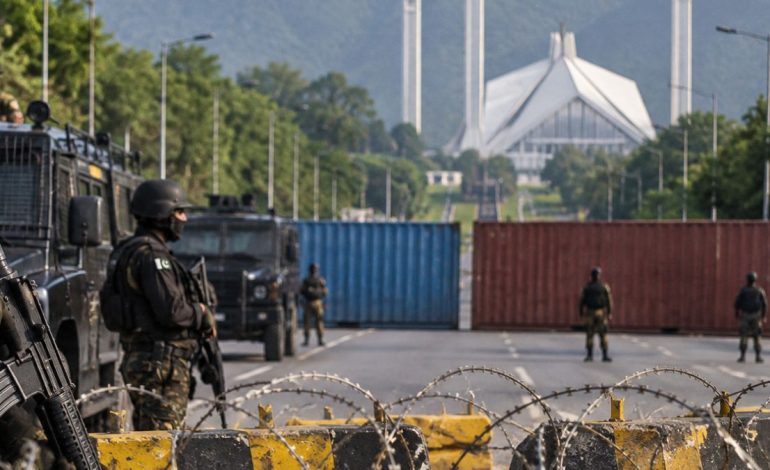
Image courtesy: AI generated picture via DALL-E

New Delhi: Pakistan has stepped up security preparations in Islamabad, Rawalpindi and Attock ahead of separate protest marches by Pakistan Tehreek-i-Insaf (PTI), Jamaat-i-Islami (JI) and Kissan Ittehad Pakistan. The government says roads and public movement must remain open, while information minister, Attaullah Tarar, has warned that groups seeking to cause violence or disruption will not be allowed to reach the federal capital.
Security plans call for more than 22,000 personnel to be deployed in Islamabad, while over 30,000 have been called for security duties in Attock, the district connecting Khyber Pakhtunkhwa with Punjab. Rawalpindi police have separately requested around 9,000 additional personnel.
Dawn reported that the Islamabad deployment would be supervised by eight deputy inspectors general, 10 senior superintendents of police, 40 superintendents and 58 deputy superintendents. Additional forces have begun arriving in Attock, while police leave in Rawalpindi district has been suspended until October 1 except in emergencies.
Containers have already been seized and positioned along highways and open spaces in Islamabad and Rawalpindi. Dawn reported that authorities have prepared plans to block entry points if required, while separate reporting has confirmed restrictions around approaches to Islamabad’s high-security red zone.
Islamabad hospitals have also been placed on high alert until September 30, with emergency staff directed to remain available, ambulances kept operational and blood banks instructed to maintain reserves as part of contingency preparations for the protest period.
The security build-up comes amid three separate protest programmes. JI launched its “Super Long March” towards Islamabad on Sunday against the petroleum development levy, with contingents travelling towards the capital from different parts of the country.
The government says it remains in contact with JI, with the information minister, Attaullah Tarar, describing the party’s leadership as peaceful and flexible while insisting that roads must remain open.
Kissan Ittehad Pakistan has announced a farmers’ march for Friday. Its leaders have raised demands including payment of outstanding sugarcane dues, a fair wheat procurement policy and minimum price, lower input costs and measures to address what they describe as worsening conditions for growers.
PTI, meanwhile, has called a nationwide protest and march towards Islamabad on September 27 seeking the release of its jailed founder Imran Khan and what the party describes as restoration of constitutional supremacy and rule of law. PTI leaders have said the protest will be peaceful.
The security preparations have been accompanied by detentions of PTI figures and members of Imran Khan’s family. Aleema Khan, sister of the former prime minister, was detained in Lahore for 30 days under the Punjab maintenance of public order ordinance, with police sources telling Dawn that she had been taken to Kot Lakhpat jail.
PTI subsequently claimed that Imran Khan’s two other sisters, Dr Uzma Khan and Noreen Niazi, along with other family members, had also been taken into custody. A PTI lawyer told Dawn that all three sisters had been arrested, although he said no detention orders had been received for Uzma and Noreen.
Tarar said on Sunday that the government would ensure roads remained open and prevent disruption to public movement. His description of possible participants as “violent groups” was a government characterization and has not been independently established.
The Islamabad high court has ruled that political parties and public office holders have no lawful right to occupy roads, highways, interchanges, toll plazas or other public places in a manner that obstructs free movement, trade or access to hospitals and educational institutions. The court also directed provincial governments not to use public resources or official machinery to facilitate protest marches towards Islamabad.
The Pakistani government has also highlighted the possible economic cost of prolonged disruption. The country’s finance minister, Muhammad Aurangzeb, said an assessment by the planning commission and ministry of finance estimated that strikes, sit-ins, marches and road closures could cost the economy around ₹120 billion a day, with services accounting for the largest share of the projected losses. The figure is a government estimate rather than an independently verified assessment.
The Islamabad police chief, Muhammad Sohail Chaudhry, has reviewed law-and-order arrangements and operational preparedness in the capital, directing officers to maintain heightened security and monitor deployments. Islamabad police has also increased checking at key points.