



New Zealand election on a knife-edge: Luxon clings to power as 400,000 votes hold the key
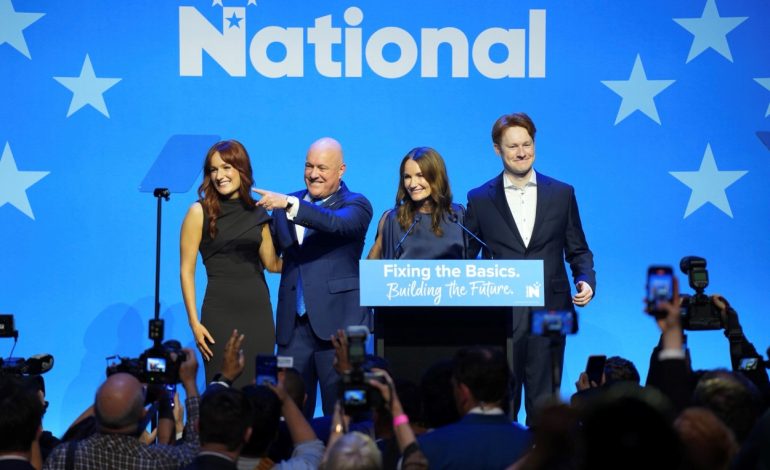
The National Party of PM Christopher Luxon (2L) is likely to retain power in New Zealand. (Photo: X/@chrisluxonmp)

New Delhi: New Zealand faces weeks of political uncertainty after a closely fought general election left the governing centre-right coalition with a razor-thin parliamentary majority, raising the possibility that the final vote count could overturn its apparent victory. The prime minister, Christopher Luxon, and his Labour rival, Chris Hipkins, have both stopped short of claiming victory as nearly 400,000 outstanding ballots threaten to reshape the political balance in Wellington.
According to the New Zealand electoral commission’s preliminary results, Luxon’s National Party secured 42 seats, with its coalition partners ACT New Zealand winning 13 and New Zealand First taking 12. Their combined strength of 67 seats gives the incumbent alliance a majority of just one seat in the 131-member parliament, where 66 seats are required to govern.
The opposition Labour Party, led by Hipkins, secured 36 seats, while the Greens won 16 and Te Pati Maori captured five, giving the three parties a combined 57. The centrist Opportunity Party emerged as a potential kingmaker after winning seven seats in its first parliamentary breakthrough, creating another complication for coalition calculations.
Why Labour won more votes but National secured more seats
One of the election’s striking outcomes is that Labour received a slightly larger share of the nationwide party vote despite National winning more parliamentary seats. Labour secured 29.36 per cent against National’s 29.21 per cent, exposing an unusual consequence of New Zealand’s mixed-member proportional (MMP) electoral system.
Under MMP, voters cast two ballots – one for a local constituency representative and another for their preferred political party, which ordinarily determines each party’s overall parliamentary representation. However, when a party wins more constituency seats than its proportional share permits, those additional seats are retained, producing what is known as an overhang.
This election has generated an unusually large 11-seat overhang, expanding parliament from its normal 120 members to 131. National’s 42 constituency victories account for seven additional seats, while Te Pati Maori’s five electorate victories produce another four, significantly affecting the parliamentary arithmetic.
Why 400,000 uncounted votes could change everything
The biggest uncertainty involves approximately 399,365 special votes, representing roughly 14 per cent of the estimated total ballots cast. These include votes submitted overseas and ballots cast by electors outside their registered constituencies, which require additional verification before being included in the official results.
Historically, special votes have tended to favour Labour, the Greens and other left-leaning parties, although previous patterns cannot reliably predict this election’s outcome. During the 2023 election, the final count helped the Greens and Te Pati Maori gain additional representation at National’s expense, demonstrating how late-counted ballots can alter coalition strength.
The electoral commission has scheduled the official results for November 27, following verification of special ballots and recounting of ordinary votes. With the governing coalition holding only a one-seat majority, relatively small changes in seat allocations could deprive Luxon of the numbers needed to remain in office.
A new political player complicates coalition talks
The Opportunity Party, led by Qiulae Wong, has emerged as one of the election’s most consequential newcomers after securing 5.96 per cent of the party vote. Its seven seats could become decisive if the final count weakens the governing coalition and creates alternative routes to a parliamentary majority.
Luxon previously ruled out cooperating with the centrist party, which campaigns on evidence-based policymaking, but the unsettled result could force political compromises. Even a combination of Labour, the Greens, Te Pati Maori and Opportunity would currently command only 64 seats, two short of the required majority.
The result also reflects an increasingly fragmented political landscape, with neither National nor Labour reaching 30 per cent of the party vote. Smaller parties now occupy a substantial share of parliament, making coalition negotiations more complex and reducing the likelihood of either major party governing without significant concessions.
What happens next?
Both Luxon and Hipkins have indicated that meaningful coalition negotiations will follow the official count, leaving New Zealand facing a potentially prolonged period of political bargaining. A government might not emerge until December, although Hipkins has expressed hopes that an administration can be formed before Christmas.
Until then, Luxon’s incumbent administration will continue under caretaker conventions, conducting routine government business while exercising restraint over major policy decisions. Under constitutional requirements, the newly elected parliament must convene no later than January 14 next year.
The uncertainty also matters beyond New Zealand’s domestic politics, particularly as Wellington navigates its economic relationship with China and security partnerships with Australia and other Indo-Pacific countries. For India, which has been expanding its engagement with New Zealand, the eventual coalition’s approach to trade, regional security and strategic cooperation will be worth watching.
For now, the election has produced neither a decisive endorsement of the incumbent government nor a clear mandate for the opposition.