



Netanyahu’s grip on power weakens as Israel’s president turns to Eisenkot. Can he build a government?
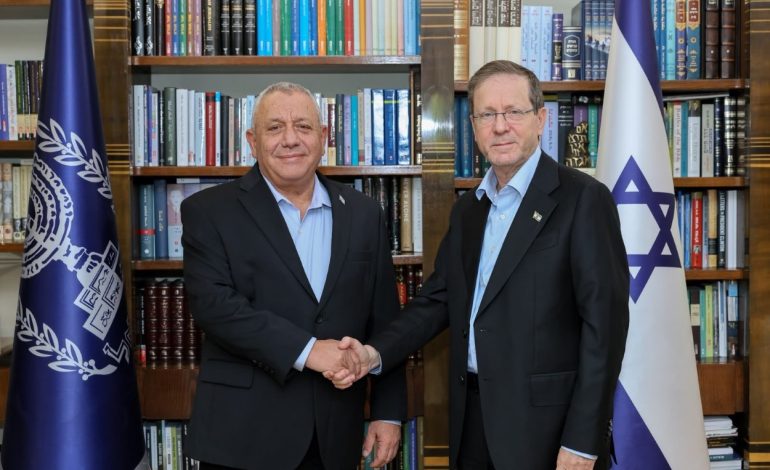
Gadi Eisenkot (L) with Isaac Herzog. (Photo: X/@gadi_eisenkot)

New Delhi: Israel’s president, Isaac Herzog, has chosen former military chief Gadi Eisenkot to attempt to form the country’s next government, dealing a significant political setback to the prime minister, Benjamin Netanyahu, after an inconclusive general election. The decision, announced on Saturday, gives Netanyahu’s principal challenger the first opportunity to assemble a governing coalition, although deep divisions between opposition parties could prevent a transfer of power.
Herzog informed Eisenkot, the leader of the centre-right Yashar party, that he would formally entrust him with the task at a ceremony scheduled for 5pm on Sunday at the presidential residence in Jerusalem. The announcement followed several days of consultations with parliamentary factions after the October 27 election failed to produce a majority for either Netanyahu’s religious-nationalist alliance or the opposition grouping seeking to replace him.
According to the Israeli president’s office, parties representing 67 members of the 120-seat Knesset recommended Eisenkot for the premiership, compared with 46 who backed Netanyahu. The remaining seven lawmakers, belonging to the ultra-Orthodox United Torah Judaism party, declined to endorse either candidate, leaving open the possibility that their support could prove decisive in subsequent negotiations.
The numerical advantage, however, does not guarantee Eisenkot a parliamentary majority because several parties that recommended him remain unwilling to govern together. His opposition alliance won 48 seats against 53 secured by Netanyahu’s bloc, with Arab-led parties holding the remaining 19 seats and potentially determining who governs Israel.
The coalition maths
Under Israel’s parliamentary system, Eisenkot will initially have 28 days to assemble a government, with the possibility of a further 14-day extension granted by Herzog. He must ultimately secure parliamentary confidence, normally requiring the support of at least 61 lawmakers for a dependable majority, although a minority administration could take office if it wins the necessary confidence vote.
The most immediate complication concerns the Arab-led parties, whose electoral gains have substantially strengthened their bargaining position. Although they recommended Eisenkot, some of his potential coalition partners oppose relying on Arab political support, particularly after more than three years of conflict following the Hamas-led attacks of October 7, 2023.
One possibility involves negotiating with the ultra-Orthodox parties, Shas and United Torah Judaism, whose combined support could provide Eisenkot with a narrow parliamentary majority. Such an arrangement would nevertheless require difficult compromises over military conscription exemptions for ultra-Orthodox men, an issue that has generated sharp disagreements between secular politicians and religious parties.
Another option would be a minority government supported externally by Arab-led lawmakers without their formal participation in the cabinet. However, Avigdor Liberman’s opposition to such an arrangement demonstrates how divisions within the anti-Netanyahu camp could undermine Eisenkot’s chances of securing office.
Netanyahu, meanwhile, has warned that an administration dependent on Arab parties would threaten Israel’s stability, portraying such an arrangement as a national security risk. His opponents reject that characterization and argue that the election results demonstrate growing public dissatisfaction with the incumbent government’s policies and leadership.
What Eisenkot would change
Eisenkot, 66, served as chief of staff of the Israel Defense Forces from 2015 to 2019 and subsequently entered politics, presenting himself as a security-focused alternative to Netanyahu. He also served as an observer in Netanyahu’s wartime cabinet following the October 2023 attacks, giving him direct experience of the government’s military decision-making.
Despite his opposition to Netanyahu’s political direction, Eisenkot remains firmly committed to Israel’s security establishment and has rejected Palestinian statehood. He has advocated dismantling Hamas’s military capabilities in Gaza, although he has also criticized violence by extremist Jewish settlers against Palestinians in the occupied West Bank.
His approach therefore suggests that a change of government would not necessarily produce a fundamental departure from Israel’s existing security priorities. Differences could nevertheless emerge over relations with the Palestinians, the conduct of military operations, accountability for the October 2023 security failures and the influence of far-right parties on government policy.
For India and other countries maintaining substantial diplomatic and defence relationships with Israel, the immediate significance lies in whether a new administration would bring greater political stability and predictability to Israeli decision-making. New Delhi’s defence cooperation with Israel spans missiles, unmanned systems, surveillance equipment and military technologies, making developments in Jerusalem relevant beyond the country’s domestic political contest.
Netanyahu has not exhausted his options, and a broad unity government involving Likud remains theoretically possible despite serious disagreements between the rival camps. If Eisenkot fails to form an administration, the presidential mandate could pass to another candidate, potentially prolonging the uncertainty and raising the prospect of another election.
Israel held five general elections between 2019 and 2022 because of repeated political deadlocks, illustrating the difficulties of maintaining viable coalitions in its fragmented parliamentary system. Herzog’s decision has changed the political initiative, but whether it ends Netanyahu’s long premiership will depend on the compromises Eisenkot can negotiate in the coming weeks.


