


Margaret Hamilton, whose Apollo software kept Moon landing on track, dies at 90
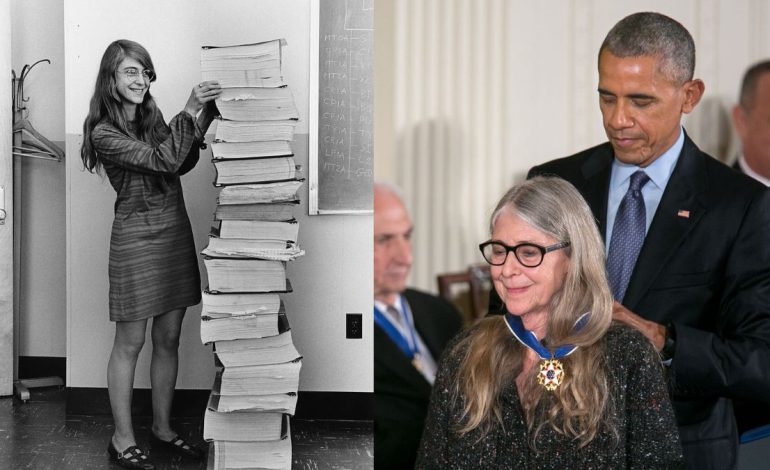
Margaret Hamilton with Apollo software listings, and later receiving the Presidential Medal of Freedom from Barack Obama. (Image courtesy: Wikimedia Commons)

New Delhi: Margaret Hamilton, the computer scientist and software engineer who led the team that developed onboard flight software for Nasa’s Apollo missions, has died aged 90. Her work proved critical during Apollo 11’s final descent in 1969, when priority driven software allowed the guidance computer to keep performing essential landing tasks despite repeated overload alarms.
Massachusetts Institute of Technology (MIT), announced on Wednesday that Hamilton had died on September 30 at the age of 90. she worked from 1959 until the mid-1970s. Hamilton later directed the software engineering division of MIT’s instrumentation laboratory, which developed onboard flight software for the National Aeronautics and Space Administration’s (Nasa) Apollo programme.
Hamilton’s best-known contribution was tested only minutes before Apollo 11’s Lunar Module Eagle touched down on July 20, 1969. During the descent, the Apollo guidance computer generated 1201 and 1202 alarms after repeated processing requests associated with the rendezvous radar overloaded the computer.
The software developed by Hamilton’s team was designed to handle such overloads. Its priority-driven system could restart and continue executing the most important tasks, including guidance and control of the descent engine, while lower priority processes were dropped or deferred. Nasa controllers therefore allowed the landing to continue.
The episode was not an emergency intervention by Hamilton herself, but a demonstration of safeguards built into the software before the mission. Neil Armstrong and Buzz Aldrin subsequently landed on the Moon while Michael Collins remained in lunar orbit aboard the command module.
Born in Paoli, Indiana, in 1936, Hamilton studied mathematics at Earlham College before joining MIT. She entered the Apollo project in 1965 as its first programmer at MIT and its first female programmer, later moving into leadership of software development for crewed missions. By 1968, more than 400 people were working on Apollo software.
A lasting software-engineering legacy
Hamilton helped establish software engineering as a distinct discipline centred on systematic design, reliability and error prevention. Nasa credits her work with concepts including asynchronous processing, priority scheduling and human in the loop decision capability that contributed to highly reliable software design.
A famous 1969 photograph showing Hamilton beside towering printed listings of software developed by the lunar and command module teams later became an enduring image of Apollo-era computing and the scale of the work behind the missions.
The then president, Barack Obama, awarded Hamilton the Presidential Medal of Freedom in 2016, the United States’ highest civilian honour. The White House citation recognized her contribution to Apollo software and to techniques that helped lay foundations for modern reliable software engineering.
After Apollo, Hamilton founded higher order software in 1976 and Hamilton technologies about a decade later, continuing her work on fault-tolerant and reliable systems. She is survived by her daughter, Lauren Hamilton, son-in-law Richard Selesnick, two grandsons, four great-grandchildren and three siblings, according to MIT.