
Kazakhstan linked to Russian Su-57 acquisition, but fighter deal remains unconfirmed
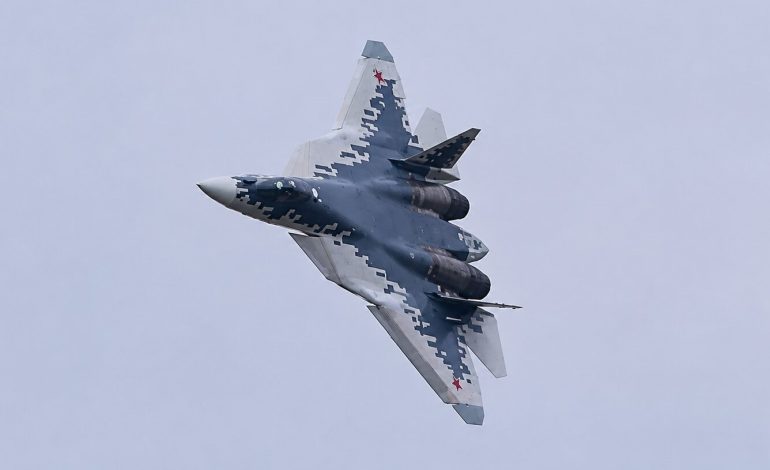
A Russian Su-57E. (Video screengrab)

New Delhi: Kazakhstan could receive Russian Su-57E stealth fighters by 2028, according to reports linking the Central Asian country to Moscow’s expanding fifth-generation aircraft export programme. If realized, the acquisition would give Kazakhstan the region’s most advanced combat-aircraft fleet and substantially deepen its long-standing operational dependence on Russian aviation technology.
The claim originated in a Military Watch Magazine report, which cited unspecified Kazakh and Russian accounts as saying the country would induct its first fifth-generation fighter within two years. The publication acknowledged, however, that most of these accounts had not identified the aircraft and assessed the Su-57 as the likely candidate on the basis of Kazakhstan’s defence ties with Russia.
That distinction is important because neither Kazakhstan’s defence ministry nor Russia’s state arms exporter, Rosoboronexport, had publicly identified Astana as an Su-57 customer by Monday. No official information has emerged about the proposed number of aircraft, contract value, weapons package, training arrangements or delivery schedule.
Subsequent reports largely repeated the original assertion rather than providing an independently sourced confirmation from either government. The available evidence therefore supports the possibility of a Kazakh acquisition but does not yet establish that a contract has been signed.
Russian statements provide a broader context for the speculation without confirming Kazakhstan’s involvement. Rosoboronexport announced in November 2024 that the first Su-57 export contracts had been concluded and said in February 2026 that further deliveries were planned during the year, but it did not identify all the customers involved, according to Interfax.
The director of Russia’s Federal Service for Military-Technical Cooperation, Dmitry Shugaev, said on May 14 that negotiations with several countries were continuing over possible Su-57 supplies. His remarks, also reported by Interfax, contained no reference to Kazakhstan or a two-year delivery timeline.
Kazakhstan nevertheless represents a plausible customer because its Air Defence Forces are built largely around Soviet- and Russian-designed aircraft, including the Su-27, Su-30SM, Su-25 and MiG-31. The country has purchased successive batches of Su-30SM fighters since 2015 and had received at least 30 aircraft by August 2024, according to an assessment based partly on imagery released by the Kazakh defence ministry.
Operating the Su-30SM has already given Kazakh pilots, technicians and ground crews experience with the wider Sukhoi ecosystem, potentially reducing the cost and complexity of converting to the Su-57E. Existing Russian weapons, maintenance infrastructure and training relationships would also make the aircraft easier to integrate than a fighter supplied through an entirely different defence network.
Reports that the Su-57 would replace Kazakhstan’s ageing Su-27s – and eventually its MiG-31 interceptors – remain projections rather than an officially announced modernization plan. The MiG-31 performs a specialized long-range interception role, meaning that its replacement would require decisions about sensors, weapons, operating doctrine and air-defence coverage rather than a simple exchange of airframes.
Russia markets the Su-57E as a low-observable multirole fighter capable of air-to-air combat and strikes against land and maritime targets, with internally carried weapons and an integrated suite of radar, electronic-warfare and electro-optical sensors. Precise details of the export configuration remain restricted, making direct comparisons with the American F-35 and China’s emerging J-35 difficult to substantiate from publicly available information.
An acquisition would make Kazakhstan the first Central Asian state to operate a fifth-generation fighter and the second former Soviet republic after Russia to field one. It could also make the country the Su-57’s second acknowledged foreign operator after Algeria, whose state media confirmed its purchase in February 2025.
The deal would reinforce interoperability within the Russia-led regional air-defence structure and the Collective Security Treaty Organization, of which Kazakhstan is a member. At the same time, Astana has been diversifying its defence relationships and has acquired European transport aircraft and Turkish unmanned systems while seeking foreign technology partnerships under its updated military doctrine.
A two-year delivery schedule would depend on production capacity, pilot conversion, weapons integration and the establishment of a secure maintenance and logistics chain. Russia must also balance export commitments with orders for its own Aerospace Forces, making the timing and size of any Kazakh procurement central to assessing whether the reported plan is realistic.
For now, the Su-57 remains the most credible candidate if Kazakhstan has indeed decided to acquire a fifth-generation fighter, but credibility is not confirmation. A formal announcement from Astana or Moscow – supported by aircraft numbers, contractual details or a training schedule – will be required before the reported 2028 induction can be treated as settled.