

Iran to enter Mecca pact? Tehran denies invitation, but door not closed
RNA illustration for representation.

New Delhi: Iran on Monday denied receiving any formal invitation to join the Mecca Joint Defence Agreement, a day after a report claimed that Tehran had been offered membership in the Saudi Arabia-Turkey-Pakistan defence pact. The denial comes as the newly established alliance draws growing attention over the possibility of expanding its membership and reshaping the regional security architecture.
Speaking to reporters at his weekly media briefing, the Iranian foreign ministry spokesman, Esmaeil Baghaei, also rejected any connection between the Pakistan Army chief Field Marshal Asim Munir’s visit to Tehran and the visit of Oman’s foreign minister. He said Iran would not allow the end of the war to be decided according to the terms and conditions of the aggressor.
Referring to Munir’s visit, Baghaei said the trip was taking place within the framework of the “very good and distinguished relations” between Iran and Pakistan.
He said bilateral relations between Iran and Pakistan were going through one of their best stages, with both sides determined to expand ties across all areas. Baghaei added that the Omani foreign minister’s visit had nothing to do with the reported defence pact and was only almost simultaneous in timing.
According to Baghaei, the Omani foreign minister’s visit was scheduled for the following day, with discussions expected to cover bilateral relations as well as issues concerning maritime traffic routes.
Mecca pact faces questions over possible expansion
The clarification followed an Al Mayadeen report claiming that Iran had received an invitation to join the Mecca Joint Defence Agreement and that Tehran was considering the proposal. The report cited Mehdi Rahimi, head of Iran’s parliament’s Khaneh Mellat news agency.
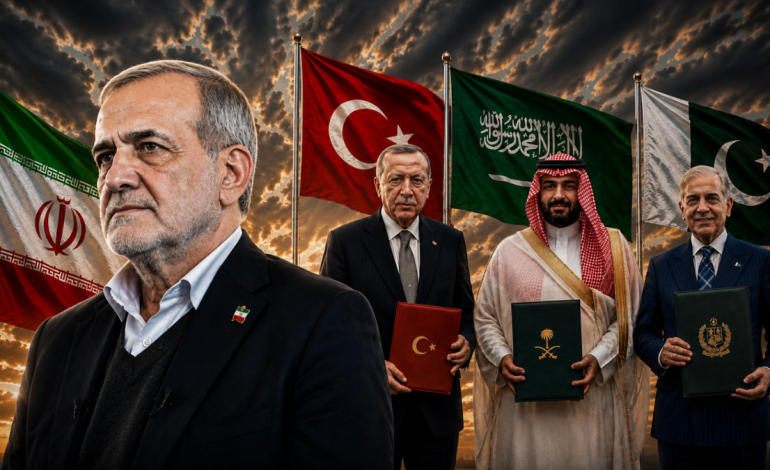
The Mecca agreement was signed by Saudi Arabia, Turkiye and Pakistan on August 7. Under the pact, an armed attack against one of the three countries would be treated as an attack against all three, establishing a collective-defence commitment among the members.
The agreement was established amid heightened regional tensions and is intended to strengthen coordination and collective deterrence among the three countries. Its potential expansion has since generated speculation about whether it could develop into a broader regional security framework.
Pakistan leaves door open for wider participation
Pakistan has previously indicated that the pact could be open to other countries. Its ambassador to Moscow, Faisal Niaz Tirmizi, said on August 12 that Islamabad had no objection to Iran and Egypt joining the arrangement.
That position has fuelled speculation over the future composition of the Mecca pact, particularly after reports emerged claiming that Iran had already been invited.
Iran’s possible inclusion would be particularly significant given its longstanding rivalry with Saudi Arabia. Although Tehran and Riyadh restored diplomatic relations in 2023 through a China-brokered agreement, the two countries continue to have competing strategic interests across the region.
Iran’s entry could transform the alliance
If Iran were eventually to join the Mecca framework, the pact would bring together Saudi Arabia, Turkiye, Pakistan and Iran under a common defence arrangement, connecting major powers from the Gulf, West Asia and South Asia.
Such an expansion would represent a major change from the pact’s original Saudi-Turkish-Pakistani composition. It could also introduce a new dimension to regional security cooperation by placing Iran and Saudi Arabia within the same collective-defence framework.
The possibility had drawn attention in Israel even before Tehran’s denial. Haaretz reported that Ksenia Svetlova of the Mitvim Institute and the Atlantic Council viewed possible Iranian accession as a fundamental transformation of the pact.
Egypt, other countries also in focus
Iran is not the only country whose possible participation has been discussed. Egypt has emerged as another potential addition to the framework, while wider regional participation could eventually involve other Gulf and Arab states.
An expanded Mecca arrangement would give the pact a much broader geographic footprint, potentially linking South Asia with the Gulf and wider West Asia. However, the reported Iranian invitation remains unconfirmed. Tehran’s latest statement means that, for now, the Mecca Joint Defence Agreement continues to comprise Saudi Arabia, Turkiye and Pakistan.
Its potential expansion could have implications for existing security arrangements involving the United States and regional powers. An enlarged grouping would bring together countries with different relationships with Washington and differing positions on regional conflicts.
For Israel, any eventual inclusion of Iran would be particularly consequential because Tehran remains one of its principal regional adversaries. At the same time, placing Iran in the same framework as Saudi Arabia would be a major departure from the rivalry that has traditionally defined Gulf geopolitics.
For now, however, Iran has denied receiving an invitation to join the Mecca pact. The denial puts the reported expansion on hold, even as the possibility of wider membership continues to raise questions about how far the Saudi-Turkiye-Pakistan alliance could evolve.