
Haifa Day row: How Indian cavalry fought in 1918 and why the battle’s legacy is contested
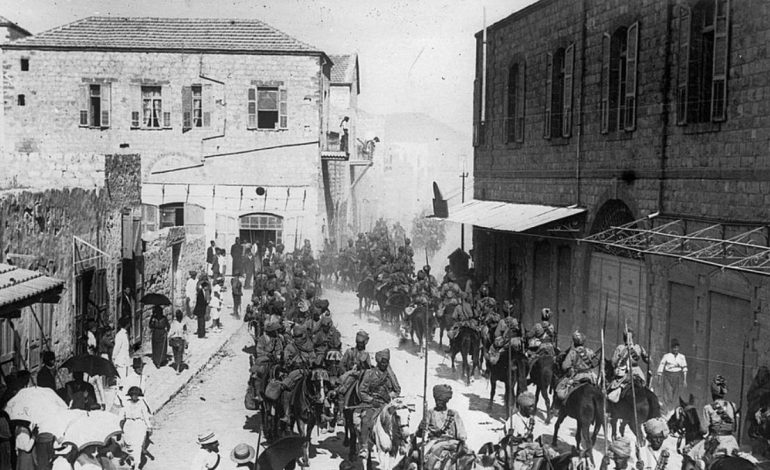
Indian cavalrymen in Haifa during the 1918 campaign in Ottoman Palestine. (Image courtesy: Wikimedia Commons.)

New Delhi: A dispute over the phrase “liberation of Haifa” has reopened questions about the Indian cavalry charge that captured Haifa from Ottoman forces on September 23, 1918. Palestine’s ambassador to India, Abdullah M Abu Shawesh, argues that the description obscures the battle’s setting in Ottoman Palestine and its British imperial context.
The 61st Cavalry regiment of the Indian Army observes September 23 each year as Haifa Day to commemorate the Battle of Haifa, fought in 1918 by Indian cavalrymen serving under British command. The commemoration has increasingly become part of the public narrative surrounding India-Israel ties, while Shawesh has urged New Delhi to reconsider the historical framing of the battle and, in particular, the use of the term “liberation”.
Shawesh told The Print that his objection was not to commemorate the courage or sacrifice of the Indian soldiers, but to describe their 1918 action retrospectively as the “liberation” of an Israeli city. He pointed out that the battle occurred three decades before Israel was established, saying: “If there is a shared history with India, it’s with the Palestinian city of Haifa.” In his account, the Indian cavalrymen were serving within a British-led imperial force in a campaign against the Ottoman empire, rather than undertaking a military operation on behalf of an independent India or the later State of Israel.
The ambassador argues that the word “liberation” changes the political meaning of what followed the battle: British forces took control of Haifa and Palestine subsequently came under British military administration rather than independent rule. He has said the Palestinian mission conveyed its position to India’s foreign ministry and circulated material challenging the contemporary description of the battle, while maintaining that recognising the role of the Indian soldiers and questioning the modern political framing are separate issues.
What happened in Haifa in 1918?
Haifa was then a city in Ottoman Palestine; the State of Israel did not exist. Britain and the Ottoman empire were enemies in World War I, and troops from British India served in the British-led Egyptian expeditionary force during the wider Sinai and Palestine Campaign.
The 15th Imperial Service Cavalry Brigade comprised the Jodhpur, Mysore and Hyderabad Lancers, forces raised by Indian princely states under the imperial service troops system. They were Indian cavalrymen serving within a British-led imperial campaign while India remained under colonial rule.
Haifa was strategically important as a Mediterranean port and railhead. Indian military history records that the brigade advanced through difficult terrain against Ottoman positions supported by artillery and machine-gun fire, with the Jodhpur and Mysore Lancers playing prominent roles in the assault.
Major Thakur Dalpat Singh, commandant of the Jodhpur Lancers, was killed during the action, but the cavalry broke through the defences and Haifa was captured. The battle is remembered as a notable successful mounted cavalry action of World War I.
The 2014 volume Indian war memorials around the world, published by the Centre for Armed Forces Historical Research at the United Service Institution of India, says the brigade “broke through and took the town” after a mounted attack through a narrow defile.
What happened after the Ottoman defeat?
The capture of Haifa did not create the later State of Israel. After British-led forces occupied Palestine in 1917-18, the territory was administered under the occupied enemy territory administration before a civilian administration replaced military rule on July 1, 1920.
The League of Nations approved the mandate for Palestine on July 24, 1922, and it formally entered into force on September 29, 1923. In 1947, UN general assembly resolution 181 proposed Arab and Jewish states, with Jerusalem under a special international regime; India voted against the resolution. Israel was established in 1948 as the British mandate ended, three decades after the Battle of Haifa.
Why is ‘liberation’ contested?
Indian official terminology has varied. While the 2014 war-memorial volume says the cavalry “took the town”, a 2018 defence ministry centenary release said Indian soldiers had “liberated” Haifa.
The differing descriptions place emphasis on different aspects of the same episode: the military achievement and sacrifice of Indian cavalrymen, the British imperial context in which they fought, Palestine’s subsequent history under British rule and the battle’s much later place in India-Israel relations.
How Haifa became a diplomatic symbol
The battle acquired greater visibility in India-Israel diplomacy in recent years. In January 2018, the Israeli prime minister, Benjamin Netanyahu, and the prime minister, Narendra Modi, paid tribute at Teen Murti in New Delhi after Teen Murti Chowk was renamed Teen Murti Haifa Chowk, while the centenary of the battle was also commemorated that year.
The argument now intersects with India’s relationships with both Israel and Palestine. India recognized the State of Palestine in 1988 and has long supported a negotiated two-state solution, while New Delhi and Tel Aviv elevated their ties in February to India-Israel Special Strategic Partnership for Peace, Innovation and Prosperity.