

China, Singapore reaffirm commitment To Malacca Strait transit rights
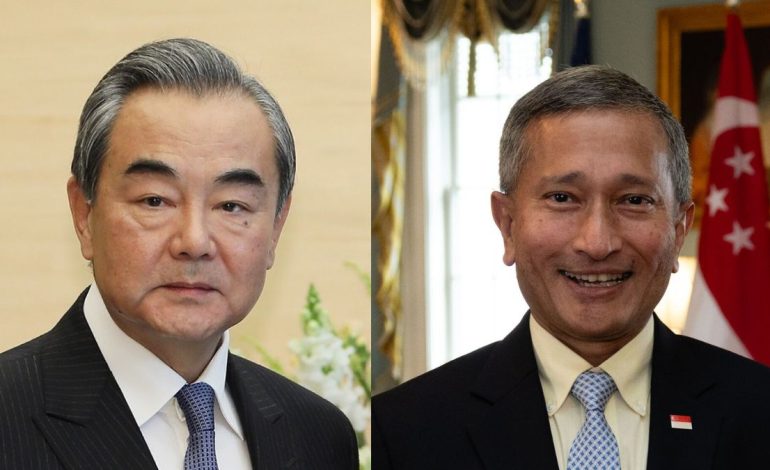
Chinese Foreign Minister Wang Yi and Singapore Foreign Minister Vivian Balakrishnan during talks in Beijing focused on safeguarding free navigation and maintaining uninterrupted shipping traffic through the strategically vital Strait of Malacca. Image courtesy: Wikimedia Commons.

Singapore, on Monday (May 25, 2026), assured China that it was committed to keeping the Strait of Malacca open for international shipping traffic, amidst speculation that the US President Donald Trump was keen on stamping the American mark on key maritime chokepoints globally.
In a meeting with Chinese Foreign Minister Wang Yi in Beijing, Singaporean Foreign Minister Vivian Balakrishnan said keeping the critical global shipping lane open was in the interest of all parties.
A Chinese read-out of the meeting noted that Singapore voiced its support for free passage through the Strait of Malacca and other international waterways.
Wang said in the meeting that “safeguarding the security of global industrial and supply chains and the smooth flow of maritime traffic is a shared aspiration of all countries and is in the common interest of the international community.”
“China is willing to continue making efforts to this end,” Wang said. The Strait of Malacca is a key maritime choke point in Asia through which China imports over 50% of the oil and roughly 4% of the natural gas annually.
The roughly 800-km (497-mile) funnel-shaped waterway, measuring under two nautical miles (3.7km) at its narrowest point, carries nearly 40% of the global trade and about 33% of the world’s seaborne oil and other liquid cargo.
The Indian island territory of Andaman and Nicobar Islands, which is also a key military base, sits astride the Strait of Malacca, with capabilities to blockade the maritime traffic flowing through the critical maritime choke point connecting the Pacific Ocean and the Indian Ocean.
India is also building a major maritime facility in the Andaman and Nicobar Islands, which would cater to both military and civilian shipping traffic, much closer to the Strait of Malacca.
The Singapore-China talks on the Strait of Malacca come even as the US and Iran are in talks for the reopening of the Strait of Hormuz in West Asia, which came under Iranian blockade after the Americans and Israelis conducted airstrikes on Tehran on February 28, resulting in a war.
The Trump administration, it was reported last year, was considering “taking back” the Panama Canal, another maritime choke point in the Americas, from alleged “Chinese influence.”