



China plans export curbs on 40 key AI, biotech and solar technologies
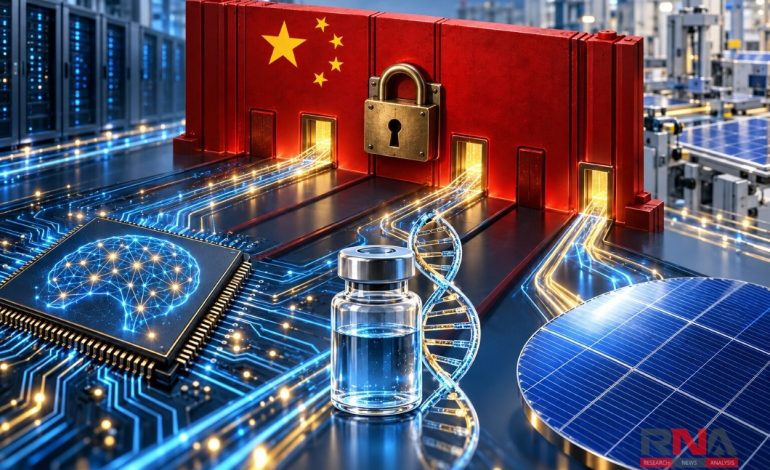
RNA Media illustration for representation.

New Delhi: China has proposed banning or restricting exports of 40 technologies spanning artificial intelligence, biomedicine and solar manufacturing, seeking tighter control over sensitive expertise in three strategically important industries. The draft, released on Friday, would prohibit exports of 14 technologies and require government approval for another 26, while an interim registration requirement has already taken effect.
The proposals, jointly issued by the commerce and science and technology ministries, would expand China’s catalogue of technologies prohibited or restricted for export. They cover 23 AI technologies, 12 photovoltaic technologies and five biomedical technologies, with public comments invited until November 15.
The immediate obligation is set out in the ministries’ official notice: exporters must register covered technology transfers before proceeding while the revised catalogue is being finalized. This also applies to transactions that have begun but remain incomplete, including transfers of intellectual property, overseas licencing and changes that place ownership or effective control in foreign hands.
The distinction matters because registration does not mean that all the proposed prohibitions and licensing requirements are already in force. Nevertheless, companies arranging overseas transfers must assess their transactions now, rather than wait for the consultation to end.
AI accounts for the largest share of the proposed additions, encompassing large models, autonomous agents, computing clusters and information processing. According to a Global Times report, the proposed prohibitions include core technologies behind models trained on sensitive national data and AI agents serving defence, critical information infrastructure and core government functions.
Other proposed restrictions cover design technologies for certain advanced AI chips and three-dimensional flash memory, alongside voiceprint recognition and other information-processing technologies. The draft also differentiates between sensitive core models proposed for prohibition and other important models that could be exported subject to controls.
The plan comes as China and the United States compete for leadership in AI, with Washington’s restrictions limiting Chinese access to advanced American chips used to train powerful models. Chinese developers have meanwhile expanded internationally through improving capabilities and competitive pricing, increasing the commercial significance of Beijing’s decisions on overseas technology transfers.
Beijing has drawn a distinction between transferring controlled technology abroad and allowing foreign customers to use AI services. In its policy explanation, the commerce ministry said access through application programming interfaces, apps, websites and software services would fall outside the proposed large-model technology export controls.
Overseas deployment involving restricted technology would, however, fall within their scope, with simplified procedures envisaged for some arrangements, including deployment on a company’s own overseas cloud infrastructure. Technologies already made public through open-source releases or academic publications would be excluded, leaving scope for international research and commercial services to continue.
In solar manufacturing, the proposals target selected production processes and core equipment used to make polysilicon, silicon wafers and solar cells. These are controls on manufacturing expertise and specified equipment, rather than a general prohibition on exports of finished solar panels.
The proposed prohibited category includes selected perovskite and tandem solar-cell manufacturing technologies, while specified heterojunction cell technologies would face restrictions. These additions place particular emphasis on advanced production capabilities, extending scrutiny beyond conventional trade in solar products.
For companies establishing factories abroad, the implications could therefore extend to technology licensing, production-line installation, commissioning and technical support. Whether an arrangement requires approval would depend on the technology and technical thresholds involved, rather than simply whether it concerns the solar industry.
The biomedical additions cover cell and gene therapies, small nucleic acid medicines and pathogenic microorganisms. The proposals envisage automatic licensing or other facilitation measures for certain overseas licensing arrangements that do not transfer ownership, seeking to preserve channels for commercial cooperation.
The Chinese commerce ministry described the revision as routine technology-trade management and said it did not target any particular country, region or entity. It cited risks associated with sensitive applications and misuse, while maintaining that most AI technologies would remain freely exportable.
China first published the catalogue in 2001 and subsequently revised it in 2008, 2020, 2023 and 2025. Under its framework, prohibited technologies cannot be exported, while restricted technologies require export licences – making the final wording and exemptions central to how far the new measures affect international business.



