


Boris Johnson’s train narrowly escapes Russian drone strike near Ukraine-Poland border
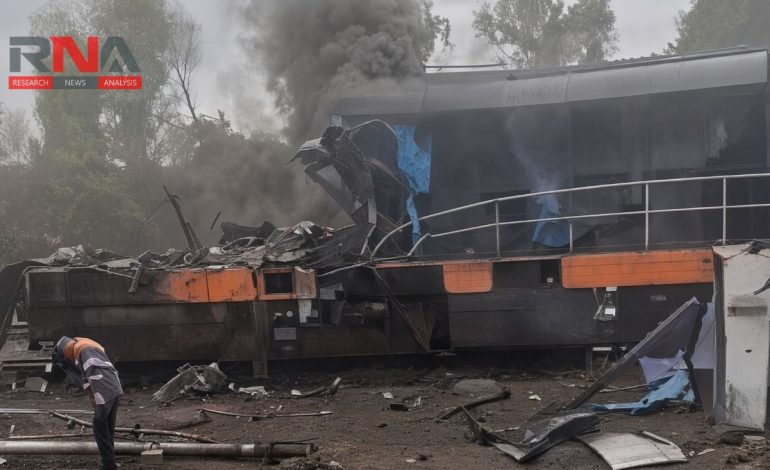
This digitally enhanced screenshot of a widely circulated video on social media shows the Warsaw-Kyiv train that has been allegedly hit by a Russian drone.

New Delhi: A Russian drone struck a passenger train near Ukraine’s border with Poland on Sunday only minutes after a diplomatic train carrying former British prime minister Boris Johnson and other senior European figures had passed through the same railway station. The episode has raised the possibility that the attack was aimed at the diplomatic train, although Ukrainian authorities have stopped short of presenting that as an established fact.
The strike took place at Yahodyn, in western Ukraine, close to the Yahodyn-Dorohusk crossing and roughly two kilometres from Polish territory. The drone hit the locomotive of a Kyiv-Warsaw passenger service after Ukrainian railway authorities had evacuated passengers and railway staff following an advance warning of the approaching threat.
The train carrying Johnson had left Yahodyn earlier than scheduled after Ukrainian railway officials detected the drone threat. The former prime minister was travelling with former Swedish prime minister Carl Bildt and security advisers from several European countries after attending the Yalta European Strategy conference in Kyiv.
Ukrzaliznytsia, Ukraine’s state railway operator, subsequently said it was “highly probable” that the diplomatic train had been the intended target and that its earlier departure may have prevented a potentially serious incident. That assessment is significant but remains the Ukrainian railway operator’s interpretation of the circumstances, rather than a finding independently confirmed by Western governments or Russia.
Bildt, who was on Johnson’s train, said the train that was struck passed through the border area only minutes after their service. He indicated that passengers on the later train were evacuated as the drone approached, while the diplomatic train received an evacuation warning before being allowed to continue towards Poland.
Johnson himself subsequently condemned the Russian attack, questioning the rationale for striking a stationary Ukrainian locomotive so close to the Polish border. He said the episode reflected the kind of attacks that Ukrainians face regularly, including against civilian railway infrastructure.
The presence of Johnson and other senior European figures gives the incident a significance that goes beyond the damage to a railway locomotive. If the diplomatic train was indeed the intended target, the episode would represent a potentially serious escalation in the risks faced by European political figures travelling inside Ukraine – particularly because the attack occurred almost at the frontier of a Nato member.
There were other high-profile figures in the immediate vicinity. Former CIA director David Petraeus was reportedly on another train at Yahodyn when the attack occurred, although that service was not struck and there were no reported casualties among the trains in the area.
The sequence of events is therefore crucial. A train carrying European political and security figures left the station ahead of schedule; an incoming Russian drone was detected; passengers and staff on another service were evacuated; and the drone subsequently struck the locomotive of that train near the Polish frontier.
Moscow’s broader justification for the strikes has been that Russian forces are targeting Ukrainian railway infrastructure associated with the movement of military equipment supplied by European countries. That explanation does not establish what the specific drone near Yahodyn was intended to hit, leaving the question of whether Johnson’s train was deliberately targeted unresolved.
The geographical setting makes the incident particularly sensitive for Poland. Yahodyn is one of Ukraine’s important rail links with the European Union, and a separate Russian drone attack in the same border area reportedly struck a truck less than a mile from Polish territory, temporarily forcing the closure of the Yahodyn–Dorohusk crossing.
For Warsaw, the concern is therefore not limited to the safety of visiting European politicians. Russian strikes increasingly close to Polish territory create a greater risk of an accidental incursion, miscalculation or incident that could directly involve a Nato member, even if the weapons themselves remain on the Ukrainian side of the frontier.
For Kyiv, the episode also demonstrates the continuing vulnerability of its railway system, which remains essential for civilian travel, humanitarian movement and the broader functioning of the Ukrainian state. The railway operator has said it routinely changes schedules and procedures in response to the aerial threat, a system that may have proved decisive in protecting the diplomatic train carrying Johnson and his fellow passengers.
The most striking element of the incident is therefore not that a Russian drone managed to hit a train near Poland, but how narrowly the attack appears to have followed a train carrying some of Europe’s most prominent Ukraine supporters. Whether that was coincidence or evidence of deliberate targeting is likely to become an important question as Ukraine and its European partners assess the implications of the strike.