‘Balochistan is becoming second Gaza’: What Surab attack says about Pakistan’s growing unrest
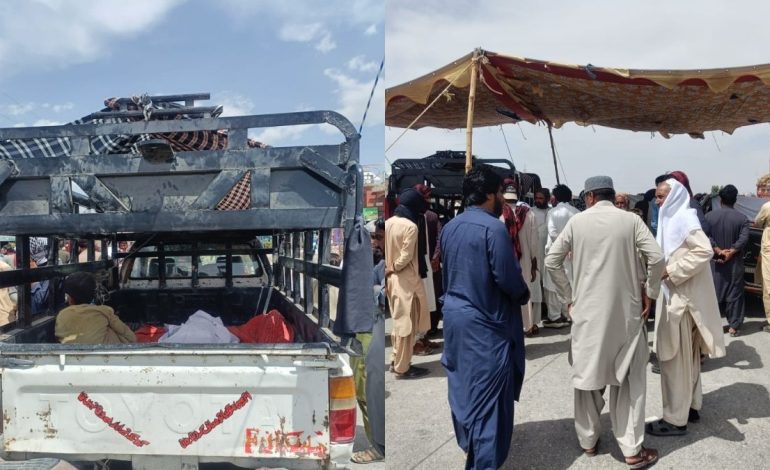
Surab killings, Baloch activist demands an investigation. Image: X/@SabihaBaloch_

New Delhi: Baloch activists have accused Pakistan’s military of carrying out an aerial attack on Surab in Balochistan on August 12, alleging that more than 20 people, including children, were killed. Pakistan’s military has disputed the account, saying the deaths resulted from a premature explosion at a site where militants were preparing explosives, followed by a security operation that killed 18 militants and three civilians.
The competing accounts have not been independently reconciled. But the incident has already added tensions in a province where a decades old separatist conflict has kept relations between the Baloch population and the Pakistani state deeply strained.
For Baloch activists, the Surab incident is being seen as another example of what they describe as military repression. For Pakistan’s security establishment, the focus remains on armed groups operating in the province.
A disputed attack, and two very different accounts
The events in Surab remain at the centre of the controversy.
The Inter-Services Public Relations (ISPR), the Pakistani military’s media wing, said the incident involved a premature explosion of an improvised explosive device. It said militants were preparing a vehicle-borne improvised explosive device when the blast occurred.
According to the military, 18 militants and three civilians were killed. It said the militants were targeted during the incident and a subsequent security operation, while two security personnel were injured.
Baloch activists have rejected that account.
They allege that Pakistani military forces carried out an airstrike on the area, killing more than 20 people and injuring others, including children.
Images from the area showed the aftermath of the incident, including a young girl carrying a toddler. Activists say such casualties demonstrate that civilians are bearing the cost of military operations in Balochistan.
There is also another account that has added to the dispute. A regime-friendly social media outlet acknowledged that security forces had carried out a quadcopter strike against a compound where militants were allegedly preparing vehicle-borne explosives.
The different accounts have not been independently verified. Communications disruptions in the area have also made it difficult to establish the full sequence of events.
Why Surab matters beyond one attack
The controversy is unfolding against the backdrop of a much older conflict.
Balochistan is Pakistan’s largest province by area and borders Iran and Afghanistan. It is also strategically important because of its coastline, natural resources and Gwadar port.
For decades, the province has witnessed insurgencies by Baloch nationalist and separatist groups.
The grievances are not limited to one issue. Baloch activists have long raised allegations of enforced disappearances, military operations and violations of basic rights, while some separatist groups have taken up arms against the Pakistani state.
Islamabad views the armed groups as a security and terrorism threat and has responded with military and counterterrorism operations.
That divide is at the heart of the present dispute.
For the Pakistani state, operations in Balochistan are aimed at armed groups.
For Baloch activists, the same operations are evidence of a wider campaign against the Baloch population.
“Azadi” is becoming a stronger call
Sabiha Baloch, a central leader of the Baloch Yakjehti Committee (BYC), told the Wire, that the killings in Surab had deepened anger towards the Pakistani state.
Speaking about the deaths in Surab, she said the Baloch people had witnessed similar military action in areas including Zaheeri and Khuzdar, with many incidents going unreported.
She described the alleged August 12 attack as a “war crime” and accused the Pakistani military of turning Balochistan into a “second Gaza.” More importantly, she said the calls for “azadi,” or freedom, have grown stronger since the killings in Surab.
Her argument is that continued military action is making it increasingly difficult for the Pakistani state to persuade Baloch people that their grievances can be addressed through negotiations.
Advocate Imran Baloch made a similar argument, saying that restrictions, curfews and road blockades were affecting ordinary people in the province.
He questioned why people would continue to trust negotiations after witnessing incidents in which civilians were allegedly killed.
But Balochistan is not the only pressure point
The tensions in Balochistan come as Pakistan is also dealing with unrest in Pakistan-occupied Kashmir (POK).
The two situations are different.
In Balochistan, the central issue is a long-running insurgency, with some Baloch groups seeking independence from Pakistan.
In POK, the recent protests have largely centred on economic hardship, electricity prices, political representation and governance. The Jammu Kashmir Joint Awami Action Committee (JAAC) emerged as a major platform for these grievances after protests intensified in 2023.
In October 2025, the committee presented a 38 point charter of demands. Talks with the authorities later broke down over a key demand concerning the abolition of 12 assembly seats reserved for Kashmiri refugees living in Pakistan.
The protests intensified again in 2026, with the JAAC announcing a long march and strike across POK in early June. Several activists have since faced restrictions. Some, including JAAC leaders, have been placed under house arrest, while others have gone underground or faced restrictions under Pakistan’s anti-terrorism laws.
Different grievances, but same question for Islamabad
The unrest in POK should not be confused with the separatist conflict in Balochistan. But both have brought the Pakistani state into confrontation with local movements.
The difference lies in what those movements are demanding. Baloch activists are challenging the state over alleged military repression, enforced disappearances and the question of Baloch political rights, with some groups demanding independence.
POK protesters are primarily demanding economic relief, political representation and changes in governance.
Elsewhere, Khyber Pakhtunkhwa continues to face militant attacks and security operations. In Sindh, political and social tensions have also produced protests.
The picture, therefore, is not of one single movement spreading across Pakistan. It is of different regional grievances emerging at the same time, each posing a different challenge to Islamabad.
Fight over story is becoming part of story
The dispute over Surab has also drawn attention to how such incidents are reported inside Pakistan. Baloch activists accuse mainstream Pakistani media of presenting those killed in Surab as terrorists and failing to report civilian casualties adequately.
Sabiha Baloch has also criticized human-rights organizations for what she described as their failure to publicly condemn the killings. The Pakistani military, meanwhile, has maintained its account that the deaths were linked to militants and an explosives incident.
With communications disrupted and access to the area limited, independent verification remains difficult.
That leaves the Surab incident caught between two competing narratives: Pakistan’s description of the episode as part of a militant threat, and the Baloch movement’s description of it as another instance of state repression.
In Balochistan, activists say military operations are deepening support for azadi, while Islamabad continues to describe its campaign as a fight against armed groups. In POK, protests have centred on economic and political grievances, while Khyber Pakhtunkhwa continues to see militant attacks and security operations.
The grievances may be different, but they point to a wider picture of political and social discontent across Pakistan. For Baloch activists, the concern is that continued military action will further weaken trust in negotiations and push more people towards the demand for azadi.