
Ajit Doval meets Han Zheng as India-China border talks put de-escalation back in focus
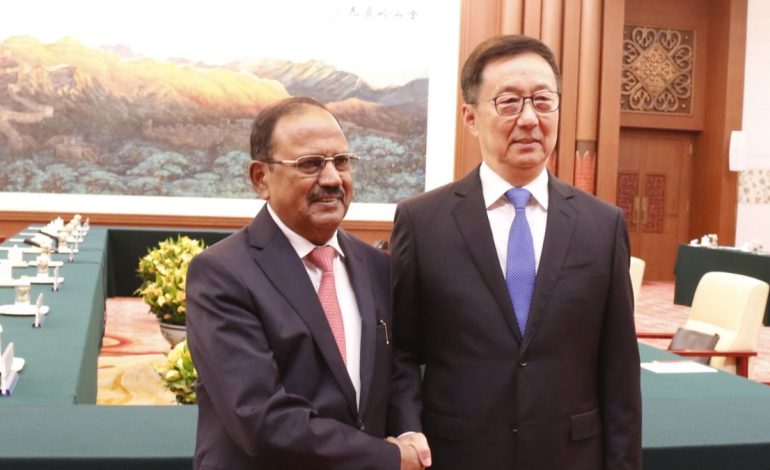
NSA Ajit Doval with Chinese Vice-President Han Zheng during their meeting in Beijing. Image courtesy: X.com/@EOIBeijing

New Delhi: The national security advisor, Ajit Doval, met the Chinese vice-president, Han Zheng, in Beijing on Tuesday. The meeting took place hours before a fresh round of India-China boundary talks, as the two sides seek to build on post-disengagement stability and begin addressing the harder question of de-escalation along the line of actual control (LAC).
Doval, who is also India’s special representative on the boundary question, discussed ways to strengthen peace and tranquillity in the border areas and improve cooperation across economic, political and multilateral forums, according to the Indian Embassy in Beijing. He is in China for the 25th round of special representatives’ talks with Chinese foreign minister Wang Yi.
The Chinese foreign ministry said Han referred to the meetings between prime minister Narendra Modi and Chinese president Xi Jinping in Kazan in 2024 and Tianjin in 2025, saying bilateral relations had returned to a path of recovery and improvement. Beijing said Doval conveyed India’s willingness to deepen mutually beneficial cooperation while appropriately handling the boundary question.
Border question entera new phase
The talks come nearly six years after the 2020 eastern Ladakh stand-off and Galwan valley clash pushed India-China relations to their lowest point in decades. India has said the October 2024 agreement resulted in disengagement from all the friction points that emerged in 2020, allowing patrolling arrangements to resume and opening the way for a gradual revival of political engagement.
When Modi met Xi in Tianjin in August 2025, he said an “atmosphere of peace and stability” had been established after disengagement. Both leaders welcomed the progress made along the border, but Modi again underlined that peace and tranquillity remained essential for the continued development of bilateral relations.
The next step is more difficult. At the India-China 24th Special Representatives’ Meeting in August 2025, Doval and Wang agreed that diplomatic and military mechanisms would discuss de-escalation, beginning with its principles and modalities. They also agreed to strengthen border-management mechanisms and establish additional General-level channels in the Eastern and Middle Sectors.
That process has continued below the political level. At the 36th Working Mechanism for Consultation and Coordination (WMCC) meeting in New Delhi on August 6, officials reviewed the situation along the LAC and discussed boundary delimitation, border management, mechanism-building and trans-border cooperation.
Both sides agreed to continue using diplomatic and military channels to resolve outstanding issues and avoid misunderstanding and miscalculation along the LAC, a particularly important objective given the scale of military deployments and infrastructure built along the frontier since 2020.
Diplomatic and Security contacts widen
The Doval-Han meeting is part of a broader revival of high-level India-China engagement. Wang Yi was in New Delhi in June for the BRICS National Security Advisors’ meeting, chaired by Doval, where terrorism, cybersecurity and non-traditional security threats were among the issues discussed.
At the political level, the reset began with the Modi-Xi meeting in Kazan in October 2024 following the disengagement agreement. Their subsequent meeting in Tianjin reinforced the decision to use the Special Representatives, foreign ministers and other official mechanisms to stabilize bilateral relations while continuing boundary negotiations.
The latest talks also come ahead of the BRICS Summit in New Delhi on September 12 and 13, adding another incentive for the two sides to prevent bilateral tensions from overshadowing wider multilateral engagement. Beijing, however, has not formally confirmed Xi’s attendance at the summit.
What India gains from continued talks
For India, the immediate benefit of sustained dialogue is risk reduction along the LAC. Disengagement addresses specific friction points, while de-escalation would deal with the wider military posture that emerged during the stand-off. Regular military and diplomatic communication can also reduce the possibility that patrol encounters or local disagreements spiral into a larger confrontation.
Progress on the border can also create room for cooperation in areas that serve Indian interests. Previous Special Representatives’ talks have covered trans-border river cooperation, emergency hydrological information and traditional border trade, while improving ties have helped restore the Kailash Manasarovar Yatra and other exchanges.
But the underlying strategic problem remains. The boundary is unresolved, competing territorial claims persist and India has consistently maintained that normal bilateral relations require peace and tranquillity at the border.