


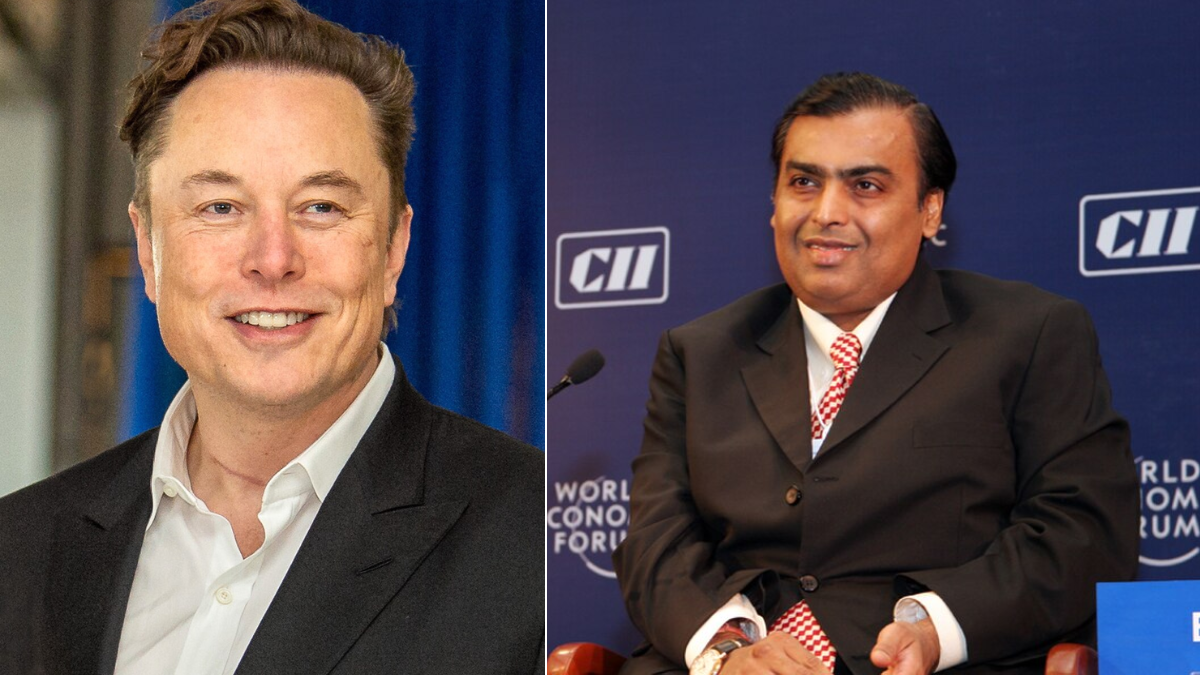
Why Elon Musk called Ambani ‘prime minister’ over Starlink launch delay. Here’s what sparked the controversy
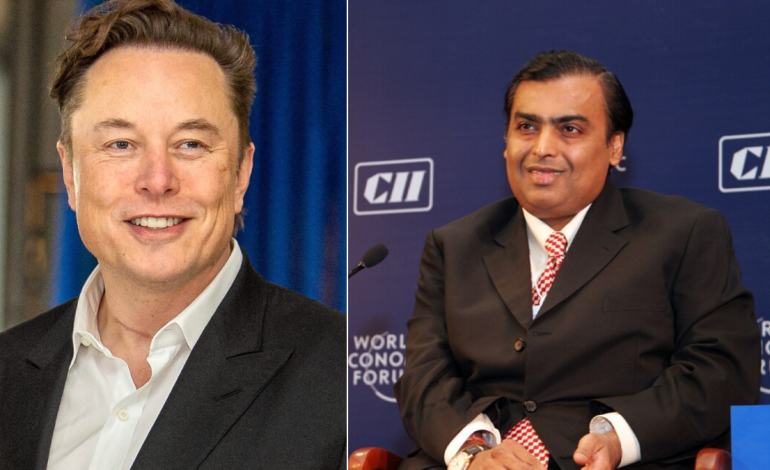
Elon Musk called Ambani “prime minister” over Starlink launch delay. (Image courtesy: Wikimedia)

New Delhi: Elon Musk has taken a sharp dig at the Reliance Industries chairman, Mukesh Ambani, over the delay of Starlink’s commercial launch in India. Musk sarcastically addressed Ambani as “prime minister Ambani” and accused powerful business interests of trying to protect their dominance over the country’s telecom market.
“Dear prime minister Ambani, please accept my humble apologies for not realising that you are the real boss of India,” Musk wrote on his social media platform X on Friday, asking Ambani to allow Starlink to compete in India.
“Naturally, you would prefer to maintain your monopolistic exploitation of the great people of India, but would you nonetheless consider allowing Starlink to compete?” he added. He argued that the service could connect people in areas without reliable internet access and help children and small businesses.
Why is Musk targeting Ambani, and what is holding up Starlink in India?
The row began on Wednesday when Musk accused unnamed powerful business interests of blocking Starlink’s launch into India to protect their market dominance. “Unfortunately, we are being blocked by certain oligarchs in order to maintain their monopolistic chokehold on the Indian people,” he wrote, describing the alleged obstruction as a “crime against the people of India”.
On Thursday, Musk again questioned the delay, saying that Starlink had spent five years complying with Indian requirements. “Starlink is licensed in over 165 countries and has spent five years complying with every single law and requirement of the government of India, so why still no license? Is Ambani the real boss of India?” he asked.
Starlink, owned by Musk’s SpaceX, uses satellites in low-Earth orbit to provide internet connectivity, particularly in remote areas where conventional networks are difficult to establish. Musk says the service can support education and businesses.
For Starlink, India is a major potential market because of its large population, although Starlink will face competition from established telecom operators such as Reliance Jio and Bharti Airtel, which offer relatively affordable mobile data services.
Earlier reports noted Starlink’s India subscription at ₹8,600 per month, with a one-time hardware cost of ₹34,000, after the prices briefly appeared on its website. However, the Starlink vice-president, Lauren Dreyer, later clarified that the figures were dummy test data displayed due to a technical glitch and that official prices for Indian customers had not yet been announced.
Starlink has already received a licence to provide satellite communication services in India. It cannot begin commercial operations until it completes the required security assessments and receives spectrum assignment. Bharti-backed Eutelsat OneWeb and Jio Satellite Communications, a subsidiary of Jio Platforms, are also awaiting the necessary approvals.
The Ministry of Communications rejected the allegations, describing them as “baseless and misconceived”. It said India’s regulatory framework treats all satellite communication operators fairly. The Union minister of state for communications, Chandra Sekhar Pemmasani, also said the pending approval process was not specific to Starlink, while the communications minister, Jyotiraditya Scindia, said on Friday that “India does not allow a monopoly in any sector”.
Security assessments are required to address concerns involving communications security, lawful interception and government oversight of satellite networks operating across national borders.
Why Starlink’s US government and military links matter
Starlink is a private internet service, but its parent company, SpaceX, also works with US government and defence agencies. Its Starshield programme provides satellite capabilities for government and national security use, raising questions about the security risks of allowing a foreign company to operate a satellite network in the country.
India will need to consider factors such as data security, control over communications and the protection of critical infrastructure before approving the service. SpaceX’s work with the US military does not mean Starlink’s Indian network would be used for military purposes, but it adds to the need for careful checks.
This comes at a time when the US is tightening restrictions on Chinese-linked technology over national security concerns. According to Reuters, the US Federal Communications Commission planned to vote on October 29 on a proposal to prevent Chinese laboratories from testing electronic devices for the US market. This raises questions about how India should assess the security risks of allowing Musk’s Starlink to operate in the country.
Ambani yet to respond as Rahul Gandhi joins the exchange
Mukesh Ambani has not publicly responded to Musk’s latest remarks. The dispute has also drawn in the leader of the opposition, Rahul Gandhi, who responded to Musk’s question about whether Ambani was the “real boss of India” by writing, “Welcome to India, Elon. Wait till you discover the other guy.” Rahul did not name anyone, but his remark appeared to refer to Gautam Adani, whom Rahul and the Congress have repeatedly accused of receiving undue favours from the government.
Musk thanked Rahul Gandhi for his response, adding, “This is indeed troubling.” However, no public evidence has established that Ambani or Reliance Jio intervened to block Starlink’s entry into India.
Starlink’s launch still depends on security clearances and spectrum allocation. While Musk has alleged that powerful business interests are restricting competition, the government maintains that satellite operators must meet the required approval and security conditions.