After Israeli media claims of Mojtaba Khamenei in critical condition, Iran releases video to show its supreme leader in good health
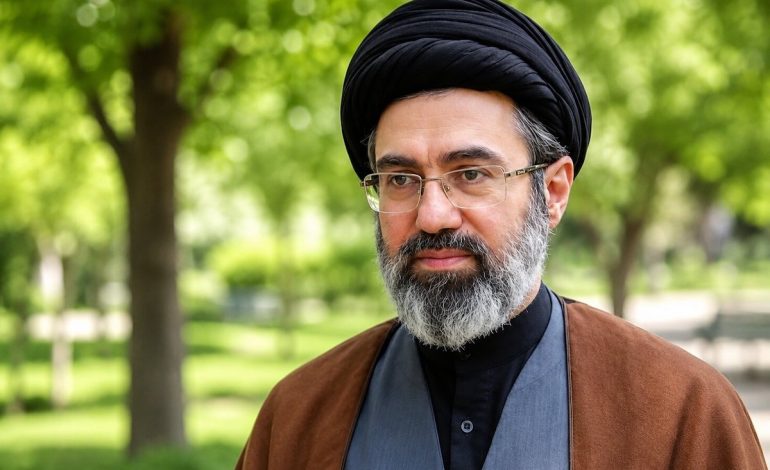
Mojtaba Khamenei.

New Delhi: Iran’s semi-official Mehr News Agency has released an undated video of the country’s supreme leader, Mojtaba Khamenei, appearing composed and engaged in a meeting with officials. The footage, barely 12 seconds long, was published days after Israeli media outlets reported that he had been rushed to hospital in an “extremely critical” condition.
The video shows Khamenei seated among advisers, apparently discussing Iran’s ongoing standoff with the United States and Israel. It marks one of the clearest visual signs of the 56-year-old leader’s condition since he assumed the country’s highest office in the aftermath of a devastating strike on his father in February.
The speculation began with a report from Israel’s Channel 14, which cited sources inside Iran to claim that Khamenei’s health had deteriorated sharply. The broadcaster’s account built on an earlier report by The Jerusalem Post, which quoted the Iran-focused outlet IranWire and sources described as close to the administration of Iran’s president, Masoud Pezeshkian.
One source cited by the Jerusalem Post went further, saying they would “not be surprised” if news of Khamenei’s death emerged soon. IranWire, for its part, reported that two sources close to Pezeshkian’s administration said the supreme leader had not met a single cabinet member since the strikes of February 28.
Those strikes, carried out jointly by the United States and Israel, killed Khamenei’s father, Ayatollah Ali Khamenei, along with several family members. Mojtaba was elevated to supreme leader by Iran’s Assembly of Experts in the strikes’ immediate aftermath, becoming the third person to hold the post since the 1979 revolution.
Tehran has now sought to push back on the narrative through Mehr, a semi-official agency run under the government’s Islamic Development Organisation. By releasing the clip, Iranian authorities appear to be signalling that their leader remains capable of functioning, even if the video’s undated nature leaves plenty of room for scepticism.
No independent verification of the footage’s timing has emerged so far. Western and Iranian-opposition sources have continued to suggest, without conclusive proof, that Khamenei sustained serious injuries in the February strikes.
Uncertainty over Khamenei’s whereabouts and physical state has persisted for months. In July, the Saudi outlet al-Hadath cited an Israeli security source to claim that he was not even in Iran, and that messages issued in his name were being drafted by Ahmad Vahidi, a senior Revolutionary Guard commander, rather than by Khamenei himself.
Around the same time, the US president, Donald Trump, told Fox News that Iran’s top military leadership had been “eliminated” and described Khamenei as “90% gone” following the American-Israeli campaign. Pezeshkian himself added to the ambiguity, acknowledging in a state television interview that direct interaction with the supreme leader was currently “very difficult”.
Earlier reports in March had gone as far as claiming Khamenei was in a coma and had lost a leg in the strikes, citing sources said to be inside Tehran. Iranian opposition figure Mohsen Sazegara told Euronews at the time that he understood Khamenei to be alive but recovering from injuries to his limbs.
Iranian officials have consistently rejected the more severe claims. Yousef Pezeshkian, the president’s son, wrote on Telegram in the days after the February strikes that friends with direct knowledge had assured him the new leader was “safe and sound”.
This is not the first time Iran’s leadership has faced foreign speculation over a supreme leader’s health, only to respond with carefully timed reassurances. A decade earlier, similar reports about Ayatollah Ali Khamenei’s health following a prostate operation were met with Iranian officials publicly vouching for his recovery through state media appearances.
The pattern this time follows a similar script – foreign claims of a grave condition, followed by an Iranian rebuttal delivered through curated footage rather than a live, unscripted appearance. Whether the latest video settles the matter is doubtful, since Khamenei is not seen speaking, and the agency has offered no date, location or independent corroboration for when it was filmed.
A vacuum or even a perception of one at the top of Iran’s clerical establishment carries consequences well beyond Tehran. The supreme leader holds authority over the Revolutionary Guard, the country’s nuclear posture, and its proxy network across the region, and any doubt about who is actually issuing orders complicates decision-making for adversaries and allies alike.
For India, which maintains a working relationship with Tehran despite the wider regional turmoil – including through the Chabahar port project and energy considerations – clarity on Iran’s chain of command matters for predictability in an already volatile west Asia. New Delhi has so far made no public comment on the succession question, treating it as an internal Iranian matter.