After Houthi attacks on Saudi Arabia, what have Pakistan and Türkiye done under the Mecca Defence Pact?
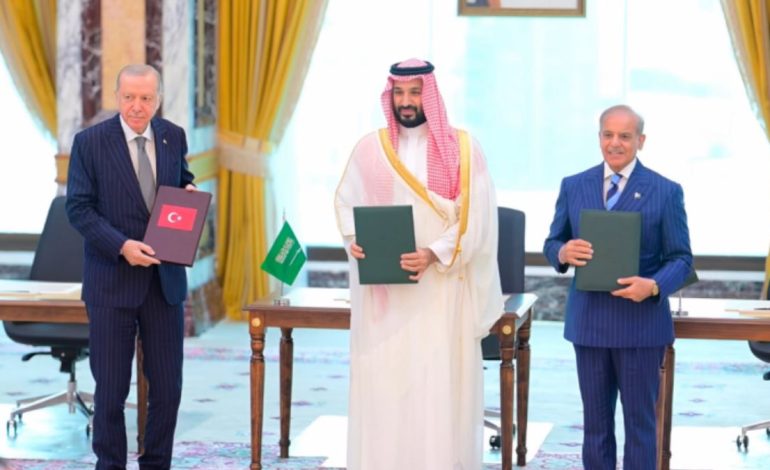
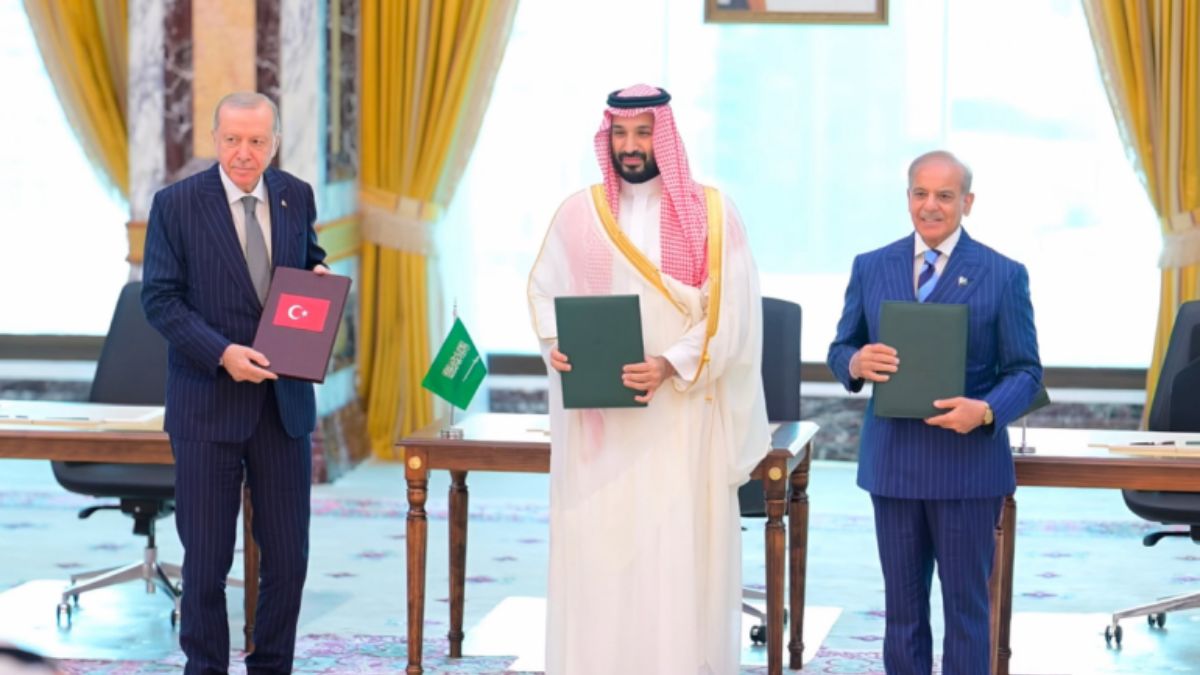
Saudi Arabia, Pakistan and Türkiye leaders at the signing of the Mecca Joint Defence Agreement. Image courtesy: X.com/@PakPMO

New Delhi: Saudi Arabia’s collective defence agreement with Pakistan and Türkiye is facing its first practical scrutiny after repeated Houthi attacks on the kingdom, including a drone that Riyadh said was intercepted south of Mecca. Both partners have publicly backed Saudi Arabia, but neither has announced a new combat operation against the Houthis.
The Mecca Joint Defence Agreement, signed on August 7, provides that an armed attack against any one of the three countries will be regarded as an attack against all. However, the publicly released framework does not prescribe an identical military response by each member, while mechanisms to implement the pact are still being developed.
Pakistan has made the stronger public military commitment. The director general of inter-services public relations, Lieutenant General Ahmed Sharif Chaudhry, told Arab News that Islamabad stood with Saudi Arabia “both diplomatically and physically” and would go to “any extent” for the kingdom’s security. Pakistani forces are already stationed in Saudi Arabia for training and logistical purposes under long-standing bilateral defence cooperation, but no fresh combat deployment against the Houthis has been announced.
Pakistan’s Foreign Office had said on September 10 that no military action under the Mecca agreement was then being discussed. On Wednesday, the foreign minister, Ishaq Dar, condemned the attempted drone attack targeting Mecca and reaffirmed Pakistan’s support for protecting Saudi Arabia and the Two Holy Mosques.
Türkiye has also condemned the Houthi attacks and reaffirmed support for Saudi sovereignty, territorial integrity and security. A Turkish diplomatic source in Ankara told AFP that Türkiye had received no official request from Saudi Arabia for military assistance, adding that the three countries’ armed forces still needed time to develop mechanisms for coordinating military operations.
Saudi Arabia said its air defences destroyed a Houthi drone south of Mecca before it entered the city’s restricted airspace. The Houthis denied targeting Mecca, although they have claimed other recent attacks on Saudi territory as fighting with the Saudi-led coalition has intensified.
As RNA Media reported earlier, the interception near Mecca brought renewed attention to the pact’s collective defence provision. Saudi Arabia has since faced further security alerts and attacks affecting cities and energy infrastructure.
The agreement was signed on August 7, 2026, at Al-Safa Palace in Mecca by Saudi Arabia’s crown prince and prime minister, Mohammed bin Salman, Pakistan’s prime minister, Shehbaz Sharif, and Türkiye’s president, Recep Tayyip Erdoğan, following a summit the three governments called the Makkah Al-Mukarramah Summit for Joint Defence.
The pact commits the three states to treat an armed attack against any one of them as an attack against all, and is aimed at strengthening collective deterrence while expanding defence cooperation among the three countries.
The agreement is built on Saudi Arabia and Pakistan’s existing 2025 Strategic Mutual Defence Agreement, extending a similar mutual-defence commitment to include Türkiye for the first time. According to Pakistan’s Foreign Office, the pact was grounded in the “longstanding historical ties” among the three states and the “bonds of brotherhood and Islamic solidarity” that unite them, and was framed as a response to the broader instability across the region rather than as a step towards confrontation with any specific adversary.