




DRDO tests quantum key distribution on live network to protect weapons trial data. What is QKD?
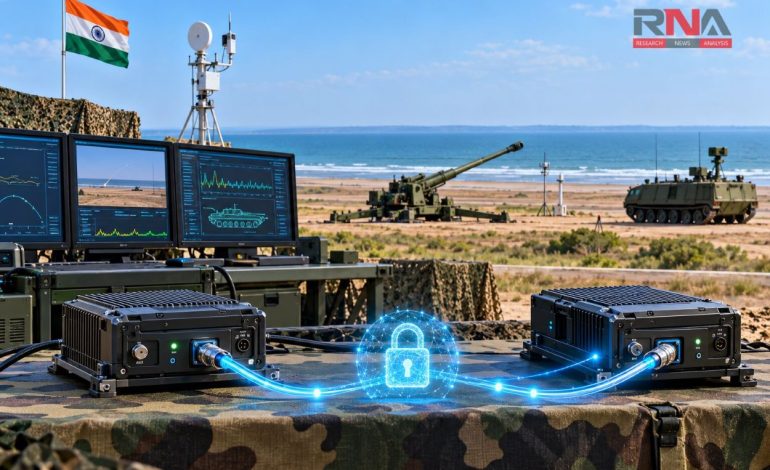
RNA Media illustration for representation.

New Delhi: The Defence Research and Development Organisation has successfully tested a quantum key distribution (QKD) platform on the live network at its Proof & Experimental Establishment (PXE) in Chandipur, Odisha. The demonstration, which was announced on Wednesday, advances efforts to protect sensitive information transmitted during artillery and armoured weapon trials.
The platform was developed under DRDO’s microelectronic devices, computational systems and cyber security cluster, with Taqbit Labs as its production partner. According to the announcement, the trial demonstrated its application in securing real-time observations and telemetry associated with weapons testing and evaluation.
These networks transmit sensor readings, performance measurements and other technical information between centres assessing military equipment. Protecting that traffic matters because it contains sensitive details about weapon behaviour and capabilities, while the live-network setting provides a practical test of integrating quantum security into existing range operations.
QKD generates shared cryptographic keys using quantum signals and allows the communicating parties to detect potential interception of the key exchange. Those keys support encryption of the data itself, making the technology a component of secure communications rather than a complete replacement for network security.
The announcement did not disclose the Chandipur link’s distance, secure key generation rate, operating duration or detailed security assessment. It therefore establishes a successful application on a working test-range network, without providing enough information to judge readiness for deployment across larger military networks.
The demonstration follows DRDO’s July 14 announcement that it had completed military field trials of a scalable fibre-based QKD system. Earlier, a joint DRDO-IIT Delhi experiment in early 2022 established a quantum key distribution link over more than 100 kilometres between Prayagraj and Vindhyachal using existing commercial-grade optical fibre.
A separate demonstration in June 2025 achieved entanglement-based quantum communication over more than one kilometre through open air at IIT Delhi. Together, these developments trace India’s progress from experimental quantum links towards systems intended to protect specific defence communication requirements under practical operating conditions.
What is QKD and how does it protect communications?
Quantum key distribution is a method of establishing a shared secret key between two communicating parties using quantum properties of light. The resulting key is an ordinary sequence of digital bits that an encryption system can use to scramble and recover information; the quantum element lies in how that key is established.
A typical arrangement requires two channels: an optical quantum channel carrying photons, and an authenticated conventional channel for exchanging processing information. The optical connection can run through fibre or open air, while authentication ensures that each endpoint is communicating with the intended partner rather than an impostor.
In a widely used approach, the transmitter randomly encodes bits in different photon polarization states, and the receiver independently chooses how to measure each arriving signal. They subsequently compare their measurement settings over the conventional channel and retain compatible results, without publicly revealing the retained bit values.
This process, called sifting, produces an initial key that still needs checking and refinement. Its security rests partly on the fact that unknown quantum states cannot be copied perfectly, while an interceptor’s measurements can introduce detectable disturbances into the exchange.
The endpoints examine a sample of their results to estimate the quantum bit error rate, which measures disagreement between their recorded bits. Errors can arise from equipment and environmental noise as well as interception, so an elevated error rate signals a security or reliability problem without necessarily proving that a spy is present.
If the observations permit secure key generation, error correction reconciles differences between the two versions of the key. Privacy amplification then mathematically compresses the reconciled material into a shorter secret key, reducing the information a potential adversary could retain, including information exposed during processing.
The finished key can support conventional encryption, or a one-time pad in which each secret key bit protects one message bit and is never reused. Consequently, the secure key generation rate should not be confused with the network’s data transmission speed: the relationship depends on the encryption method and how frequently keys are replaced.
Distance remains a major engineering constraint because optical fibre absorbs photons, reducing the number reaching the receiver. Ordinary telecommunications amplifiers cannot simply restore unknown quantum states, while many extended QKD networks use trusted relay sites whose physical security becomes part of the system’s overall protection.
Claims of unconditional security refer to guarantees under a defined mathematical model and its assumptions, rather than immunity from every practical attack. Faulty sources or detectors, compromised computers, weak authentication and insecure relay facilities can undermine a deployment, while disruption of the optical channel can interrupt key generation.
QKD also differs from post-quantum cryptography, which uses mathematical algorithms designed to resist attacks by future quantum computers and can run on conventional hardware. The US National Institute of Standards and Technology approved its first three post-quantum standards in August 2024, covering key establishment and digital signatures.
For defence users, evaluating QKD therefore requires measuring final secret key output, reliability, hardware security and integration with encryption and authentication. A successful live-network trial is meaningful evidence of practical progress, but wider deployment depends on demonstrating that the complete system remains secure and dependable under its intended operating conditions.