



India signs ₹4,106 crore defence contracts for Air Force satellite, Varunastra torpedoes
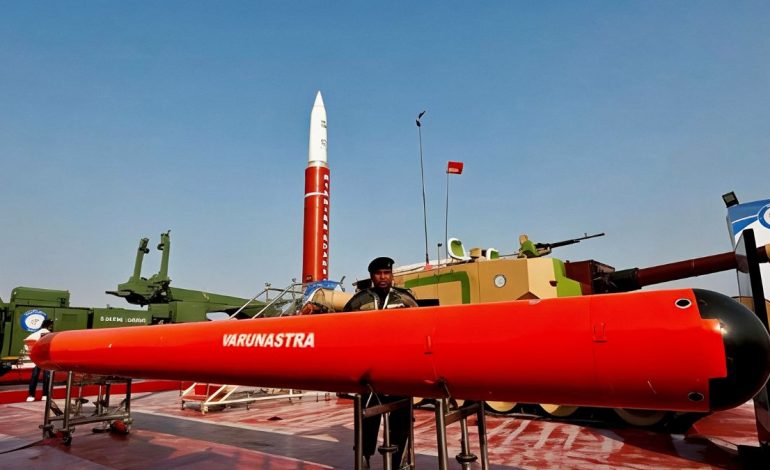
Varunastra, the Indian Navy’s indigenously developed heavyweight torpedo for anti-submarine warfare. (Image courtesy: X/@hippocrates04 )

New Delhi: The Ministry of Defence signed two contracts worth approximately ₹4,106 crore on Thursday for the GSAT-7C military communication satellite and Varunastra heavyweight torpedoes. The acquisitions address separate requirements of the Indian Air Force and Indian Navy, aiming to strengthen secure military communications and ship-launched anti-submarine capabilities.
The agreements were signed in New Delhi in the presence of A Anbarasu, additional secretary and director general (acquisition) in the defence ministry. The GSAT-7C contract is valued at ₹2,563 crore, while the Varunastra order is worth ₹1,543 crore.
Bengaluru based NewSpace India Limited (NSIL), the commercial arm of the Indian Space Research Organisation (Isro), will supply the indigenously designed, developed and manufactured GSAT-7C satellite.
The satellite is intended to provide secure, resilient communication links between Air Force aircraft, command centres and other military assets, including over distances beyond conventional line-of-sight radio coverage. Reliable satellite connectivity is particularly important for coordinating widely dispersed military operations.
The Defence Acquisition Council had approved a ₹2,236 crore proposal for GSAT-7C and associated ground hubs in November 2021, aimed at enabling real-time connectivity between software defined radios. The latest announcement does not clarify whether those ground hubs are included in the newly signed contract.
The ₹1,543 crore contract with Hyderabad based Bharat Dynamics Limited (BDL) covers Varunastra, an indigenous ship-launched heavyweight torpedo developed by the Naval Science and Technological Laboratory under the Defence Research and Development Organisation (DRDO).
The electrically propelled torpedo is equipped with advanced manoeuvring capabilities and is designed to engage hostile submarines at long ranges, according to the defence ministry. It uses acoustic homing guidance, offers selectable speeds of 27 and 40 knots and can operate at depths ranging from 8 to 600 metres, according to BDL.
Varunastra provides naval warships with an underwater attack capability against submarines detected during anti-submarine operations. The weapon was inducted into the Indian Navy in 2016, while BDL handed over an initial production torpedo in 2020. The latest contract represents additional procurement rather than the introduction of a new weapon system.
Both contracts support the government’s Atmanirbhar Bharat and Make in India initiatives, bringing together domestic space technology, defence manufacturing and indigenous weapons development.
The defence ministry has not announced a launch date for GSAT-7C or disclosed the number of Varunastra torpedoes ordered and their delivery schedule. The operational benefits of both contracts will depend on subsequent manufacturing, delivery and deployment.