


States race to lock in AI data-centre investments worth ₹9 lakh crore
RNA illustration for representation.

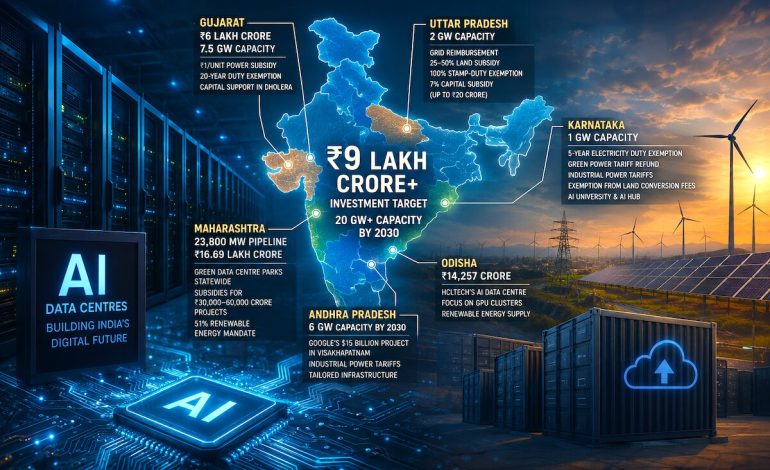
New Delhi: India’s states are competing aggressively to capture the country’s AI-driven data-centre boom, rolling out dedicated policies, power subsidies and land incentives to attract hyperscale investment. The combined state targets now exceed ₹9 lakh crore in investment and more than 20 gigawatts (GW) of capacity by 2030.
The rush reflects a broader bet that India’s data and computing needs will multiply as artificial intelligence adoption accelerates across sectors. States are differentiating themselves through concessional power tariffs, renewable energy mandates, land subsidies and tax exemptions, effectively bidding against each other for the same pool of global and domestic capital. India generates nearly 20% of the world’s data but currently accounts for only around 3% of global data centre capacity, underlining the scale of the opportunity states are chasing.
Gujarat’s ₹6 lakh crore push
Gujarat’s data centre policy for 2026–29 targets ₹6 lakh crore in investment and 7.5GW of capacity, the most ambitious among the states. The state is offering power at a ₹1-a-unit subsidy, a 20-year duty exemption and capital support for projects coming up in Dholera. The chief minister, Bhupendra Patel, unveiled the policy at Gandhinagar’s Mahatma Mandir, and the state said it had already received proposals from 14 companies to set up data centres, with investments expected to exceed ₹6 lakh crore in the first phase.
Gujarat’s deputy chief minister, Harsh Sanghavi, said Dholera is being positioned to become the world’s largest data centre city, backed by an upcoming airport and a semi-high-speed rail link from Ahmedabad. The state is drawing on its existing 69GW of installed power capacity, of which 47GW comes from renewable sources, to support the buildout. Investor appetite has already outpaced the policy’s initial allotment, with demand from companies in India and overseas reaching nearly twice the 7.5GW on offer.
The state has also signed on individual projects ahead of the policy, including a ₹25,000-crore, 250-megawatt (MW) green data centre with Larsen & Toubro Vyoma in the Dholera Special Investment Region, expected to begin operations by 2028.
UP, Karnataka target gigawatt-scale capacity
Uttar Pradesh’s 2026 policy aims for 2GW of capacity, backed by grid connection reimbursement, a land subsidy of 25–50% and a full stamp-duty exemption. A 7% capital subsidy is also on offer, capped at ₹20 crore.
Karnataka has finalised a new Green Data Centre Policy targeting 1GW of additional capacity. Incentives include a five-year exemption on electricity duty, a green power tariff refund, eligibility for industrial power tariffs and exemption from land conversion fees. The state is expanding hubs beyond Bengaluru to Mangalore and Mysuru, alongside plans for an AI University and an AI Hub built around shared GPU infrastructure.
Andhra banks on Google’s Vizag project
Andhra Pradesh is developing Visakhapatnam as an AI hub, targeting 6GW of capacity by 2030. The centrepiece is Google’s $15-billion project in the city, supported by industrial power tariffs and infrastructure tailored to the project’s needs. Construction began in April 2026 at Tarluvada, around 30km from Visakhapatnam, with the project spread across the 2026–2030 period and described by Google as a long-term blueprint for a full-stack AI ecosystem.
Three hyperscale campuses are planned across more than 600 acres at Adavivaram, Tarluvada and Rambilli, with land allocated to Google subsidiary Raiden Infotech India, and commissioning targeted for July 2028. The hub will start with roughly a gigawatt of capacity and is expected to scale up to multiple gigawatts as operations expand, forming part of a global network of Google AI hubs across 12 countries.
The state government has committed a combined 5GW of data centre capacity in Visakhapatnam alone across Google, Meta, Reliance, Tata Consultancy Services and other companies, with the chief minister, N Chandrababu Naidu, describing the ambition as turning the port city into a “Data City”. Officials expect the Google project alone to generate close to 188,000 jobs.
Odisha, Maharashtra scale up separately
Odisha has landed its first AI data centre project, a ₹14,257-crore investment with HCLTech, with a focus on GPU clusters and renewable energy supply. The facility will be set up in partnership with Sarvam and the Odisha government at the upcoming Odisha Sovereign AI Park in Bhubaneswar, combining HCLTech’s full-stack AI capabilities with Sarvam’s foundation models to build sector-specific AI applications for public and private enterprises.
A separate 5,000-seat global technology centre is also planned in Bhubaneswar, with operations expected to begin by 2028, though the number of GPUs, total IT load and the training-versus-inference compute mix have not yet been disclosed.
Maharashtra has expanded its Green Data Centre Parks policy statewide, building a pipeline of ₹16.69 lakh crore across 44 mega projects totalling 23,800MW. Subsidies are linked to investments in the ₹30,000–60,000-crore range, and the state has lowered its mandated renewable energy share to 51%.
The scale of competing incentives underlines the strategic weight states now attach to AI infrastructure, seen increasingly as a driver of jobs, investment and technological standing rather than a routine industrial project. Power availability, land and regulatory certainty have emerged as the deciding factors in where hyperscalers and domestic developers choose to build.
With states offering overlapping and, in some cases, more generous terms than their neighbours, questions remain over whether the sums pledged translate into commissioned capacity, or whether a national framework will eventually be needed to avoid a subsidy race that dilutes returns for the exchequer.