


As US’s unease over China’s AI rise deepens, White House announces $5 billion as Genesis Mission top-up
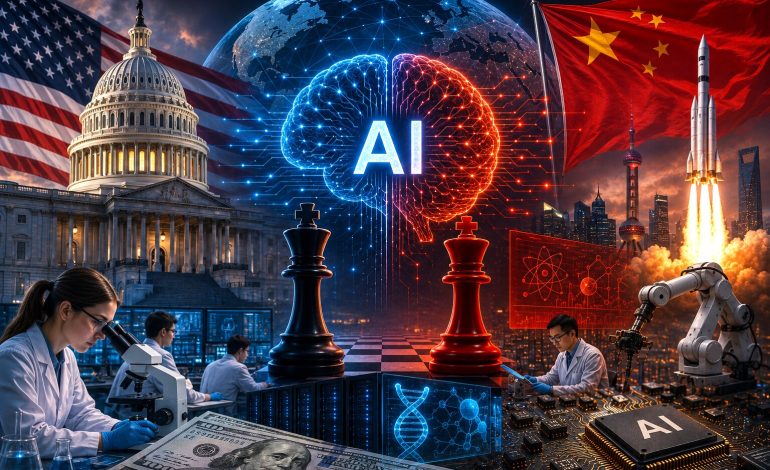
RNA illustration for representation.

New Delhi: The White House has unlocked more than $5 billion in additional federal funding for the Genesis Mission, its year-old drive to put artificial intelligence to work across American science. This comes at a moment when concern is building in Washington that China’s AI industry is closing the gap faster than many in the administration had expected.
The expansion was announced by the director of the White House Office of Science and Technology Policy, Michael Kratsios, alongside a new slate of “national science and technology challenges” that more than 15 federal agencies will now pursue jointly. The announcement was streamed live at the Genesis Mission 2026 summit, which opened at 9am ET (7.30pm IST) on Wednesday.
The Genesis Mission was launched by an executive order signed by the US president, Donald Trump, in November 2025 and began life inside the country’s energy department. It has since grown into what the White House calls a “whole of government” initiative, with agencies contributing research grants, funding calls, specialized datasets and laboratory facilities to a shared platform built by the department, called the American Science and Security Platform.
That platform is meant to connect researchers across government with data, computing power and AI tools in one place.
Kratsios described the effort as the continuation of a tradition of “national mobilizations paired with the construction of new institutions”. He added that it would let America harness AI for scientific discovery at a scale nobody else could match. The energy secretary, Chris Wright, said 278 projects had been selected from a strong field of applications, calling it evidence that the country’s innovation pipeline remained healthy.
Disease cures to nuclear forensics
The new challenges cover five broad areas. On health, the US health and human services department will combine long-running patient health data with environmental monitoring and national laboratory computing power to search for the root causes of chronic disease and childhood cancers, while the country’s veterans’ department will apply similar tools to genomic data from military veterans to catch disease risk earlier.
On infrastructure and energy, the transportation and energy departments plan to build digital twins of roads, buildings and the power grid to cut maintenance costs and improve reliability. A separate industrial strand aims to rebuild American strength in semiconductors and to speed up the design and testing of both civilian and military hardware, including, notably, conventional and nuclear weapon components.
A further set of challenges reaches into space science, quantum computing and automated laboratories that can run experiments with little human intervention, while a final strand is explicitly framed around security: detecting biological threats earlier and tracing the origin of nuclear materials.
The language used by some cabinet members left little doubt about the competitive framing behind the funding.
The interior secretary, Doug Burgum, said his department’s data on minerals, water and geology would help ensure the US had what it needed “to win the global race for AI”. The undersecretary of war for research and engineering, Emil Michael, said the Pentagon was scaling investment in AI, quantum computing and biotechnology to convert decades of accumulated data into a scientific advantage for American forces.
Why Washington is anxious now
The Genesis Mission’s expansion lands against a backdrop of mounting nervousness in the US capital about China’s progress in AI, a shift that has become sharper over the past two months. The rapid rise in competitiveness of China’s AI models has set off alarm in Washington, testing the limits of the usual protectionist response, with the US trade representative, Jamieson Greer, telling CNBC this week that his office was studying closely how Beijing was spreading its AI development.
Part of the anxiety is about strategy as much as raw capability. American AI firms appear to hold the lead for now, but Chinese rivals are pursuing a different race altogether, betting on cheaper, commercially appealing models rather than the most advanced ones. Analysts at the Boston Consulting Group have reached a similar conclusion, finding that while the United States retains its edge in talent and capital, China has steadily narrowed the gap in computing power and turned its intellectual-property strengths into a consistent fast-follower approach to frontier models.
That approach has produced results that have unsettled Washington. Chinese firms such as DeepSeek and Zhipu have made significant strides in closing the performance gap with American developers, and users worldwide are increasingly drawn to their open-source models and lower running costs, with Chinese systems accounting for a growing share of the most-used models on independent platforms.
Washington seemed to have seriously note that the Chinese president, Xi Jinping, used a Beijing technology conference this month to position China as a champion of AI as a “global public good”, launching a new grouping of nations sympathetic to Beijing’s approach to the technology.
The episode that appears to have concentrated minds most was a brief, chaotic few weeks in late June and early July. The US commerce department had ordered Anthropic to restrict access to its advanced Fable 5 and Mythos 5 models on national security grounds, forcing a global shutdown, only for the Chinese firm Zhipu to respond within a day by releasing its own powerful open-source model, GLM-5.2, free of charge, before Washington reversed its own order.
The rise of another Chinese model, Kimi K3, has since added further pressure on the administration’s AI policy, prompting a White House official to accuse a Chinese startup of distilling an American company’s model and using restricted Nvidia chips to do so.
That pressure appears to be reshaping policy thinking inside the administration. Officials are showing signs that they could move to ban leading Chinese AI models outright, a step that would effectively hand the domestic market to American firms, with the commerce department having previously weighed adding several Chinese AI laboratories to its export-control blacklist.
Beijing’s own ‘AI for science’ programme
China’s own push to apply AI to research is not new, and it long predates the Genesis Mission. The country’s ministry of science and technology and its national science foundation launched a national project in 2023 to embed AI into frontier research, and the Beijing municipal government followed in 2025 with a three-year plan to build a dedicated scientific language model and more than 10 specialized research databases by 2027. Researchers describe the effort as heavily state-subsidized and coordinated from the top, with particular focus on fields such as nuclear fusion and advanced materials.
In these areas, Beijing is deploying AI tools to secure a competitive edge, even as it grapples with continuing constraints on access to top-end chips.
That programme now sits inside a much larger national framework. China’s 15th five-year plan, covering 2026 to 2030, treats AI as a foundational national priority on a par with defence and economic growth. Officials project the country’s AI-related industries will exceed 1.4 trillion dollars in value by the end of the decade, and the same plan explicitly links AI ambitions to a parallel push for leadership in quantum computing.
Chinese officials have publicly framed the effort in cooperative rather than competitive terms, with the country’s science and technology minister saying Beijing wants AI governance built jointly with other nations and AI itself treated as a global public good that benefits all of humanity.
Seen against that backdrop, the Genesis Mission’s expansion reads less like a routine science-funding announcement and more like Washington’s attempt to answer a rival state programme with one of its own, backed by the deep data resources of its national laboratories, health agencies and military research arms. The White House has said further announcements on industry and international partners are still to come, suggesting Wednesday’s funding round is an opening move rather than the whole of it.