


Monsoon fury: Indian Air Force keeps humanitarian air bridge open to Nagaland, airlifts over 250 stranded people
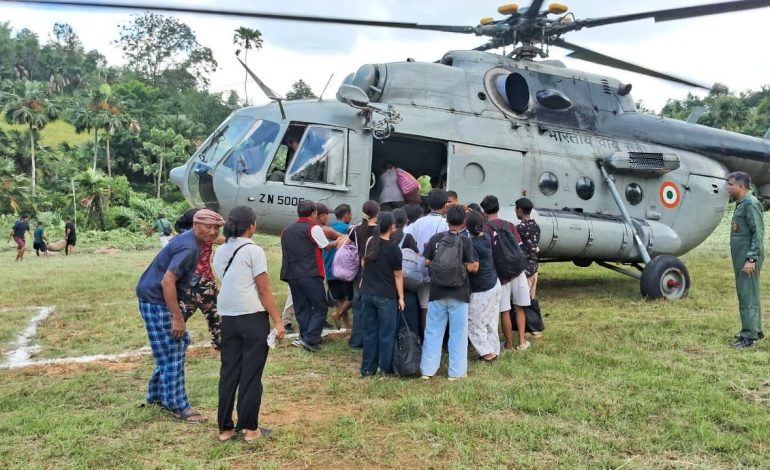
An IAF helicopter evacuating stranded people from a Nagaland village. (Photo: X/@IAF_MCC)

New Delhi: The Indian Air Force continued its aerial relief mission across Nagaland on, evacuating stranded passengers from parts of the state left cut off by monsoon-related road damage. Two helicopters were deployed to the extra assistant commissioner’s headquarters at Namsang, in Longleng district, from where they evacuated 42 stranded passengers on Monday, bringing the total number of evacuees to more than 250.
The Namsang sorties formed part of a wider day of operations that the Air Force carried out at the request of the Nagaland State Disaster Management Authority (NSDMA), as flights resumed following a day’s suspension caused by bad weather. By the time the day’s flying was done, the two helicopters had between them evacuated 107 people and airlifted 4.65 metric tonnes of relief material into the district.
Earlier on Monday, the first sortie of the day had delivered 1.85 and 1.30 metric tonnes of supplies to Namsang before evacuating 22 and 26 stranded passengers back to Dimapur. A second sortie followed to carry relief material that could not be accommodated earlier because of payload limits, with one helicopter delivering a further 1.50 metric tonnes before evacuating 25 more passengers, and the other ferrying 17 passengers from Dimapur to Longleng and returning with 18 stranded people.
Those flown out included students, patients and other civilians whose journeys had been blocked by the collapse of road links across the district. The operation took the Air Force’s tally of evacuees from Nagaland since July 23 past 250.
Longleng district remained largely cut off by road even as the air effort continued. The Longleng-Tuensang road had been partially reopened for single-lane light vehicles, subject to weather, but six other routes linking the district to Changtongya, Tamlu, Tobu, Aboi and Namsang remained closed.
Within Longleng town itself, land subsidence and fresh ground cracks forced the evacuation of several families from Shamkang and local high school wards over the weekend. Two houses were reported completely washed away, and a third has developed severe structural cracks and been declared unsafe.
The Air Force had similarly airlifted a combined 148 stranded passengers out of Mon and Longleng on July 23 and 24, before poor weather forced a suspension of flights on July 26. The Namsang evacuations on Monday marked a resumption of that effort rather than a fresh crisis.
The relief effort now under way extends well beyond Longleng. In Mon district, the disaster management authority has distributed essential supplies to more than 360 landslide-affected families, while road-clearing crews from the Public Works Department, the National Highways Infrastructure Development Corporation Limited and the Border Roads Organisation continue working on several blocked stretches.
Tuensang district, meanwhile, is contending with a separate and continuing land subsidence emergency that has forced the evacuation of 49 families since July 19. The ground near the district transport office is reportedly sinking by six to eight inches a day, prompting the demolition of at-risk buildings.
In Mokokchung, restoration crews have redirected traffic onto an alternative national highway after landslides damaged the main route linking the district to Amguri. A relief camp at Tuli is currently sheltering 19 displaced people from nine families.
The India Meteorological Department and the NSDMA have both flagged fresh spells of heavy to very heavy rain and thunderstorms across Nagaland from Tuesday to Friday, raising the prospect of further disruption just as restoration work gathers pace. Authorities have urged residents in landslide-prone and low-lying areas to stay alert.
The NSDMA said it continues to coordinate closely with district administrations and all responding agencies to keep rescue, relief and restoration work moving. It also acknowledged the Air Force’s role in sustaining the airlift to Longleng through a week of largely uncooperative weather.
The Namsang sorties formed part of a wider day of operations that the Air Force carried out at the request of the Nagaland State Disaster Management Authority (NSDMA), as flights resumed following a day’s suspension caused by bad weather. By the time the day’s flying was done, the two helicopters had between them evacuated 107 people and airlifted 4.65 metric tonnes of relief material into the district.
Earlier on Monday, the first sortie of the day had delivered 1.85 and 1.30 metric tonnes of supplies to Namsang before evacuating 22 and 26 stranded passengers back to Dimapur. A second sortie followed to carry relief material that could not be accommodated earlier because of payload limits, with one helicopter delivering a further 1.50 metric tonnes before evacuating 25 more passengers, and the other ferrying 17 passengers from Dimapur to Longleng and returning with 18 stranded people.
Those flown out included students, patients and other civilians whose journeys had been blocked by the collapse of road links across the district. The operation took the Air Force’s tally of evacuees from Nagaland since July 23 past 250.
Longleng district remained largely cut off by road even as the air effort continued. The Longleng-Tuensang road had been partially reopened for single-lane light vehicles, subject to weather, but six other routes linking the district to Changtongya, Tamlu, Tobu, Aboi and Namsang remained closed.
Within Longleng town itself, land subsidence and fresh ground cracks forced the evacuation of several families from Shamkang and local high school wards over the weekend. Two houses were reported completely washed away, and a third has developed severe structural cracks and been declared unsafe.
The Air Force had similarly airlifted a combined 148 stranded passengers out of Mon and Longleng on July 23 and 24, before poor weather forced a suspension of flights on July 26. The Namsang evacuations on Monday marked a resumption of that effort rather than a fresh crisis.
The relief effort now under way extends well beyond Longleng. In Mon district, the disaster management authority has distributed essential supplies to more than 360 landslide-affected families, while road-clearing crews from the Public Works Department, the National Highways Infrastructure Development Corporation Limited and the Border Roads Organisation continue working on several blocked stretches.
Tuensang district, meanwhile, is contending with a separate and continuing land subsidence emergency that has forced the evacuation of 49 families since July 19. The ground near the district transport office is reportedly sinking by six to eight inches a day, prompting the demolition of at-risk buildings.
In Mokokchung, restoration crews have redirected traffic onto an alternative national highway after landslides damaged the main route linking the district to Amguri. A relief camp at Tuli is currently sheltering 19 displaced people from nine families.
The India Meteorological Department and the NSDMA have both flagged fresh spells of heavy to very heavy rain and thunderstorms across Nagaland from July 28 to 31, raising the prospect of further disruption just as restoration work gathers pace. Authorities have urged residents in landslide-prone and low-lying areas to stay alert.
The NSDMA said it continues to coordinate closely with district administrations and all responding agencies to keep rescue, relief and restoration work moving. It also acknowledged the Air Force’s role in sustaining the airlift to Longleng through a week of largely uncooperative weather.