
Centre tightens noose around Zakir Naik’s IRF, empowers states to freeze funds and restrict access to properties
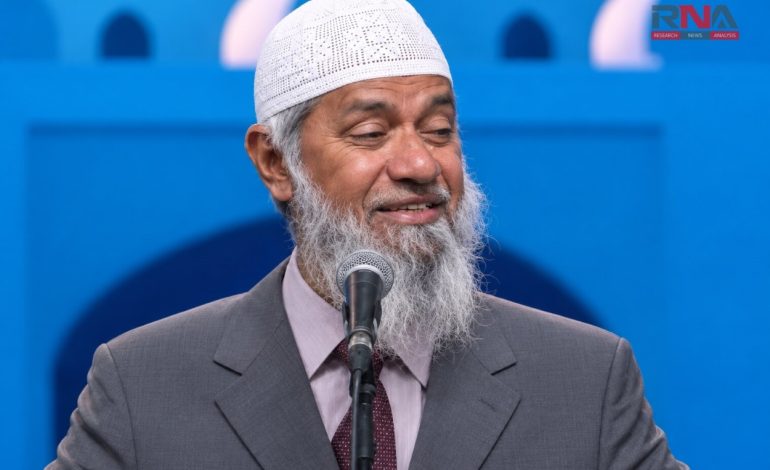
Digitally enhanced screenshot of a video showing Zakir Naik preaching.

New Delhi: The Centre has widened its crackdown on fugitive Islamic preacher Zakir Naik’s banned Islamic Research Foundation (IRF), empowering state governments and Union territory administrations to block its financial transactions and restrict access to premises used by the organization. The move comes nearly two weeks after the Union home ministry extended the ban on the foundation for another five years, citing threats to national security and communal harmony.
In a Gazette notification issued on Thursday, the Ministry of Home Affairs invoked Section 42 of the Unlawful Activities (Prevention) Act, 1967 (UAPA), to authorize states and Union territories to exercise powers available to the Centre under Sections 7 and 8 of the law. The decision effectively decentralizes the enforcement of financial and property-related restrictions against the foundation, enabling authorities across the country to act within their respective jurisdictions.
The development marks a renewed effort by New Delhi to dismantle any remaining financial and organizational infrastructure associated with the IRF in India, even as Naik continues to live in Malaysia. It also comes against the backdrop of Kuala Lumpur’s decision not to extradite the preacher to India, where he faces criminal proceedings.
What powers have states been given?
Under Section 7 of the UAPA, the authorities can prohibit financial transactions involving money, securities or credits believed to be intended for the activities of an unlawful association. Individuals, institutions or other entities holding such assets can be directed not to transfer, disburse or otherwise deal with them without prior written authorization from the government.
The provision also allows a designated gazetted officer to investigate suspected financial dealings, inspect relevant premises and examine documents and records. This could enable state authorities to identify and disrupt financial channels supporting the banned foundation, including those involving individuals or entities acting on its behalf.
Section 8 of the UAPA, meanwhile, deals with physical infrastructure used by unlawful associations and empowers the government to formally notify premises suspected of being used for their activities. These may include residential buildings, offices, portions of buildings and even vessels.
Once such a notification is issued, the district magistrate can prepare an inventory of movable assets at the premises and impose restrictions on the use of articles believed to be connected with the banned organization. Entry into the premises can also be regulated, while police officers of the rank of sub-inspector or above may exercise statutory search powers.
The notification does not, however, amount to an automatic confiscation of every property associated with Naik or his foundation. The UAPA prescribes specific procedures for imposing restrictions and provides affected parties with recourse to the district judge to challenge prohibitory orders and notifications.
IRF ban extended until 2031
The latest directive follows the home ministry’s November 13, 2026, notification, declaring the IRF an unlawful association for another five years with immediate effect. The previous ban, imposed in November 2021, was due to expire on November 14, 2026.
As RNA Media reported earlier, the government justified the extension by citing the foundation’s alleged involvement in promoting religious hostility, encouraging radicalization and undertaking activities prejudicial to India’s sovereignty and territorial integrity. The ministry also expressed apprehension that lifting the ban could allow the organization to regroup and revive its activities.
The IRF was first outlawed on November 17, following investigations into its activities and Naik’s public speeches, with the prohibition subsequently renewed on November 15, 2021. Tribunals constituted under the UAPA upheld the government’s decisions in 2017 and 2022, respectively.
The latest five-year prohibition remains subject to the statutory review mechanism under Section 4 of the UAPA, which requires a tribunal to examine whether sufficient grounds exist for declaring an association unlawful.
A decadelong pursuit of Zakir Naik
A Mumbai-born medical graduate, Naik established the IRF in 1991 and subsequently gained an international following through lectures on Islam and comparative religion. His influence expanded considerably through satellite television broadcasts, particularly Peace TV, and later through digital and social media platforms.
Indian security agencies intensified their scrutiny of Naik in 2016 following reports that individuals associated with the terrorist attack on the Holey Artisan Bakery in Bangladesh’s capital, Dhaka, had been influenced by his preaching. The controversy brought his speeches and the activities of his foundation under heightened scrutiny.
The National Investigation Agency (NIA) filed a chargesheet against Naik in October 2017, accusing him of criminal conspiracy, promoting religious enmity and offences under the UAPA. Separately, the Enforcement Directorate (ED) initiated proceedings over alleged money laundering.
Naik, who holds permanent residency in Malaysia, has consistently denied allegations of money laundering and inciting religious hatred. He has not returned to India since leaving the country in 2016.
Malaysia’s refusal to extradite Naik
The Centre’s latest move assumes additional significance in the light of Malaysia’s position on India’s extradition request, which has remained unresolved for several years. New Delhi formally approached Kuala Lumpur on January 19, 2018, seeking Naik’s provisional arrest and extradition.
On November 3, Malaysia’s home ministry informed the country’s parliament that it had decided against extraditing Naik and had made no commitment to surrender him to Indian authorities. The ministry cited provisions of the bilateral extradition treaty signed in 2010 and Malaysia’s domestic extradition legislation.
Kuala Lumpur also disclosed that India had submitted a diplomatic communication seeking reconsideration on May 29, 2020, but that no fresh formal extradition request had since been received.
Why the Centre’s move matters
With Naik remaining beyond the immediate reach of Indian law-enforcement agencies, the delegation of powers represents an attempt to strengthen enforcement against his organization’s potential support network within India. Bringing state governments directly into the process could improve coordination between central investigating agencies, local police forces and district administrations.
The effectiveness of the measure will, however, depend on the ability of authorities to establish links between suspected assets or activities and the outlawed foundation. The November 26 notification expands the machinery available to enforce the ban domestically, but does not resolve the diplomatic and legal obstacles surrounding Naik’s extradition.