
Israel’s power struggle takes dramatic turn as Eisenkot opens coalition talks with Netanyahu’s Likud
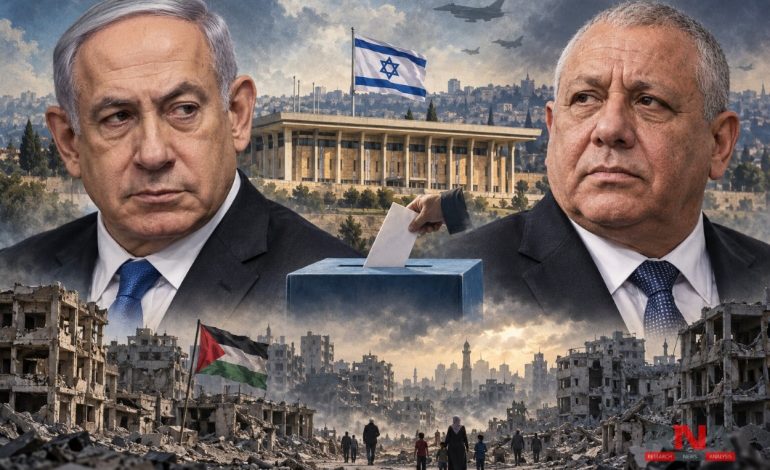
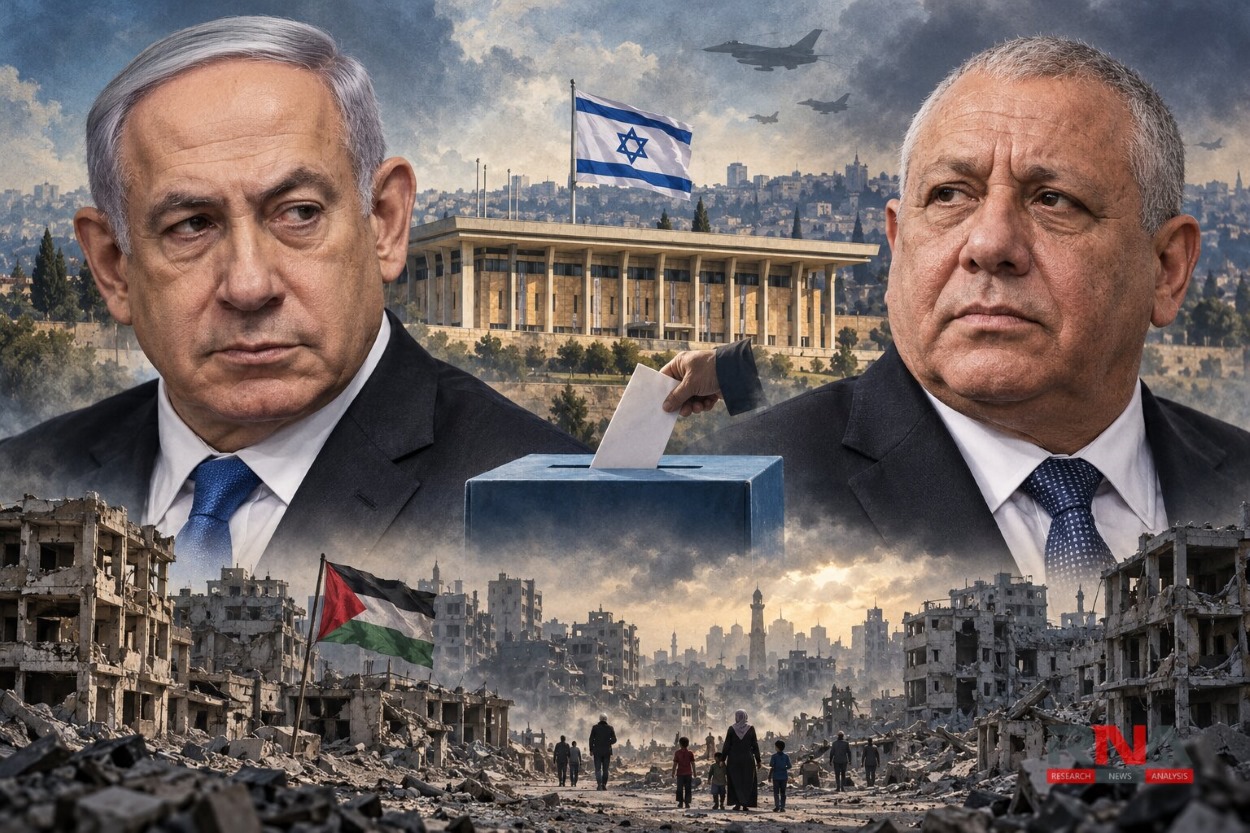
RNA Media illustration featuring Benjamin Netanyahu (L) and Gadi Eisenkot for representation.

New Delhi: Israel’s prolonged political deadlock has entered a decisive phase after the opposition leader, Gadi Eisenkot, opened negotiations with the Likud party of the caretaker prime minister, Benjamin Netanyahu, in an attempt to assemble a new government following last month’s inconclusive parliamentary election. The unexpected outreach has raised the possibility of a national unity administration but also exposed fundamental disagreements over political leadership, Palestinian statehood, military conscription and Israel’s future security policies.
Negotiating teams from Eisenkot’s centrist Yashar party and Netanyahu’s Likud met at a hotel in Herzliya, near Tel Aviv, on Sunday, November 22, for another round of discussions aimed at breaking the stalemate. According to AFP, the meeting followed earlier negotiations but began with both sides maintaining positions that could make a compromise difficult.
The fresh initiative followed an announcement by Yashar on Saturday that Eisenkot had instructed his representatives to explore every viable political arrangement, including a potential partnership with Netanyahu’s right-wing party. The former chief of the Israel Defense Forces (IDF), who campaigned on replacing Netanyahu, has indicated that he could cooperate with Likud lawmakers but remains opposed to serving in a government headed by the outgoing prime minister.
The negotiations come against the backdrop of the October 27 parliamentary election, which deprived Netanyahu’s governing alliance of its majority without producing a clear alternative capable of governing independently. As RNA Media reported after the certification of the results, Netanyahu’s bloc secured 53 seats in the 120-member Knesset, Eisenkot’s opposition alliance won 48, and two Arab-led parties together captured 19 seats.
Coalition arithmetic complicates Eisenkot’s bid
Although Netanyahu’s alliance emerged with more seats than Eisenkot’s bloc, the latter secured broader support during consultations conducted by the president, Isaac Herzog, following the election. Representatives of parties holding 67 parliamentary seats recommended Eisenkot to form the next government, against 46 who supported Netanyahu, prompting Herzog to formally entrust Eisenkot with the task on November 8.
However, a presidential mandate does not automatically translate into a workable parliamentary majority, particularly when parties recommending the same candidate disagree on who should participate in the government. Eisenkot must secure sufficient support in the Knesset, where 61 seats constitute an absolute majority, by December 6, although the president can grant a further 14 days if negotiations show prospects of success.
The most contentious question concerns the participation of Arab-led parties, whose combined 19 seats could provide the opposition with enough parliamentary support to challenge Netanyahu’s bloc. As RNA Media reported earlier this month, the veteran Arab lawmaker, Ahmad Tibi, indicated that the Joint List was prepared to support an opposition-led administration without necessarily joining the governing coalition.
That option, however, faces resistance from sections of Eisenkot’s own political camp, particularly the nationalist politician Avigdor Liberman, who opposes a government dependent on Arab-party support. Liberman favours negotiations with ultra-Orthodox Jewish parties instead, although differences over compulsory military service and the privileges enjoyed by religious communities present another significant obstacle.
Netanyahu lays down tough conditions
Netanyahu has advocated a broad national unity government, arguing that Israel requires political stability to address its security challenges following years of conflict in Gaza and escalating regional tensions. His party has nevertheless made clear that any partnership must preserve several fundamental positions associated with the outgoing administration, potentially limiting Eisenkot’s ability to pursue meaningful policy changes.
Likud has demanded an end to political boycotts and personal attacks against Netanyahu, alongside a commitment to exclude Arab parties from the proposed coalition. It has also sought agreement on rejecting Palestinian statehood, retaining Israeli security control in designated areas of Gaza, Lebanon and Syria, and resolving the contentious issue of ultra-Orthodox military conscription through negotiations with religious leaders.
These demands could turn the coalition exercise into a larger contest over the direction of Israeli security and foreign policy, rather than merely a dispute over ministerial positions. Although Eisenkot and Netanyahu share several hawkish security positions, their differences over political accountability, institutional reforms and the composition of a future administration could prove difficult to reconcile.
Another complication involves the former prime minister, Naftali Bennett, an important partner in the anti-Netanyahu camp, who has categorically rejected joining a government involving Netanyahu or his political bloc. Bennett has instead advocated a broad coalition headed by Eisenkot, making any arrangement that restores Netanyahu to a leading governmental position potentially unacceptable to a crucial section of the opposition.
Minority government remains an option
With time running out, Eisenkot has also signalled his willingness to present a minority national emergency government for parliamentary approval if negotiations for a broader coalition collapse. Such an arrangement could initially depend on support from Arab lawmakers outside the government, although opposition from nationalist parties would make its survival uncertain.
The stakes extend beyond coalition politics, particularly for Netanyahu, who continues to face a corruption trial and demands for an independent investigation into the security failures preceding the Hamas-led attacks of October 7, 2023. Eisenkot’s allies have already introduced legislative proposals addressing institutional accountability and limits on prime ministerial tenure, issues that could further complicate negotiations with Likud.
Eisenkot has nevertheless secured an important parliamentary advantage, with his ally, Matan Kahana, elected speaker of the Knesset on November 17 in a setback for Netanyahu’s political camp. The development demonstrated that opposition parties could cooperate on parliamentary appointments, although building a durable governing coalition remains considerably more complicated.
For Israel’s regional partners, including India, the outcome will determine who directs Israeli diplomacy and defence policy during a period of continuing instability across West Asia. Whether Eisenkot succeeds in replacing Netanyahu, negotiates an uneasy power-sharing arrangement or fails to secure a majority, the coming weeks could significantly influence Israel’s political direction and its handling of regional security challenges.