



India’s population hits 1.47 billion, widens lead over China as UN warns of shrinking youth advantage
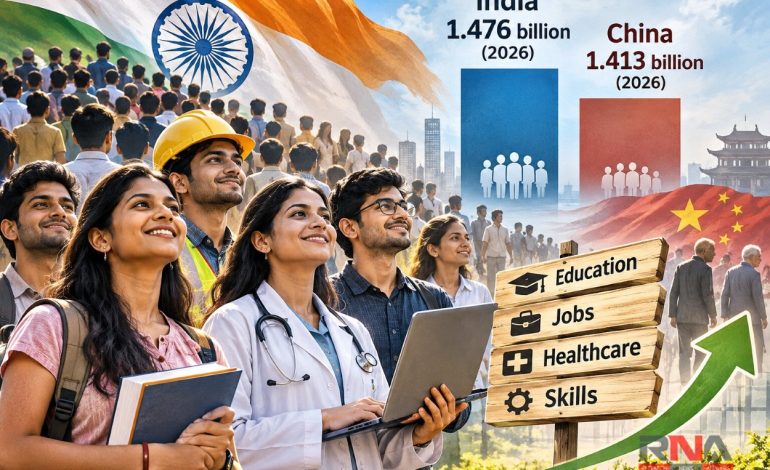
RNA Media illustration for representation.

New Delhi: India’s population has reached an estimated 1.476 billion in 2026, consolidating its position as the world’s most populous country and widening its demographic lead over China, according to the latest United Nations Population Fund (Unfpa) report. However, the UN agency has cautioned that India’s large population of young people will translate into an economic advantage only if the country accelerates investment in education, employment, healthcare and skills development before its demographic window begins to close.
The State of World Population Report 2026, released on November 19, places India’s population at 1,476.6 million, compared with China’s 1,412.9 million – a difference of nearly 64 million people. The findings underline the increasingly different demographic trajectories of Asia’s two largest powers, with India retaining a relatively youthful population as China confronts declining fertility and a rapidly ageing society.
India overtook China in 2023, ending the latter’s decades-long position as the world’s most populous nation, according to UN population estimates. Its population has continued growing despite a sustained decline in fertility, reflecting the demographic momentum created by earlier generations with comparatively high birth rates.
India’s demographic advantage over China
The Unfpa figures show that approximately 69 per cent of India’s population falls within the economically productive age group of 15–64, compared with 70 per cent in China. However, the more consequential difference lies at the opposite ends of the age spectrum, where India’s younger population gives it a potentially longer period of workforce expansion.
Around 26 per cent of Indians are aged 10–24, representing approximately 384 million people, compared with 18 per cent in China. Meanwhile, only eight per cent of India’s population is aged 65 or older, against 15 per cent in China, highlighting the considerably heavier ageing burden facing Beijing.
China’s fertility rate has fallen to approximately 1.0 birth per woman, well below the replacement level of 2.1, despite successive measures to encourage larger families. India’s estimated fertility rate is also below replacement level at 1.9, suggesting that its population growth will eventually slow before reversing.
There was no verified official Chinese government response specifically addressing the Unfpa report at the time of reporting on Wednesday. Nevertheless, the demographic comparison has broader economic implications, particularly for labour availability, industrial competitiveness, domestic consumption and the sustainability of pension and healthcare systems.
Young population not automatically economic dividend
The Unfpa’s central argument is that favourable demographics alone cannot guarantee economic growth, because a large working-age population becomes an advantage only when sufficient productive employment is available. Without improvements in educational outcomes, workforce participation and employment quality, India risks seeing its demographic opportunity weakened by unemployment, underemployment and persistent income inequality.
The agency’s India-specific assessment emphasizes expanding access to education, vocational training, healthcare and economic opportunities, particularly for young women and underserved communities. It also warns that regional disparities remain substantial, making targeted investment essential rather than relying exclusively on national averages.
These differences are particularly visible in fertility trends across Indian states, with the latest National Family Health Survey (NFHS-6) recording rates ranging from 1.0 birth per woman in Sikkim to 2.7 in Bihar. Such variations mean that some states are already approaching the demographic challenges associated with ageing societies, while others must prepare for continuing growth in their young populations.
India’s population is projected to peak at approximately 1.7 billion around the middle of the 2060s before gradually declining, according to longer-term UN projections. That trajectory gives policymakers several decades to strengthen the economy’s capacity to absorb new workers, although the most favourable period for securing a demographic dividend will not remain open indefinitely.
Young Indians remain optimistic about future
Beyond population estimates, the 2026 report draws on Unfpa’s Demographic Futures Survey, which covered more than 108,000 internet-connected adults across 73 countries, including 1,722 respondents in India. The findings suggest that young people’s decisions about employment, marriage and parenthood are increasingly shaped by their economic circumstances and access to essential services.
In India, 83 per cent of respondents expressed optimism about their future, although 47 per cent reported concerns involving conflict, economic insecurity and inequality. Women aged 18–39 identified an ideal family size of 2.1 children, while nearly 85 per cent of childless respondents aged 35–39 said they would ideally like to become parents.
The report also records improvements in maternal healthcare, with maternal mortality falling to 87 deaths per 100,000 live births during 2022–24 and skilled health personnel attending 91.3 per cent of births. Nevertheless, Unfpa has called for stronger primary healthcare systems and accessible reproductive health services to ensure that young people can make informed choices about their futures.
Strategic implications for India
India’s demographic position could strengthen its competitiveness in manufacturing, technology and services as economies such as China, Japan and South Korea grapple with ageing workforces. However, realizing that potential will require sustained job creation, higher female labour-force participation, stronger technical education and improvements in productivity rather than depending on population numbers alone.
The significance of India’s expanding labour pool has also featured in discussions about international economic cooperation, including a recent RNA Media report on India-Russia trade ambitions. That report highlighted India’s large population and working-age workforce as important elements of its long-term economic attractiveness.
The Unfpa findings ultimately present India with a development challenge rather than a demographic victory over China, because population size by itself says little about economic prosperity or living standards. India’s ability to capitalize on its youthful population will depend on how effectively it converts millions of new entrants into the workforce into skilled, healthy and economically productive citizens.