



Russia’s answer to Starlink enters Ukraine war. Why the battle for satellite supremacy matters to India
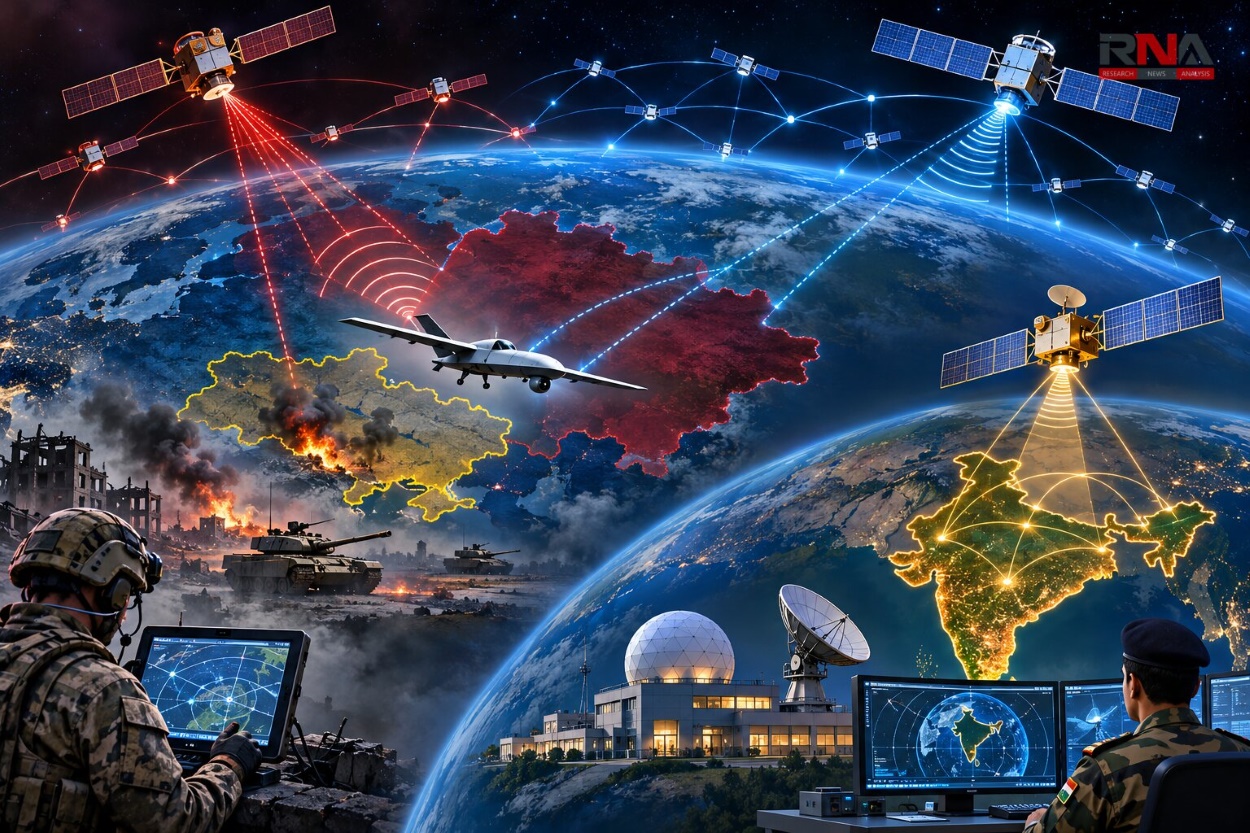
RNA Media illustration for representation.

New Delhi: Russia has begun using its newly developed Rassvet satellite network for military communications over Ukraine, potentially giving its forces a new means of controlling battlefield drones and directing precision strikes without relying on western satellite infrastructure. The development, disclosed by Ukrainian military intelligence on Friday, signals a significant new phase in the technological competition underpinning the Russia-Ukraine war, where access to secure, high-speed communications has become almost as important as conventional weapons.
The Russian system, conceived as a domestic alternative to Elon Musk’s Starlink network, remains considerably smaller and less capable than its American counterpart, but Moscow is accelerating efforts to expand its coverage. The disclosure coincided with a warning from Russia’s security council that western-controlled satellite networks could threaten national sovereignty, highlighting the growing strategic importance of communications infrastructure operating hundreds of kilometres above the battlefield.
Ukraine’s main intelligence directorate (GUR) confirmed that Russian forces were already employing Rassvet satellites to communicate over Ukrainian territory, Reuters reported. The network currently provides only intermittent connectivity, but Ukrainian intelligence believes its expansion could eventually help Russia transmit reconnaissance information, redirect attack drones during flight and make aerial operations more difficult to disrupt through electronic warfare.
Andrii Yusov, a spokesman for Ukrainian military intelligence, said Russia had not yet deployed enough satellites to guarantee uninterrupted communications across Ukraine. Nevertheless, the emerging network provides Moscow with an independent space-based communications capability at a time when access to American satellite services has become increasingly restricted.
Russia has launched 32 operational Rassvet satellites in two batches during March and July this year, according to Ukrainian intelligence, with further deployments planned before the end of the year. The system is being developed by the Russian technology company Bureau 1440, which has outlined plans for a constellation exceeding 900 satellites by 2035, although achieving that target will require substantial manufacturing capacity, launch infrastructure and reliable access to advanced electronic components.
How Rassvet could change drone warfare
The immediate military significance of Rassvet lies in its potential to overcome limitations affecting Russia’s expanding fleet of reconnaissance and attack drones. Traditionally, many long-range unmanned aircraft have depended on pre-programmed flight paths, satellite navigation and onboard guidance systems, limiting operators’ ability to alter their missions after launch.
A reliable two-way satellite connection could allow operators to receive surveillance information from aircraft in flight, adjust their routes and provide new target coordinates as battlefield conditions change. It could also enable reconnaissance drones to transmit imagery over considerably greater distances without depending exclusively on terrestrial radio links or intermediate relay platforms.
Such capabilities are particularly relevant to a conflict in which both Russia and Ukraine have increasingly employed drones to strike military installations, logistics facilities, transport networks and energy infrastructure. Satellite communications could make some unmanned aircraft more adaptable, although their effectiveness would still depend on the quality of the onboard equipment, available bandwidth, ground terminals and resistance to electronic interference.
Mykola Zientsev, a Kyiv-based security analyst cited by Reuters, assessed that Russia already possessed at least two useful satellite communications windows each day, each lasting more than an hour. He also pointed to indications that the emerging capability was influencing the precision of Russian attacks involving jet-powered drones, although the extent of any operational improvement remains difficult to establish independently.
The technology could also complicate Ukrainian efforts to intercept Russian drones by severing their communications links. Conventional radio-controlled drones often rely on signals transmitted from relatively nearby ground stations, whereas low-Earth-orbit satellite connectivity can support communications across much longer distances and potentially offer alternative pathways when terrestrial links are disrupted.
Satellite-connected drones are not immune to jamming, however, and their performance depends on antenna design, signal strength, frequency management and the availability of satellites overhead. The system also introduces new vulnerabilities involving ground infrastructure, electronic interference and the security of communication terminals, meaning that satellite connectivity should not be confused with guaranteed protection against electronic warfare.
Why Russia is building its own Starlink
Rassvet is part of Moscow’s effort to reduce its dependence on technologies controlled by countries supporting Ukraine, particularly in communications, surveillance and electronic systems. Western sanctions have complicated Russia’s access to advanced components, but the war has also demonstrated the operational disadvantages of relying on infrastructure that an adversary or foreign commercial provider can restrict.
During the earlier stages of the conflict, Russian forces reportedly acquired Starlink terminals through unofficial supply channels and employed them in battlefield communications. Ukrainian authorities subsequently worked with SpaceX to identify and disable unauthorized Russian-operated terminals, restricting Moscow’s ability to exploit a system that had become central to Ukrainian military operations.
The asymmetry is substantial, since Starlink operates more than 10,000 active satellites, compared with Russia’s small but growing Rassvet constellation. The American network can provide much broader and more continuous coverage, whereas the Russian system currently depends on limited periods when its satellites pass over areas requiring communication.
A report by Janes established that Ukrainian intelligence had detected Russian military use of the system as early as July, with the findings discussed publicly in September. The November 6 disclosure therefore represents further confirmation of an emerging capability rather than evidence that the system has only just entered service.
Moscow’s longer-term objective is to establish a network capable of supporting military, governmental and commercial communications without depending on western-controlled infrastructure. Such a system could offer additional strategic advantages by supporting operations across remote Russian territory, where conventional communications networks are often sparse.
The project also forms part of a wider geopolitical competition over who controls access to communications from space. While the United States has developed a substantial lead through privately operated satellite constellations, Russia and China have increasingly emphasized the importance of developing independent space infrastructure for reasons of national security and technological sovereignty.
On Friday, Russia’s security council called for faster expansion of Rassvet and increased domestic production of satellites and user terminals. The council also warned that services such as Starlink and OneWeb could be used to influence political and social conditions in countries dependent on foreign communications systems, reflecting Moscow’s concern about strategic reliance on external providers.
Ukraine’s Starlink dependence exposes another vulnerability
Ukraine’s experience illustrates both the military advantages and the political complications created by satellite communications operated by private companies. Since Russia launched its “special military operation” in February 2022, SpaceX’s Starlink network has become central to Ukrainian battlefield communications, allowing troops to exchange information, operate drones and maintain connectivity when terrestrial infrastructure is damaged or unavailable.
Yet the system’s importance has also created a substantial dependency on decisions made outside Ukraine. SpaceX controls the network and its access arrangements, while the United States government exercises influence over certain defence-related services, creating potential complications when commercial policies, diplomatic priorities and military requirements do not coincide.
An analysis published by the Centre for Strategic and International Studies (CSIS) on November 2 highlighted a recent disruption that illustrated these concerns. On October 14, Ukrainian officials reported that speed restrictions imposed on Starshield-connected terminals had interrupted operations involving high-speed interceptor drones, although normal service was subsequently restored by October 24.
The restrictions reportedly affected terminals moving faster than approximately 160 kilometres per hour, creating difficulties for Ukrainian drones attempting to intercept faster Russian unmanned aircraft. Responsibility for introducing the restrictions became a matter of disagreement, with competing accounts concerning decisions taken by SpaceX and American officials.
The episode demonstrated that access to a technically sophisticated communications network does not necessarily guarantee uninterrupted military service. Even when a system remains operational, changes to commercial terms, geographical permissions or technical restrictions can affect battlefield operations without any physical damage to satellites or communications terminals.
For Washington and its allies, the implications extend beyond Ukraine because satellite connectivity increasingly supports military command systems, intelligence sharing, maritime operations and unmanned platforms. Countries that rely heavily on foreign commercial networks must therefore consider whether they possess sufficient technical, contractual and political safeguards to ensure continuity during a military emergency.
What the satellite rivalry means for India’s military
The developments carry implications for India, which is expanding its own military satellite communications infrastructure while preparing for increasingly network-centric warfare across land, maritime and aerial domains. The lessons are particularly relevant to the Indian armed forces because their operational requirements extend from the mountainous northern borders to the vast maritime approaches of the Indian Ocean.
India already operates dedicated military communications satellites and has moved to strengthen the infrastructure supporting its armed forces. On October 15, the Ministry of Defence signed a ₹2,563 crore contract with NewSpace India Limited for the GSAT-7C satellite, intended to provide secure and resilient communications for Indian Air Force assets.
The Indian Army is also pursuing GSAT-7B, a dedicated communications satellite for which a ₹2,963 crore contract was signed in March 2023. Designed to provide high-throughput, beyond-line-of-sight communications, the satellite is intended to improve connectivity between military formations, weapons platforms and airborne assets, including units operating in difficult terrain.
The Indian Navy received a further capability enhancement with the launch of CMS-03, also known as GSAT-7R, on November 2, 2025. The satellite supports the Navy’s requirement for reliable communications across dispersed maritime operations, where ships, aircraft and other platforms must exchange information across enormous distances.
These Indian systems, however, are not direct equivalents of Starlink or Rassvet, which rely on large constellations of satellites in low Earth orbit. India’s dedicated military communications architecture has traditionally placed greater emphasis on geostationary satellites, which can provide persistent coverage over broad geographical areas but have different latency, terminal and network characteristics from low-orbit systems.
The distinction is increasingly important as India develops longer-range unmanned aircraft, autonomous maritime platforms and integrated command-and-control networks. Such systems will require secure communications capable of supporting high-volume data transmission, continuous surveillance and timely operational decisions in areas where conventional radio connectivity may be inadequate.
The Russia-Ukraine experience also underlines the importance of redundancy, particularly when satellites, ground terminals or terrestrial communications networks are subjected to electronic or physical attack. For India, this means that sovereign satellite capabilities, protected ground infrastructure, alternative communication pathways and interoperability between different systems will be as important as the acquisition of new spacecraft.
A further consideration is the relationship between military and commercial satellite operators, whose services could supplement dedicated defence communications during emergencies. Commercial connectivity may offer flexibility and additional capacity, but the Ukrainian experience demonstrates why military planners must understand the operational consequences of depending on networks that remain subject to external decisions.
Ultimately, the competition between Rassvet and Starlink illustrates a broader transformation in modern warfare, where reliable access to space-based communications can influence the effectiveness of weapons operating thousands of kilometres from their controllers. Russia’s fledgling network is unlikely to match Starlink’s scale in the near future, but its emergence demonstrates that satellite communications have become a strategic capability that major military powers can no longer afford to overlook.
For India, the central lesson is not simply to build more satellites, but to ensure that its armed forces retain dependable control over the communications networks supporting their operations. As the fighting in Ukraine increasingly links drones, sensors, command systems and satellites into a single operational environment, the ability to maintain secure connectivity under hostile conditions could become one of the defining requirements of future military power.