


Freezers turn warm spoiling food at US military bases, Pentagon suspects cyberattack
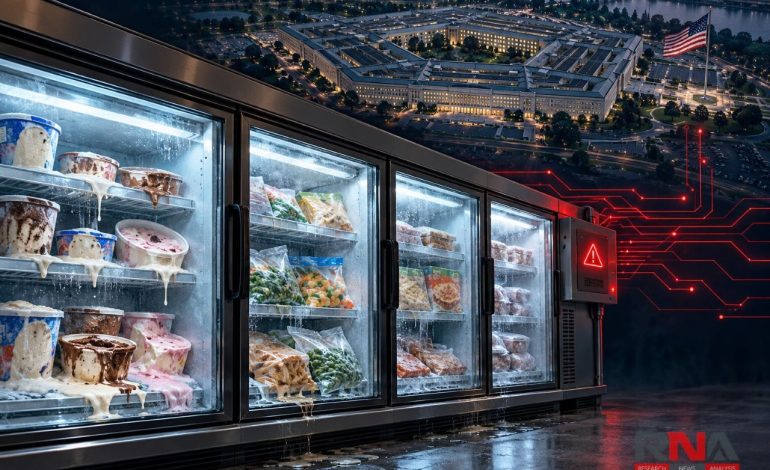
RNA Media illustration for representation.

New Delhi: The Pentagon is investigating whether a cyberattack caused a series of refrigeration failures that spoiled food at military grocery stores across the United States in August. Investigators are also consulting French authorities following attacks on supermarket cooling systems in France, although no connection between the two cases has been established publicly.
Four officials familiar with the matter told Reuters that investigators were treating the American incidents as a suspected hack. The Pentagon confirmed that a US Cyber Command unit was coordinating with other government agencies and law enforcement, while the US Army Criminal Investigation Division said its Cyber Field Office was involved and working with French investigators.
Food spoiled across several bases
The failures affected at least six commissaries – grocery stores serving military personnel, their families and other eligible customers – within days of one another in late August. Public notices identified affected stores at Fort Irwin and Travis Air Force Base in California, Fort Huachuca in Arizona, FE Warren Air Force Base in Wyoming, Naval Station Newport in Rhode Island and Columbus Air Force Base in Mississippi.
The disruption extended beyond frozen goods, with stores reporting losses of meat, dairy products and fresh produce. Some continued selling dry goods while refrigerated sections remained unavailable, and officials said products were being transferred to alternative temperature-controlled facilities where possible.
At Fort Huachuca, officials reported that the freezers had entered defrost mode overnight, spoiling all the frozen food. The account drew attention because the equipment had warmed its contents rather than simply suffering an ordinary interruption to cooling, although that behaviour alone did not establish malicious interference.
The investigation was already under way by September 1 when Stars and Stripes reported that military criminal investigators, including the Army’s cybercrime specialists and the US Air Force office of special investigations, were examining the outages. At that stage, the agencies had not disclosed what caused the failures or whether they were connected.
Recovery efforts began at individual stores while investigators pursued the cause. Fort Irwin said by the end of August that freezer repairs had been completed, inspections were taking place and emergency food orders had been placed to replenish supplies.
French attacks provide a possible lead
The French case involved deliberate interference with internet-connected refrigeration systems at hundreds of supermarkets overnight on October 11–12. As RNA Media had reported, temperatures in some units rose to about 50°C, destroying food stocks, while the Paris prosecutor’s office said the large-scale attack had also been associated with fires.
France’s national computer emergency response team, CERT-FR, subsequently confirmed numerous compromises involving remote refrigeration controllers from Danfoss, Copeland and Dixell. Its alert, first issued on October 12, 2026, and updated on October 16, warned that campaigns targeting the equipment were probably continuing.
The agency advised operators to remove management interfaces from direct internet access, check equipment configurations – particularly defrost schedules – and permit remote access only through protected connections. It also recommended firmware updates and changes to default passwords, warning that resetting an unsupported device without addressing its exposure could leave it vulnerable to another compromise.
Whether comparable equipment was installed at the affected American commissaries remains unresolved in the latest reporting. Investigators have not publicly identified an attacker, explained how any intrusion occurred or announced a final determination that the US failures were caused by hacking.
How cooling systems become cyber targets
The technical concern centres on the controllers used to supervise refrigeration equipment across stores, warehouses and cold-storage facilities. These systems centralize functions that keep food at safe temperatures, making their management interfaces a potentially consequential point of access for an intruder.
In research published on August 9, cybersecurity company Claroty disclosed several vulnerabilities in the Danfoss AK-SM 800A refrigeration controller platform. They included weaknesses that could allow normal authentication to be bypassed or commands to be executed remotely; Claroty said it had privately notified Danfoss, which addressed the findings in updated firmware.
Those findings demonstrate a potential route to disrupting refrigeration, but do not establish how the American outages occurred. The distinction matters because a known vulnerability, a malfunctioning appliance and a confirmed cyberattack represent different levels of evidence, and the Pentagon’s investigation has yet to bridge those gaps publicly.
Separate European outages were attributed to maintenance
Other refrigeration problems at US military stores have received a different explanation. On four commissaries in Germany and England, the Defense Commissary Agency attributed partial outages to equipment wear, maintenance requirements and delays in obtaining specialized replacement parts.
The agency’s spokesman, Jefferson Wolfe, said those failures were unrelated both to one another and to the August incidents in the United States. The distinction leaves the inquiry focused on the unexplained American cluster, with the French investigation offering a possible lead rather than a proven link.