


DRDO to showcase homegrown chips at ESTIC 2026 as India pursues semiconductor self-reliance
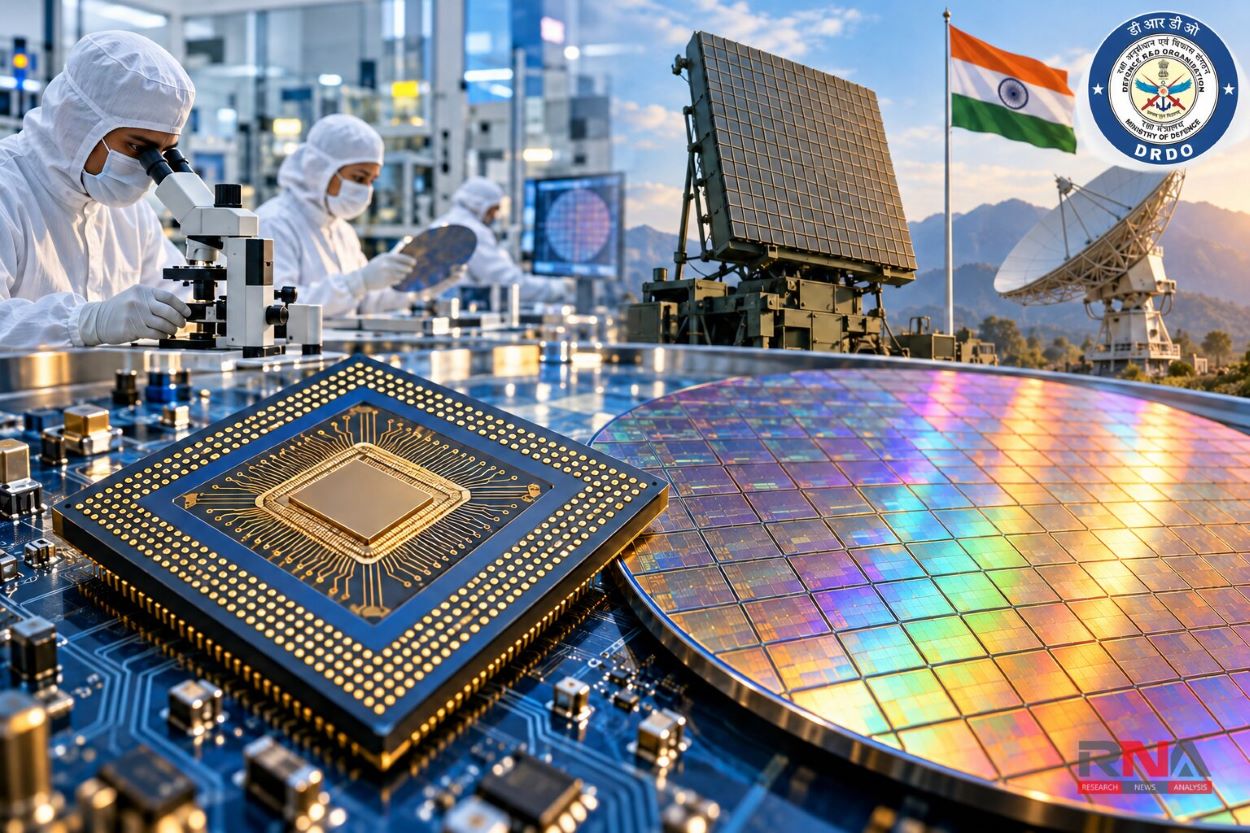
RNA Media illustration for representation.

New Delhi: The Defence Research and Development Organisation will showcase indigenous semiconductor technologies at ESTIC 2026, bringing India’s work on chips for defence and strategic applications into focus. The exhibition will accompany discussions on strengthening domestic chip capabilities at the Emerging Science, Technology and Innovation Conclave, scheduled for October 27–29 at Bharat Mandapam in New Delhi.
DRDO organized a curtain-raiser in Bengaluru on Tuesday to encourage participation by industry, universities and research institutions. It is coordinating the conclave’s session on semiconductors and next-generation chips, while its thematic exhibition will present technologies developed by its laboratories for critical defence requirements.
The conclave, organized by the Council of Scientific and Industrial Research under the guidance of the office of the principal scientific adviser, will cover 12 technology themes. These range from advanced manufacturing and energy to artificial intelligence, robotics, quantum communication and space, placing semiconductor development alongside sectors that increasingly depend on specialized electronic hardware.
According to the published programme, the semiconductor session will take place on October 29 with the vice-president and managing director of Micron India, Anand Ramamoorthy, delivering the keynote address. Other speakers include the director of IIT-Madras, V Kamakoti; the chief executive of Bharat Semi, Vrinda Kapoor; and the chief executive of Netrasemi, Jyothis Indirabhai.
A panel moderated by DRDO’s director general for electronics and communication systems, BK Das, will bring together representatives from DRDO, Qualcomm, Tata Semiconductor, Bharat Electronics, Ananant Systems and BITS Pilani. The discussions are expected to examine purpose-built artificial intelligence systems-on-chips, processing at the silicon edge and advances in microprocessors, connecting research priorities with industrial and defence requirements.
The statement places the event within India’s ambition to become a major global semiconductor centre by 2047, with intermediate goals for 2030 and 2035. It does not, however, provide an itemized list of exhibits or announce a new production facility, making the immediate news a technology showcase and collaboration initiative.
DRDO’s existing semiconductor work provides a useful indication of the capabilities behind that effort. In a November 11, 2024, announcement, the defence ministry said its Solid State Physics Laboratory had developed indigenous processes for producing four-inch silicon carbide (SiC) wafers, gallium nitride (GaN) high electron mobility transistors rated up to 150 watts, and monolithic microwave integrated circuits rated up to 40 watts for applications extending to the X-band.
These technologies address demanding power and radio-frequency applications, including radars, communications and electronic warfare equipment. The ministry identified improved efficiency, smaller size and lower weight among their advantages, with potential uses extending to unmanned systems, satellite communications, electric vehicles and renewable energy.
The same announcement said a limited production capability for indigenous GaN-on-SiC microwave integrated circuits had been established at GAETEC in Hyderabad. That qualification matters: an established fabrication process and limited output represent progress, while expansion into sustained industrial production remains a separate undertaking.
DRDO has also sought to move the technology beyond its laboratories through technology transfer to industry. Its documentation describes processes for power transistors, amplifiers and switching circuits used in high-power, high-frequency communications and radar applications, demonstrating the link between semiconductor research and the components required by equipment manufacturers.
The forthcoming conclave follows a broader series of initiatives announced at SEMICON India 2026, which concluded on September 19, 2026. These included an indigenous system for managing wafer-fabrication operations at the Semi-Conductor Laboratory in Mohali and a collaboration between C-DAC and Bharat Electronics on domestic high-performance computing, artificial intelligence and data-centre solutions.
Those announcements also covered training in circuit design, verification, testing, manufacturing and packaging, underlining the range of capabilities needed to turn chip research into usable products. Against that background, ESTIC’s semiconductor session offers an opportunity to connect DRDO’s specialized technologies with manufacturers, researchers and potential users across India’s emerging chip industry.