
Brazil election: Flavio Bolsonaro edges Lula as presidential race heads to runoff
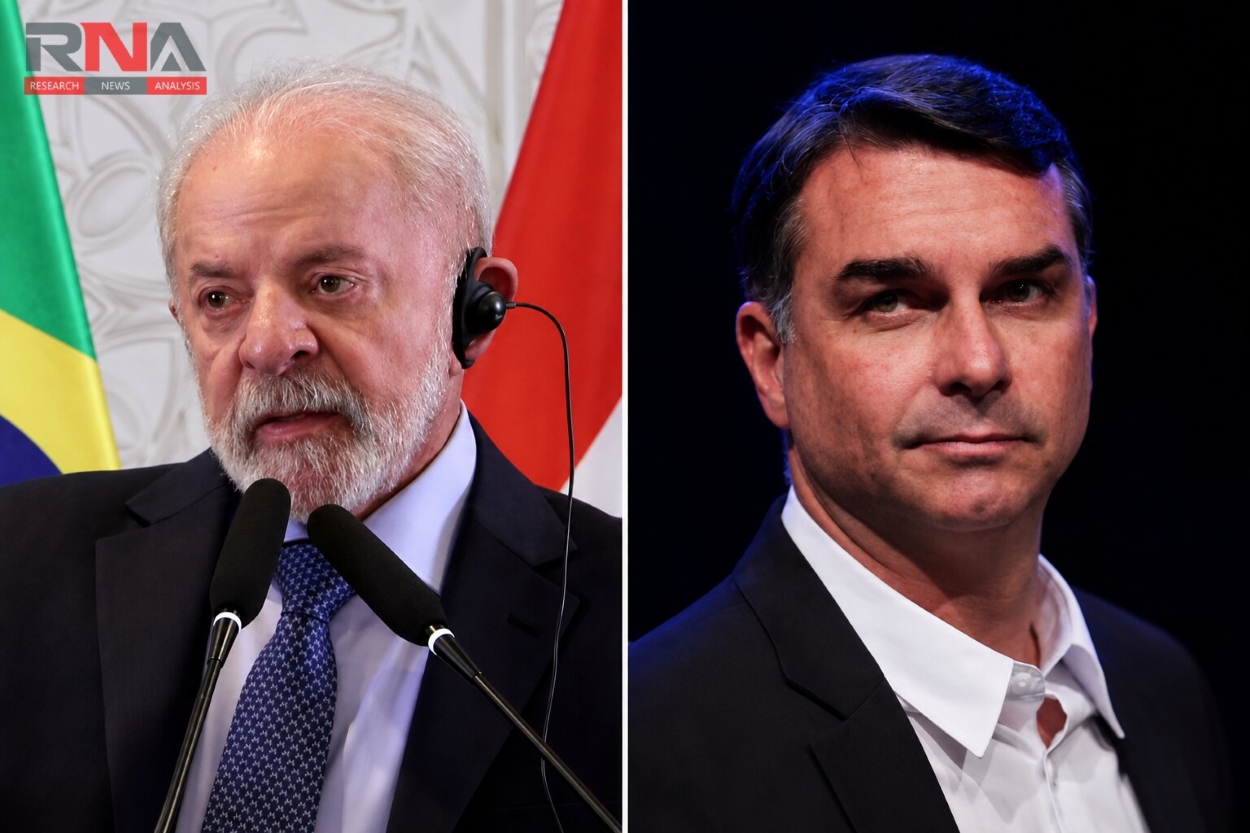
This combination image shows Luiz Inacio Lula da Silva (L) and Flavio Bolsonaro.

New Delhi: Brazil’s presidential election will be decided in a runoff on October 25, 2026, after the right-wing challenger, Flavio Bolsonaro, narrowly outpolled the president, Luiz Inacio Lula da Silva, without securing an outright majority. The result leaves Lula facing a difficult re-election contest and gives Bolsonaro fresh momentum in a campaign dominated by living costs, crime and dissatisfaction with the political establishment.
With 99.99% of ballot boxes counted, Bolsonaro had received 56.10 million votes, or 47.03% of valid votes, against Lula’s 53.88 million, or 45.16%, according to Brazil’s superior electoral court. The approximately 2.23-million-vote gap established a clear first-round lead, but neither candidate crossed the majority threshold required to avoid another vote.
Brazil’s two-round system requires a presidential candidate to obtain more than half of valid votes, excluding blank and invalid ballots, to win immediately. The runoff therefore gives both contenders three weeks to seek support beyond their existing constituencies, with the first-round lead offering a political advantage rather than a guarantee of victory.
Bolsonaro, a 45-year-old senator representing Rio de Janeiro, is contesting the presidency for the first time, while Lula, 80, is seeking a fourth term after governing from 2003 to 2010 and returning to office in 2023. Their running mates are the federal deputy, Alfredo Gaspar, and the incumbent vice-president, Geraldo Alckmin, respectively.
The outcome overturned the order forecast by many pre-election surveys, which had placed Lula ahead, Reuters reported. Bolsonaro presented his performance as evidence of a demand for change, while Lula acknowledged that he had expected to win outright and promised to begin a renewed campaign.
The contest also tests the continuing influence of the former president, Jair Bolsonaro, who is serving a 27-year sentence for plotting a coup after losing the 2022 election. His son has campaigned on securing his release and restoring his political role, making the family’s future part of the presidential contest.
For Lula, the central challenge is translating improvements in unemployment and inequality into support from households still struggling with expensive essentials, debt and insecurity. Bolsonaro has sought to channel those frustrations into an anti-incumbent vote, while Lula has emphasized his social programmes and offered further assistance to indebted families.
The economic choices extend beyond immediate household relief, with the rival campaigns offering different approaches to Brazil’s high borrowing costs. Lula’s economic advisers have proposed government bond buybacks to reduce long-term yields, while Bolsonaro’s advisers argue that spending restraint and fiscal discipline are needed to bring rates down sustainably.
Winning over supporters of eliminated candidates will now be crucial, although endorsements will not necessarily determine how those voters behave. The Associated Press reported that the third-placed writer, Augusto Cury, would endorse neither finalist, while fellow candidates Ronaldo Caiado and Renan Santos had previously indicated the same position.
Foreign policy provides another dividing line, with Bolsonaro advocating closer relations with the US president, Donald Trump, including agreements involving Brazil’s mineral resources. Lula has made sovereignty a campaign theme and accused Washington of seeking to influence the election, allegations the US administration has rejected.
For India, the election concerns a strategic partner with which it cooperates through BRICS, the G20 and the India-Brazil-South Africa dialogue forum, known as IBSA. According to the Ministry of External Affairs, the relationship was elevated to a strategic partnership in 2006 and rests on extensive bilateral and multilateral cooperation.
The partnership now covers defence, energy, biofuels, agriculture, space, digital cooperation and cyber security, giving New Delhi practical interests in Brazil’s next administration. The result could affect the emphasis Brasília places on these relationships, although the existing institutional framework provides continuity beyond individual leaders.
Despite the polarized campaign, the Organization of American States’ observation mission reported that voting proceeded smoothly and under adequate security conditions. The decisive question now is whether Bolsonaro can expand his first-round advantage or Lula can assemble a broader coalition for the final vote.