




Anthropic enters biology wet lab as it races to expand into drug discovery, report says
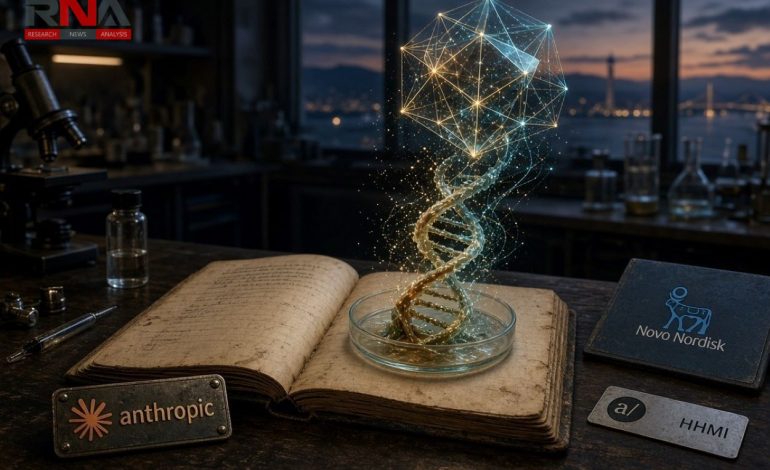
RNA Media illustration for representation.

New Delhi: Anthropic has quietly established a physical biology laboratory in the San Francisco Bay Area as the artificial intelligence company expands from computational research into laboratory-based life sciences, an exclusive Reuters report said. This is seen as a significant broadening of its ambitions beyond developing AI models.
The move comes as Anthropic increasingly positions its Claude systems as tools for scientific research, including drug discovery, while maintaining that human scientists and conventional laboratory experiments remain essential to validating biological hypotheses.
The existence of the wet laboratory was confirmed by Eric Kauderer-Abrams, Anthropic’s head of life sciences, in an interview with Reuters, which reported that the company is conducting physical biological experiments both in its own facilities and through external partners. The development is notable because much of the recent AI push into biology has centred on analysing existing datasets, modelling proteins and generating hypotheses digitally – activities commonly described as “in silico” research.
Anthropic has said its broader life-sciences effort is intended to help researchers tackle difficult biological problems, including rare diseases that can receive comparatively limited commercial attention. Its approach, however, is not that of a conventional pharmaceutical company: the company is developing AI tools and research capabilities that can support biological discovery, rather than presenting itself as a developer of finished medicines or as a replacement for clinical research.
The expansion follows a series of moves that have given the programme greater institutional and commercial depth. Anthropic acquired biotechnology AI company Coefficient Bio in a deal valued at about $400 million, introduced Claude Science, and has entered partnerships with pharmaceutical and research organizations as it seeks to apply its models to increasingly complex scientific work.
On September 16, 2026, Danish pharmaceutical company Novo Nordisk announced a collaboration with Anthropic under which Claude and Anthropic’s scientific tools will be used to address drug-discovery problems and support research and development workflows. The companies said they would work on targeted biological-reasoning challenges and applications intended to accelerate the discovery and development of new medicines, although they did not announce a specific medicine emerging from the collaboration.
Anthropic has also been developing AI capabilities specifically for scientific work. In August, the company reported experiments in which Claude was used for protein-binder design and chemical analysis, saying that some of the generated protein designs achieved binding rates above those typically seen in conventional protein-design campaigns. Such results remain research findings rather than evidence that an AI-designed treatment has successfully passed the much longer stages of preclinical and clinical development required for a medicine.
The establishment of an in-house wet lab therefore marks an important change in the way Anthropic can test the output of its models. Instead of stopping at a computer-generated hypothesis, researchers can potentially move through a cycle in which AI proposes or analyses biological ideas, laboratory experiments generate new evidence, and the resulting data are fed back into subsequent research under human supervision.
That approach also reflects Anthropic’s wider attempt to make Claude useful across the scientific process. In February, the company announced partnerships with the Allen Institute and the Howard Hughes Medical Institute to extend Claude’s role in biological research, arguing that the growing volume of biological data has created a bottleneck in turning information into experimentally validated insights.
Anthropic has simultaneously been tightening the infrastructure around the use of its models in biology. On September 17, 2026, it launched a beta Life Sciences Verification Program that gives verified life-sciences organizations access to selected models with safeguards tailored to biological work, including applications in drug discovery, research biology, clinical development and manufacturing.
The timing is significant because the expansion of AI into biology carries a dual challenge: the same systems that could accelerate medical research can also lower barriers to sophisticated biological experimentation. Anthropic has consequently sought to separate access for legitimate scientific users from unrestricted access, with its verification programme designed to provide additional capabilities to approved organizations while keeping the associated data compartmentalized.
For the pharmaceutical industry, the attraction is straightforward: AI can potentially reduce the time researchers spend searching scientific literature, analysing biological data, designing molecules or proteins and planning experiments. But the physical laboratory remains the critical reality check, because promising computational predictions must ultimately survive experiments, preclinical testing, clinical trials and regulatory scrutiny before they can become treatments.
Anthropic’s move consequently represents less a departure from AI research than an attempt to close the gap between artificial intelligence and physical science. By combining Claude’s computational capabilities with laboratory experimentation and partnerships with established life-sciences institutions, the company is positioning itself to participate in a part of scientific research where useful predictions matter only when they can be demonstrated in the real world.