


DRDO showcases Astra MkI, Akash-NG and surveillance systems at AAD 2026 in South Africa

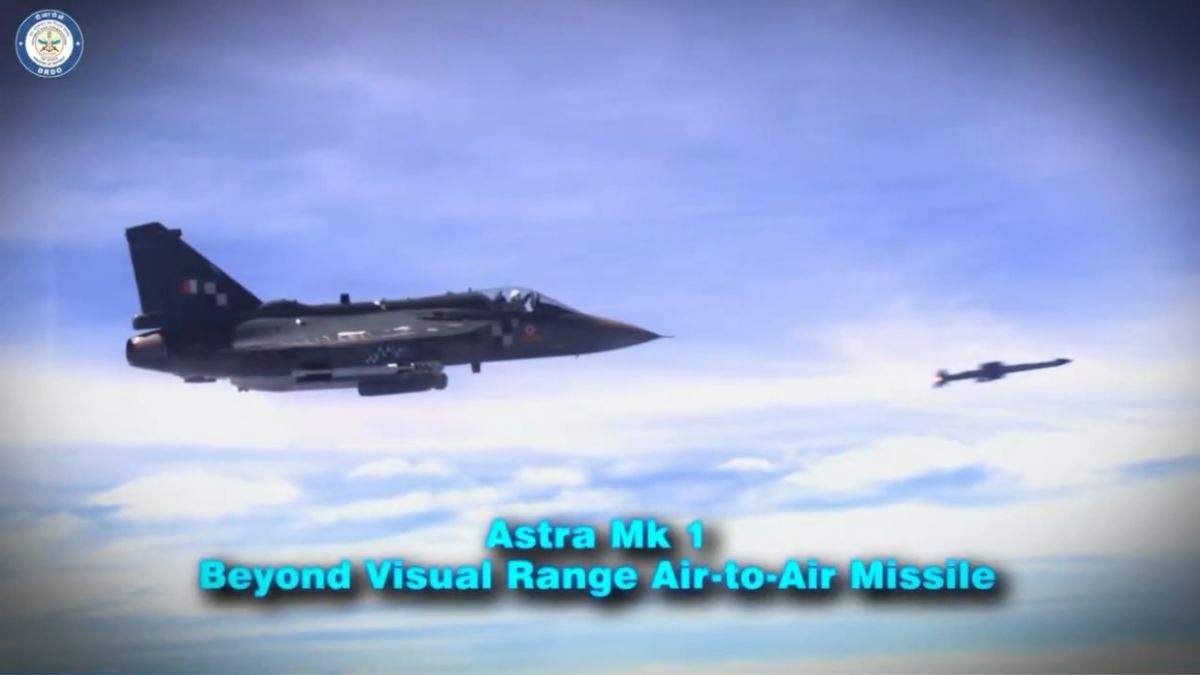
DRDO’s indigenous Astra Mk1 beyond-visual-range air-to-air missile in action. Image courtesy: Screen grab via X.com/@DRDO_India

New Delhi: The Defence Research and Development Organisation (DRDO) is showcasing a range of indigenous defence technologies at Africa Aerospace and Defence (AAD) 2026, running from September 6 to 20 in Tshwane, South Africa, placing Indian airborne surveillance, missile, maritime and specialized battlefield systems before an international audience. The India Pavilion’s five-day exhibition opened at Air Force Base Waterkloof on Wednesday and will continue until Sunday.
In a post on X on Wednesday, DRDO said it is participating in AAD 2026 from Wednesday to Sunday at Hangar 2, Stall 2W 15. It said the participation highlights India’s indigenous defence capabilities and its commitment to strengthening international defence cooperation. A video accompanying the post showed systems including the Medium Range Maritime Reconnaissance system, the Airborne Early Warning and Control system (AEW&C), the Wheeled Chemical, Biological, Radiological and Nuclear (CBRN) Reconnaissance Vehicle, and the Portable Diver Detection Sonar (PDDS-X).
ANI reported that the wider DRDO display also includes the Astra MkI beyond-visual-range air-to-air missile, the Akash-NG surface-to-air missile, the Low Frequency Variable Depth Sonar (LFVDS), and technologies related to an active protection system.
The Medium Range Maritime Reconnaissance programme is being developed around a modified C-295 aircraft for the Indian Navy, with DRDO responsible for the mission aircraft and mission systems. DRDO’s AEW&C technology uses airborne sensors to detect and provide early warning of airborne and sea-surface targets and hostile emissions, while distributing information to controllers in the aircraft and on the ground.
Astra MkI is an indigenous beyond-visual-range air-to-air missile using active radar terminal guidance. Akash-NG, meanwhile, is a new-generation air-defence system intended to counter aerial threats. DRDO completed user evaluation trials of Akash-NG in December 2025, saying the trials had paved the way for induction.
Maritime and specialized technologies
The maritime display extends to underwater surveillance. DRDO describes its Portable Diver Detection Sonar as a deployable system capable of detecting, tracking and classifying divers and diver delivery vehicles around ships and harbours, while its low-frequency variable depth sonar technology is intended for submarine detection and tracking under varying underwater conditions.
The Wheeled CBRN Reconnaissance Vehicle is an indigenous 8×8 platform equipped with specialized instrumentation for reconnaissance in areas potentially affected by chemical, biological, radiological or nuclear hazards. DRDO’s active protection work, separately, includes technologies intended to protect armoured and combat vehicles against anti-armour threats.
India’s participation comes as the country expands the overseas reach of its defence industry. Defence exports reached a record ₹38,424 crore in 2025-26, up 62.66 per cent from the previous financial year, with Indian defence products reaching more than 80 countries.
As RNA Media reported earlier, the government has placed greater emphasis on indigenous critical technologies, stronger DRDO-industry collaboration and a larger Indian presence in global defence supply chains. The defence minister, Rajnath Singh, said at Vimarsh on Tuesday that India would need to substantially increase indigenous content and achieve multi-fold growth in defence exports as part of its longer-term 2047 goals.
India and South Africa also have an established defence cooperation framework. At the ninth Joint Defence Committee Meeting in Johannesburg in June 2025, the two sides exchanged two agreements in the area of submarine cooperation and reviewed cooperation covering defence policy, military engagement, acquisition, production and research and development.