



Handwritten reduction from 30% to 15% quashed: AFT restores woman Army officer’s disability pension
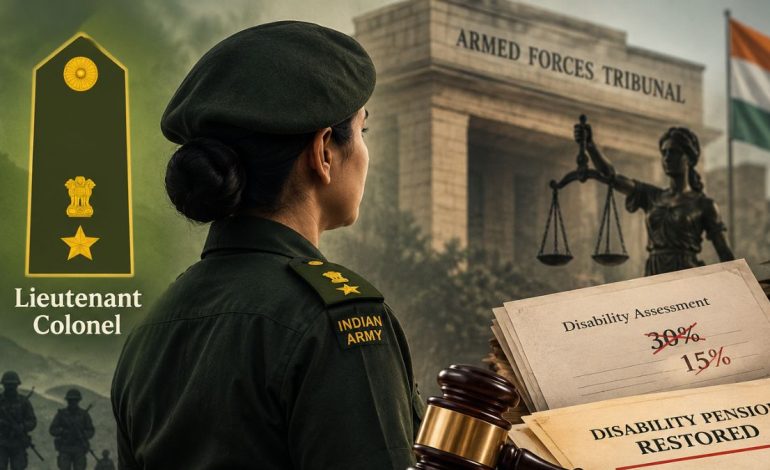

New Delhi: The Armed Forces Tribunal (AFT) has restored disability pension to a retired woman lieutenant colonel after finding that her disability assessment had been improperly reduced from 30% to 15% through a handwritten alteration in her medical-board proceedings. The Chandigarh Bench held that the officer who made the change had no jurisdiction to interfere with the assessment recorded by the duly constituted medical board.
The tribunal restored Lieutenant Colonel Himani Pant’s disability assessment at 30% and directed that it be reckoned at 50% for computation of the disability element of pension for life.
The reduction was consequential because disability assessed below 20% generally does not qualify for payment of the disability element under the applicable defence-pension framework.
Lieutenant Colonel Pant, a resident of Ambala Cantonment, was commissioned into the Army Education Corps in 1998. She developed osteoarthritis in both knees in October 2010 while serving at Shillong and was subsequently placed in a permanent low medical category.
She retired on April 9, 2023, after about 25 years of service. Before retirement, both the categorization medical board and the release medical board assessed her disability at 30per cent for life, while the release medical board also concluded that the condition had been aggravated by military service.
However, the typed figure of 30% recorded in the release medical board proceedings was scored out and replaced by hand with 15% by the commandant of the military hospital. Her claim for the disability element of pension was subsequently rejected.
Lieutenant Colonel Pant approached the AFT in 2023, challenging the alteration. Her counsel argued that the commandant had no authority to change the medical assessment because the proceedings were governed by a prescribed approval structure involving higher medical authorities.
The Army authorities maintained that the commandant was competent to review the assessment.
Tribunal rejects unilateral reduction
The bench comprising Justice Sudhir Mittal (retired) and Lieutenant General Ravendra Pal Singh (retired) rejected the Army’s argument. It noted that the 30% assessment had been recorded by the medical board before being manually altered to 15%.
The tribunal held that the commandant was not part of the prescribed chain for accepting and approving the medical board’s findings and therefore lacked jurisdiction to substitute the assessment. It also noted that both the categorization medical board and release medical board had independently arrived at the same 30% figure.
The bench said that any departure from an earlier medical opinion required a properly constituted review or fresh medical examination supported by recorded reasons. Finding no lawful basis for the unilateral reduction, it quashed the 15% assessment and restored the finding that Pant’s disability had been aggravated by military service.
According to the order as reported, the tribunal directed that the 30% disability be reckoned at 50% for pension purposes for life.
AFT cites need for proper medical review
The ruling follows the principle laid down by the Supreme Court in Ex-Sapper Mohinder Singh vs Union of India in 1993. The court had held that an assessment made by a duly constituted medical board that physically examined an individual should not be displaced merely through an administrative opinion without examination by a properly constituted fresh or review medical board.
The Supreme Court has also extended broad banding benefits to eligible personnel whose disabilities are attributable to or aggravated by military service, including those retiring on completion of service rather than being invalided out.
Under the Ministry of Defence framework, the medical board records the actual degree of disability, while the percentage used for computing the disability element may subsequently be rounded or broad banded in accordance with the applicable policy. In Pant’s case, restoration of the 30% assessment brought her within the disability-pension framework and entitled her to the corresponding 50% reckoning for pension computation.
The judgment reinforces that a medical assessment affecting a serviceperson’s pension cannot be altered outside the prescribed medical review and approval process.