
PLA study urges Chinese cities to prepare for low-yield nuclear attack, calls Japan a ‘major danger signal’
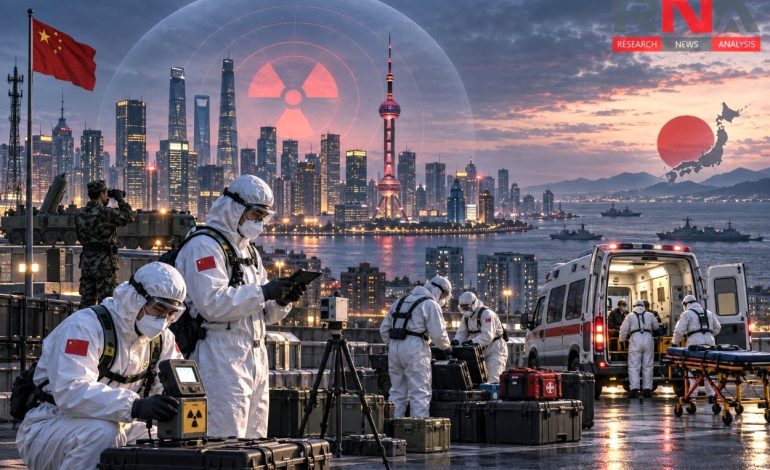
RNA Media illustration for representation.

New Delhi: A study conducted by medical scientists attached to China’s People’s Liberation Army − Rocket Force (PLA-RF) has urged Chinese cities to prepare for a possible nuclear terror attack, warning that Japan is sending “a major danger signal” to the world. The report, published in the peer-reviewed Chinese Journal of Radiological Health and cited by South China Morning Post, argues that while a full-scale nuclear war remains unlikely, a limited nuclear strike by a smaller power or a terrorist group can no longer be dismissed.
The study originates from the PLA-RF Characteristic Medical Centre, the wing of China’s strategic missile force responsible for medical readiness against nuclear, biological or radiological emergencies. It was published on September 4, although its findings drew wider international attention only this week.
The researchers concluded that the probability of a large-scale global nuclear conflict remains comparatively low, given the deterrence posture of the world’s major nuclear powers. They cautioned, however, that smaller or aspiring nuclear states, driven by geopolitical or religious disputes, could still mount a single nuclear-weapon terror attack on a neighbouring country or a major power’s key city.
Japan featured prominently in the assessment. The authors noted that Tokyo has not acceded to the Treaty on the Prohibition of Nuclear Weapons (TPNW), adopted in 2017 as the first legally binding international instrument seeking a comprehensive ban on nuclear arms.
Tokyo has, in fact, never signed it.
The study also flagged reported deliberations within the Japanese government over revising the country’s decades-old “three non-nuclear principles” – the commitment to neither possess, produce nor permit the introduction of nuclear weapons onto Japanese soil. Any dilution of that doctrine, the researchers argued, would send a troubling signal to the wider international community.
Their concern builds on an earlier Chinese government report, released in January this year, which alleged that Japan may have secretly produced weapons-grade plutonium. That report also claimed Japan possesses the technological base, industrial capacity and economic strength to develop nuclear weapons rapidly, should it choose to do so.
Beijing has long accused Tokyo of pursuing “remilitarization” and has periodically raised similar concerns about Japan’s nuclear latency, its stockpile of separated plutonium and its advanced nuclear fuel cycle. Japan denies harbouring any intention of acquiring nuclear weapons and has consistently defended its non-nuclear policy as a pillar of its postwar identity.
Beyond the geopolitical assessment, the study modelled a scenario in which a single, low-yield nuclear device strikes a major Chinese city. The researchers drew on historical data from the 1945 Hiroshima bombing, alongside broader international simulations, to project the medical fallout of such an attack.
They found that even a low-yield nuclear terror strike could generate mass casualties and complex, multi-system injuries, placing what they termed a “huge test” on any city’s or country’s medical capacity. Emergency responders, the study warned, would face hazardous radiation conditions, widespread disorder and overwhelmed hospital infrastructure in the crucial hours after such an attack.
To meet that challenge, the researchers recommended expanding specialized medical capacity, stockpiling antibiotics and radiation-protection equipment, and strengthening public education on nuclear and radiation safety. They also called for more emergency rescue training, urging authorities to “prepare for a rainy day.”
China already operates an emergency rescue network of more than 30 bases nationwide, established to treat casualties from a potential nuclear incident. The researchers argued that this capacity needs to expand further, alongside better-trained personnel and dedicated resources for nuclear and radiological emergencies.
The findings arrive against a backdrop of steadily deteriorating China–Japan relations, marked by disputes over the East China Sea, Taiwan and Tokyo’s expanding defence budget. In January 2022, the five permanent members of the United Nations security council – China, the United States, Russia, Britain and France – issued a rare joint statement declaring that “a nuclear war cannot be won and must never be fought.”
China maintains a declared no-first-use policy on nuclear weapons, a position it has held since first testing an atomic device in 1964. Yet Beijing has, in recent years, considerably expanded and modernized its nuclear arsenal, a build-up the Pentagon has estimated could push its warhead stockpile past 1,000 by the early 2030s.
For India, sandwiched between two nuclear-armed neighbours already locked in their own uneasy embrace, the China-Japan nuclear discourse carries indirect but real significance. Any erosion of Japan’s non-nuclear posture, or a growing perception in Beijing that nuclear terrorism is a genuine planning contingency, adds another layer of complexity to an already crowded Asian nuclear landscape that includes China, India, Pakistan and North Korea.
New Delhi has traditionally kept a studied distance from the China-Japan nuclear debate, focusing instead on its own no-first-use doctrine and credible minimum deterrence posture. The PLA study, produced by a state-linked medical research body rather than a policy thinktank, nonetheless underscores how seriously Chinese strategic planners are treating low-probability, high-consequence nuclear scenarios – a trend Indian defence planners may wish to track closely, given China’s expanding missile and warhead inventories along the Himalayan frontier.
Japan’s government had not issued a formal response to the study at the time of writing. Tokyo has consistently maintained that its three non-nuclear principles remain official policy, even as debate over the country’s long-term defence posture continues within its ruling coalition.