




India joins US-led global initiative to shape next-generation 6G networks
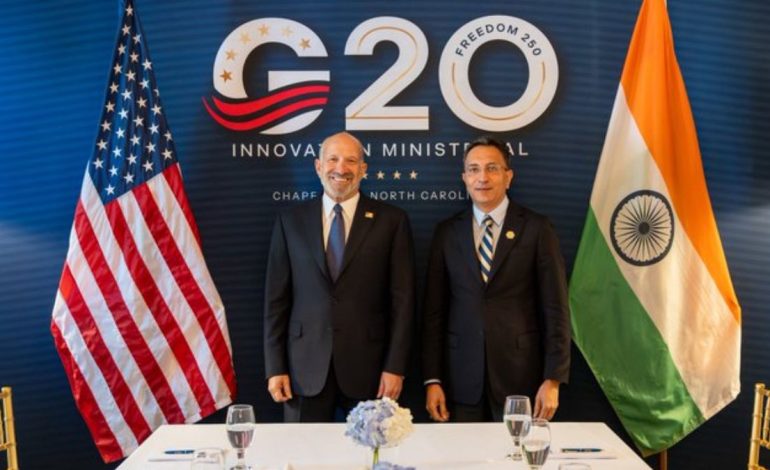
Secretary Lutnick and Jitin Prasada discuss 6G cooperation at the G20 Innovation Ministerial. X.com/@CommerceGov

New Delhi: India has joined a US-led international initiative aimed at shaping how next-generation 6G networks are developed, secured and connected across countries, bringing New Delhi into an early global effort focused on security, interoperability, resilience and innovation. India’s entry into the Call to Action for 6G Leadership and Security takes the initiative to 26 participating governments.
The US commerce department announced India’s participation after the US commerce secretary, Howard Lutnick, met the minister of state for commerce and industry and electronics and information technology, Jitin Prasada, on the sidelines of the G20 Innovation Ministers’ Meeting in Chapel Hill, North Carolina. The department said India had joined the United States and 24 other countries working to ensure that future networks reflect shared security interests while supporting competitiveness and innovation.
India joins 26-government 6G initiative
The call to action was launched on July 27 by the National Telecommunications and Information Administration, an agency of the US commerce department. 25 governments initially backed the framework, making India the 26th participant.
The initiative calls for cooperation on open, interoperable, secure and resilient 6G networks, while recognizing trusted artificial intelligence as an important element in the development and operation of future systems. It also envisages engagement with industry and academia and cooperation on secure and resilient technology supply chains.
It is not a technical standards body or a commercial 6G deployment programme. Instead, it provides a framework for governments to coordinate while 6G technologies, security requirements, spectrum approaches and international standards are still being developed.
The G20 Innovation Ministers’ Meeting was held on September 1 and 2 and hosted by the US commerce department and the White House Office of Science and Technology Policy. The US commerce department said 6G featured in the bilateral engagement between Lutnick and Prasada.
India’s official account of the meeting separately said the two ministers discussed cooperation in semiconductors, artificial intelligence and data centres. Prasada also raised opportunities for further US investment under India semiconductor mission 2.0 and deeper cooperation in AI technologies and safeguards.
India’s participation in the 6G initiative therefore adds future telecom policy to a wider technology dialogue already covering semiconductor manufacturing, AI and digital infrastructure.
India links initiative with Bharat 6G push
India is already pursuing its own 6G programme through the Bharat 6G Mission and Bharat 6G Alliance, which brings together telecom companies, equipment manufacturers, startups, research institutions and academia. The domestic programme is intended to increase India’s contribution to 6G research, intellectual property and international standard-setting.
The Bharat 6G Alliance aims to support Indian participation in global standards organizations, develop intellectual property and products and build partnerships with international 6G groupings. Its work also covers research, testing, security, certification and domestic telecom manufacturing.
The government has set 2030 as the broad horizon for India’s 6G ambitions. The communications minister, Jyotiraditya Scindia, told Parliament in March that India was targeting nearly 10 per cent of global 6G patents and seeking a larger role in international standardization.
As of February, the India’s telecommunications department had approved 104 research and development projects worth ₹271 crore relating to 6G technologies. By July, the Bharat 6G Alliance had expanded to 90 members working through seven specialised groups.
India joins early-stage global 6G coordination
6G remains under development, with international work currently focused on research, spectrum planning, testbeds and technical standardization under frameworks including the International Telecommunication Union’s IMT-2030 process.
India’s participation in the US-led initiative does not mean it has entered a joint commercial 6G network programme. No India-specific funding commitment, spectrum allocation, deployment plan or commercial launch timetable has been announced.
The immediate significance is narrower: India will now participate in an international government-level framework discussing the security, resilience, interoperability and supply-chain principles expected to influence future 6G networks. That complements the Bharat 6G programme’s stated aim of increasing India’s role as a contributor to future telecom technologies, intellectual property and global standards.